Axios AM

September 06, 2019
It's Friday! Today's Smart Brevity count: 1,075 words ... 4 minutes.
- Don't miss Axios PM, my 5 p.m. ET quick read on what matters. Sign up here.
1 big thing: The "flying blind" economy

Illustration: Aïda Amer/Axios
CEOs, central bankers and money managers say they're operating in a world where they have no idea what's coming next, leaving them with few options but to prepare for the worst, Axios' Courtenay Brown writes.
- Why it matters: Uncertainty about a handful of unprecedented phenomena — the grinding trade war with China, the peripatetic Brexit debate, President Trump's government-by-tweet — is inflicting pain on the global economy.
Corporate America is raking in eye-popping profits, but is in a decision-making tailspin.
- Uncertainty is now showing up in hard data: The lack of corporate dollars being spent — on factories, software or new equipment — dragged down economic growth in the 2nd quarter.
- Business investment fell 0.6% — the first drop in 3 years.
Everyone is stymied over how to make financial or investment plans, because the rules keep changing by the day.
- Businesses don't know what to do about their operations in China, how to price their products or source their materials. And they don't know how consumers will react to higher prices during the holiday season.
Central bankers are also throwing up their hands.
- There are “no recent precedents to guide any policy response to the current situation," Fed Chair Jerome Powell said in a speech last month, referring to the trade war.
Main Street is grappling with a lot of questions, too — mostly about how to absorb the impact of tariffs.
- How much should mom-and-pop companies raise retail prices? Should they seek out different suppliers? Are they going to have enough to pay employees?
Consumers, too, are in a bind.
- Nobody knows what to do with their money in an environment where the stock market is a roller coaster — generally doing well, but subject to wild swings pegged partly to Trump's tweets. And savings accounts pay lower interest rates due to the Federal Reserve rate cut.
The bottom line: The trade war and Brexit — two fights that were supposed to be in the rear view mirror by now — have gotten even messier and uglier in recent days. So uncertainty will remain ubiquitous.
2. Scoop: Howard Schultz to end campaign but spend big

Former Starbucks CEO Howard Schultz, who put his independent presidential exploration on hold in June, will tell supporters later this morning that he's abandoning his campaign but still plans to spend big "to fix our broken system."
- Why it matters: Schultz — a billionaire who planned to spend north of $100 million on 2020 — now will direct that same amount, over a longer time, toward innovative efforts to reduce inequality and promote political reform.
Between the lines: Schultz, 66, didn't want to be a spoiler if Joe Biden becomes the nominee, and calculated that he'd have to begin locking down ballot access before the Democratic race is settled.
- What's next: Schultz, who plans to combine philanthropy and strategic investing with a passion for increasing access to the American dream, now becomes one of the most active private players in public policy.
In a "Dear Friends" letter going to hundreds of thousands of supporters later today, Schultz writes:
- "[N]ot enough people today are willing to consider backing an independent candidate because they fear doing so might lead to re-electing a uniquely dangerous incumbent president."
- "If I went forward, there is a risk that my name would appear on ballots even if a moderate Democrat wins the nomination, and that is not a risk I am willing to take."
- "Finally, a back injury in April and three subsequent surgeries have required a level of recovery that has prevented me from continuing my travels and engaging with people to the degree that is necessary."
- "The money that I was prepared to commit to a presidential campaign will instead be used to invest in people, organizations and ideas that promote honesty, civility and results in our politics."
- "Onward with love of country, Howard."
3. Bahamas, before and after
These satellite photos show downtown Marsh Harbor, Great Abaco, the Bahamas, on Oct. 25, 2018, and yesterday, p0st-Dorian.

4. Pic du jour

Johnny Crawford navigates his kayak down a flooded street in Charleston, S.C., yesterday after Hurricane Dorian blew through.
- What's next: After triggering tornadoes in South Carolina, Hurricane Dorian was closing in for a possible direct hit today on North Carolina's Outer Banks, a string of low-lying islands, even as it weakened to a Category 1 storm. (AP)
5. Poll: Most think disasters are worsening

6. Slowdown in new businesses poses risk
Americans have slowed the pace at which they’re forming new companies, AP's Josh Boak writes.
- The longest expansion on record, which began in mid-2009, has failed to restore entrepreneurship to its pre-recession level, according to a Census Bureau report based on tax filings.
Why it matters: Smaller companies account for roughly 85% of all hiring.
- Social and demographic forces are thought to be limiting opportunities for entrepreneurs and smaller companies: America is aging, many young adults are weighed down by student debt, and larger retailers have used their scale to offer lower prices than smaller companies can afford.
7. Gun action picks up
8. CNN to host 2020 town hall on LGBTQ issues
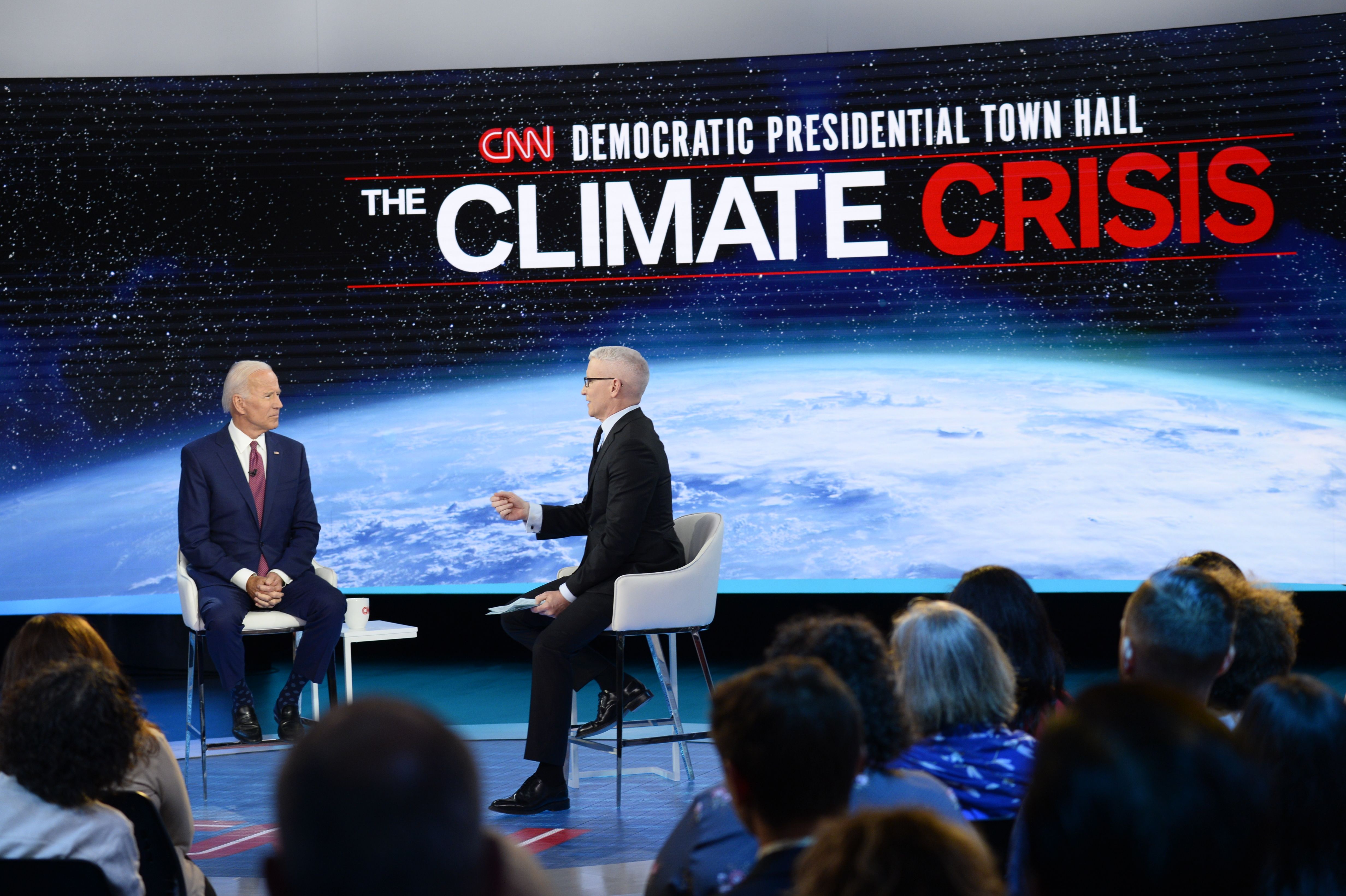
"The Human Rights Campaign Foundation announced it will host a CNN Democratic presidential town hall in [L.A. in October] focused on lesbian, gay, bisexual, transgender and queer issues," CNN's Mark Preston writes.
- Why it matters: "HRC said the ... primetime event, airing live on the eve of National Coming Out Day, will feature the largest ever audience for a Democratic presidential town hall devoted to LGBTQ issues."
- So far, Joe Biden, Pete Buttigieg, Julián Castro, Sen. Kamala Harris, Sen. Amy Klobuchar and Sen. Elizabeth Warren have accepted HRC's invitation.
9. Groupons for health care
If you're looking for some certainty about how much a health care test will cost you, the best solution may be a maddening one, Axios' Sam Baker writes — buying a Groupon.
- Groupons seem to be especially popular for imaging services, like MRIs and CT scans — tests that are already susceptible to overuse. In Atlanta, you can get a heart CT scan for as little as $26.
Sam’s thought bubble: Medical Groupons are not the sign of a system that’s trying very hard to offer better care for patients. They’re a sign of a system that still rewards volume, whether those procedures are necessary or not.
10. 1 name thing
Japan will start using the traditional order when printing Japanese names in English in official documents, putting family names (surnames) first — a switch from the Westernized custom the country adopted more than a century ago, officials said today.
- The idea has been floated for years and but ministers in Prime Minister Shinzo Abe’s ultra-conservative Cabinet recently started pushing for it again, AP reports.
The Cabinet agreed today to begin making the change with government documents, though no timeline was given.
- “It is important for all of us in the world to recognize language and cultural diversity as we live in an increasingly globalized society,” said Education Minister Masahiko Shibayama.
📱 Please invite your friends and co-workers to sign up here for Axios AM and PM.
Sign up for Axios AM

Catch up with the most important news of the day