Axios AM

August 06, 2025

🐫 Happy Wednesday! Smart Brevity™ count: 1,874 words ... 7 mins. Thanks to Noah Bressner for orchestrating. Copy edited by Carolyn DiPaolo.
💉 Situational awareness: Health Secretary RFK Jr. is pulling $500 million in funding for new mRNA vaccines to focus on "safer, broader vaccine platforms," Axios' Adriel Bettelheim writes.
1 big thing: What does AI owe YOU?
You could easily live without AI. But AI wouldn't exist without you, Jim VandeHei and Mike Allen write in a "Behind the Curtain" column.
- So does AI owe you for your small part in creating it?
Why it matters: This question sits at the very heart of legal, economic, moral and societal debates unfolding before us today — and deep into the future. The answer will unlock everything from court verdicts to the fortunes of financial winners and losers years from now.
🖼️ The big picture: First, the facts. Large language models (LLMs) such as OpenAI's ChatGPT or Anthropic's Claude were built by ingesting the totality of human information online — everything from news stories by Axios to social media postings by you.
- AI developers call this "training data" because they used the internet — and all its content — to train machines to think, reason and operate like the humans feeding the web. The goal: think better, faster and cheaper than us. Then, unleash these machines everywhere for everything.
- By 2025, content produced by billions of internet users helped shape the massive digital corpus that modern AI models were trained on — mostly through public, web-accessible data. Think any content — posts, blogs, forums, websites, Wikipedia edits, reviews, and videos.
Some content owners — mass producers and individual creators — are suing AI companies for using their content without permission. The litigation — by media companies, music producers, book publishers — is often brought under copyright laws. AI makers defend their use of protected content by invoking long-contested "fair use" principles.
- Copyright owners have filed close to 50 lawsuits against AI companies in federal court, according to the Copyright Alliance, which represents creators.
- Some publishers, including News Corp and Axios, have struck deals with OpenAI for use of their content.
The Supreme Court could ultimately decide — likely years from now — whether the owners of these LLMs violated federal law with their training tactics.
- "We're at the top of the first inning of understanding how the courts are going to define fair use as it applies to AI training," Keith Kupferschmid, president and CEO of the Copyright Alliance, tells us. He said cases involving images and music will be more difficult for AI companies to win, while cases involving text are more complex.
But what about you? If you ever posted a comment on Reddit, or tweeted, or shared pictures on Instagram, or posted a rant on Facebook, you're a tiny part of the LLMs' brains.
- Your words were gobbled up to help train the machines, creating untold riches for tech companies and investors. But no one asked your permission or offered to compensate for that tiny part you played in making others rich.
It's doubtful you'll get a penny for your time or mind now. President Trump, in his speech at last month's AI summit in Washington, made plain his opposition to companies doling out cash based on derivative use of the internet (unless it's blatant piracy).
- "[W]hen you read something and when it goes into this vast intelligence machine, we'll call it, you cannot expect to every time, every single time, say: 'Oh, let's pay this one that much,'" he said. "[W]e have to allow AI to use that pool of knowledge without going through the complexity of contract negotiations, of which there would be thousands for every time we use AI."
- His main point: It would give China an insurmountable edge if we tie ourselves in knots over who owes what to whom.
But some AI leaders, most notably Anthropic's Dario Amodei, argue you should benefit — in the future. They believe if AI only enriches the big companies and investors, America will face a rebellion — and potentially sky-high unemployment.
- So instead of paying you now, which might hamstring the companies, they talk of spreading the wealth if AI truly creates trillions of dollars of wealth long-term. This could be as novel as a guaranteed minimum income (universal basic income, or UBI), funded by AI companies, or as ordinary as higher taxes on AI to fund social programs and government overall.
- Or it could be a private sector indirect benefit of higher growth, driving higher wages.
Regardless, the AI companies will get a lot bigger and a lot richer — before you get a penny, if you ever do.
2. 🪖 Axios interview: Army's sizzling commodity
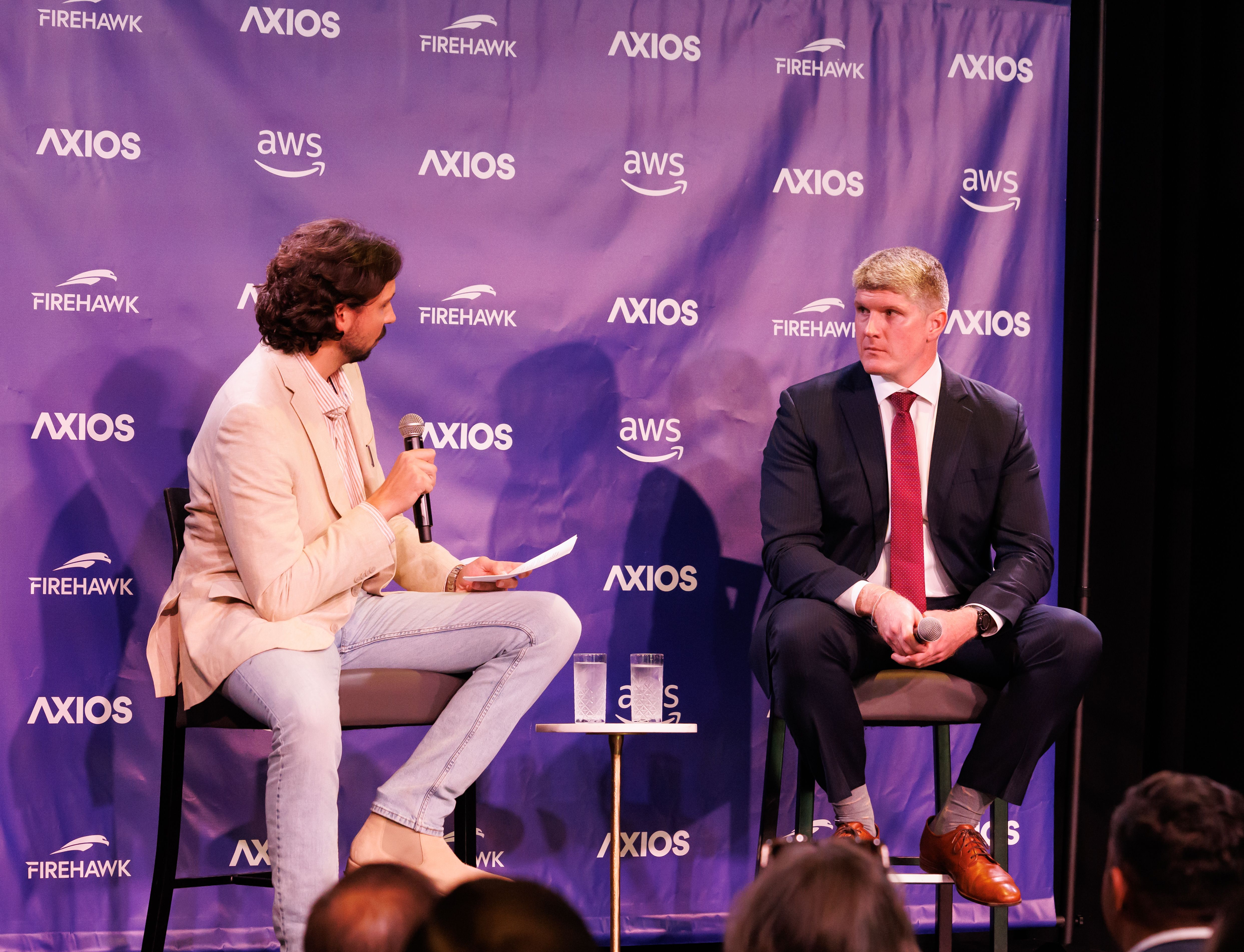
Demand for U.S. Army overhead defenses against missiles or drones won't "be letting up anytime soon," a top Army official told Axios Future of Defense author Colin Demarest at an Axios event in Huntsville, Ala.
- Why it matters: Missile defense is hot right now. The stakes are amplified by fighting in Eastern Europe and the greater Middle East, where explosive drones batter troops and civilians every day.
David Fitzgerald, acting under secretary of the Army, said onstage last night in the Rocket City: "Our air defenders are probably one of the most in-demand and operationally deployed capabilities that we have within the Army."
- "Those units get rode pretty hard," he said. "I think that's just reflective, though, of the critical capability that they bring" to the fight.
👀 The intrigue: Fitzgerald sees openings for increased AI applications in the future.
- Coordinated swarms of missiles, drones and decoys have complicated the job of protecting military bases, critical infrastructure and cities.
Get Axios Future of Defense ... Get Axios Huntsville, the newest of our 34 Axios Local cities.
3. 🤖 New OpenAI models help U.S. in China race

OpenAI's release of two open-source models yesterday propels the U.S. forward in its AI race with China, Axios AI+ author Ina Fried writes.
- Why it matters: The arrival of China's open-source DeepSeek model earlier this year — combined with Meta's refocusing of its open-source efforts — had intensified concerns that China's open models could end up dominating the global market.
🎨 The big picture: OpenAI's new models are designed for customers who want the cost savings and privacy that come from running AI models directly on their own devices rather than relying on cloud-based services such as ChatGPT or its rivals.
- The company is also pitching the models to countries seeking greater control, local data storage and independence from cloud providers like Google and Microsoft.
- OpenAI CEO Sam Altman, stressing the political importance of the release, said: "We are excited for the world to be building on an open AI stack created in the United States, based on democratic values, available for free to all and for wide benefit."
🔮 What to watch: The company's long-awaited GPT-5 model is rumored to be arriving in the coming days.
4. 🏛️ Pic du jour: Trump's rooftop gaggle

For nearly 20 minutes yesterday, President Trump toured the roof of the White House colonnade that leads to the West Wing and surveyed the surrounding grounds.
- Reporters, tipped off by the out-of-the-ordinary positioning of snipers above the Oval Office, shouted questions from below. One called out: "Sir, why are you on the roof?"
- "Taking a little walk," Trump shouted back. "It's good for your health." (AP)
Between the lines: Trump was spotted with James McCrery, the architect of the White House's $200 million ballroom project that will be built where the East Wing stands.
- Watch: Trump's view from the roof.

At a separate event yesterday, Trump established a task force on the 2028 Olympic Games in Los Angeles to ensure the event is "safe, seamless and historically successful."
5. 📉 Major homicide drop

Homicides declined in major U.S. cities — by more than 50% in some places — during the first six months of the year, Axios' Russell Contreras writes from new data compiled by an organization of law enforcement executives.
- Why it matters: The stats are the latest signs that violent crime in America is falling from the COVID crime wave, and that drop appears to be accelerating during President Trump's first months in office.
🧮 By the numbers: Reports from 68 law enforcement agencies showed a 19% drop in homicides in the first six months of 2025 compared to the same period in 2024, according to stats compiled by the Major Cities Chiefs Association.
- Denver, Honolulu, Orlando, Portland and Tampa all had a 50% or more decrease in homicides during that period.
6. 🏈 ESPN buys NFL Network
Disney's ESPN will acquire the National Football League's NFL Network in exchange for the league taking a 10% equity stake in ESPN, Axios Media Trends author Sara Fischer writes.
- Why it matters: The landmark deal brings the country's biggest sports league even closer to the preeminent sports network as streaming upends live TV.
The agreement allows ESPN to fully own and operate the NFL Network, and integrate it into ESPN's upcoming direct-to-consumer streaming network that's set to debut this fall.
- NFL's Redzone linear channel will join Disney's portfolio of TV networks, giving ESPN broad rights to distribute the NFL RedZone Channel to pay TV operators for continued inclusion into their sports packages.
- ESPN Fantasy will be combined with NFL Fantasy.
- The NFL will continue to own and operate some of its media properties, including NFL Films, NFL+, NFL.com, the NFL Podcast Network, the NFL FAST Channel and the official sites for the league's 32 clubs.
7. 💵 Scoop: Anthropic's dollar deal
Anthropic plans to offer its products to the federal government for as little as $1, Axios' Ashley Gold scoops.
- Why it matters: America's leading AI companies are now competing for the massive client that is the U.S. government, and how the government uses AI can set the tone for other industries and businesses.
A source close to Anthropic said the pricing could vary by customer or agency, and that the government hasn't yet been informed of the offer.
8. 📚 1 for the road: Fall book on DOJ

Carol Leonnig and Aaron C. Davis, both Pulitzer Prize-winning Washington Post reporters, will be out Nov. 4 with "Injustice," billed as an investigation of "the subversion of the Justice Department over the last decade," starting with the department's "defensive crouch" in President Trump's first term.
- Why it matters: "With a plethora of sources deeply embedded in the ranks of three presidencies," says the publisher, Penguin Press, "Leonnig and Davis reveal the daily war secretly waged for the soul of the department, how it has been shredded by propaganda and partisanship."
Leonnig announced this week that she's leaving The Post after 26 years and will start in September as a senior investigative correspondent at MSNBC, where she has been a contributor since 2017.
- She tells Axios that the co-authors' "reporting found key leaders in the Justice Department and FBI shied away from investigating Trump's efforts to overturn the will of voters in 2020, and his refusal to return classified documents he took when leaving the White House in 2021."
"We knew we had a book in summer 2023," Leonnig added, "when Aaron and I learned the inside-the-room details of DOJ and FBI fighting over everything from whether to investigate early warnings of violent attacks on Jan. 6 to whether to conduct a surprise raid on Trump's club at Mar-a-Lago."
📬 Thanks for reading! Please invite your friends to join AM.
Sign up for Axios AM