Axios AI+

May 05, 2025

1 big thing: CEOs push AI and CS for high schoolers

More than 200 CEOs signed a letter today urging state leaders to mandate artificial intelligence and computer science classes as a high school graduation requirement.
Why it matters: The letter follows President Trump's creation of an AI education task force to expand students' exposure to AI instruction, as aptitude with the technology increasingly becomes a workforce expectation.
- "I think of it as a K-12 experience for students, where they're learning scaffolded knowledge about computer science throughout," said Cameron Wilson, president of Code.org, which led the effort.
Driving the news: Students who attend high schools that offer a computer science course end up earning 8% higher salaries than those who don't, regardless of career path or whether they attend college, per the Brookings Institution.
- The effects are more significant for students who haven't historically been well represented in computer science fields, like women, students from lower socioeconomic status backgrounds and Black students.
- Some new computer science classes have seen higher enrollment among these underrepresented groups, according to research released last month.
- From 2009 to 2016 a Java-programming course was the only AP Computer Science class offered. A newer, more broadly focused AP Computer Science class quadrupled the female, Black and Hispanic student test takers.
What they're saying: "This is not just an educational issue," the letter said.
- "It's about closing skills and income gaps that have persisted for generations. It's also about keeping America competitive."
Zoom in: CEOs who signed the letter included leaders of high-profile companies like American Express, Airbnb, Dropbox, LinkedIn, Salesforce, Microsoft, Yahoo, Zoom and Uber.
- Several coding education and ed-tech company CEOs also signed on.
State of play: Graduation requirements are set at the state level.
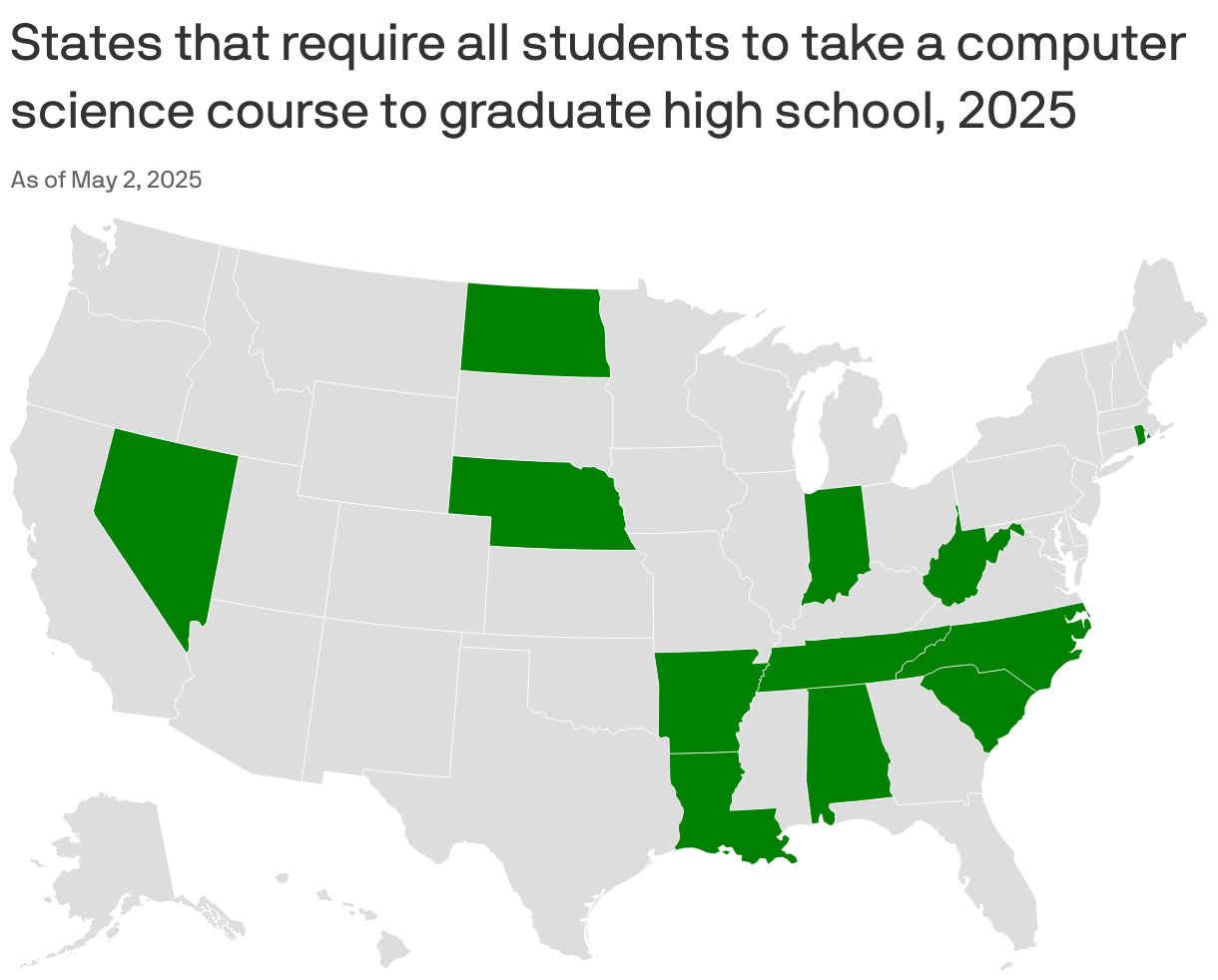
- 12 states require students to earn credit in computer science to graduate from high school, per Code.org.
- Those are Alabama, Arkansas, Indiana, Louisiana, Nebraska, Nevada, North Carolina, North Dakota, Rhode Island, South Carolina, Tennessee and West Virginia.
- Legislation in West Virginia was signed last week.
By the numbers: In 2024, 35 states had plans for computer science education. That's up from 18 states in 2020 and two in 2017, per Code.org.
- In 22 states, computer science classes satisfy math, science or foreign language credits for college admissions requirements.
- About 6.4% of high school students take computer science classes annually, according to the Computer Science Teachers Association.
- Code.org offers computer science and AI curricula free to teachers.
Between the lines: Teachers have warned that AI could hurt students' critical thinking skills — but ongoing AI instruction would teach students how to safely and productively use these tools, Wilson said.
- "Using the AI technology itself and learning to use it — that's helpful and useful. But then there's actually understanding how it works, and then actually using the AI to build and create and solve problems," he said.
- "Those things fit on a spectrum of knowledge, and I think all of those things sort of fit together for what I consider to be true AI literacy."
What we're watching: Trump on April 23 signed an executive order to advance AI education and foster youth interest "from an early age to maintain America's global dominance in this technological revolution for future generations."
- He established a White House task force on AI education to build public-private partnerships that expand K-12 AI instruction.
The bottom line: "In the age of AI, we must prepare our children for the future — to be AI creators, not just consumers," the CEOs' letter said.
- "A basic foundation in computer science and AI is crucial for helping every student thrive in a technology-driven world. Without it, they risk falling behind."


3. Training data
4. + This
Axios AI+
