Axios AI+

December 11, 2024

Finland's Aalto University announced Monday that it will next month launch the Nokia Design Archive, showcasing hundreds of the company's iconic cell phones from the 1990s through 2017.
Today's AI+ is 1,050 words, a 4-minute read.
1 big thing: Gemini 2.0, the next chapter for Google's AI

Google Gemini 2.0 — a major upgrade to the core workings of Google's AI that the company launched today — is designed to help generative AI move from answering users' questions to taking action on its own, Google DeepMind CEO Demis Hassabis tells Axios.
Why it matters: Google, like others in the industry, is heavily touting the potential of AI agents. But the technology needs a boost in performance and accuracy if it's going to be able to act reliably with less human supervision.
- "You actually want a system to not just give you information, but actually go and be able to complete tasks for you," Hassabis said this week in a video interview from Sweden, where yesterday he accepted this year's Nobel Prize in chemistry.
Catch up quick: This morning, Google introduced Gemini 2.0 Flash, which the company says is twice as fast as its predecessor and more powerful than the larger "pro" version of Gemini 1.5.
- It also announced a number of prototypes and products built on top of the new technology, with additional versions of Gemini 2.0 set to debut in January.
The big picture: Hassabis said building AI systems that can take action on their own has been DeepMind's focus since its early days teaching computers to play games such as chess and Go.
- "We were always working towards agent-based systems," Hassabis said. "From the beginning, they were able to plan and then carry out actions and achieve objectives."
- Hassabis said AI systems that can act as semi-autonomous agents also represent an important intermediate step on the path toward artificial general intelligence (AGI) — AI that can match or surpass human capabilities.
- "If we think about the path to AGI, then obviously you need a system that can reason, break down problems and carry out actions in the world," he said.
Zoom in: Google is now incorporating Gemini 2.0 in a variety of ways into both research projects and shipping products.
- The new model is beginning to power the AI Overviews shown atop Google search results.
- Google is also using Gemini 2.0 in a new version of its experimental Project Astra interactive AI assistant (see below).
- The company also debuted agents for gaming and coding, as well as Project Mariner, an experimental Chrome plugin that can take action across various websites.
Between the lines: Hassabis acknowledged that Google and others are running out of room to improve large language models just by increasing their size.
- "There is evidence of diminishing returns I think across the industry," Hassabis said, noting that at least when it comes to text, companies are running out of new sources for training data.
Yes, but: Though the new generation of models may not be delivering leaps as staggering as their predecessors, the improvements are still meaningful, Hassabis said — but he believes large language models alone won't get the industry to AGI.
- "It's always been my expectation and my contention for years that we still need probably two or three more big breakthroughs of the level that we came up with in the past with deep reinforcement learning and transformers specifically...to get to AGI," he said.
2. Hands on with Project Astra, Google's see-all assistant
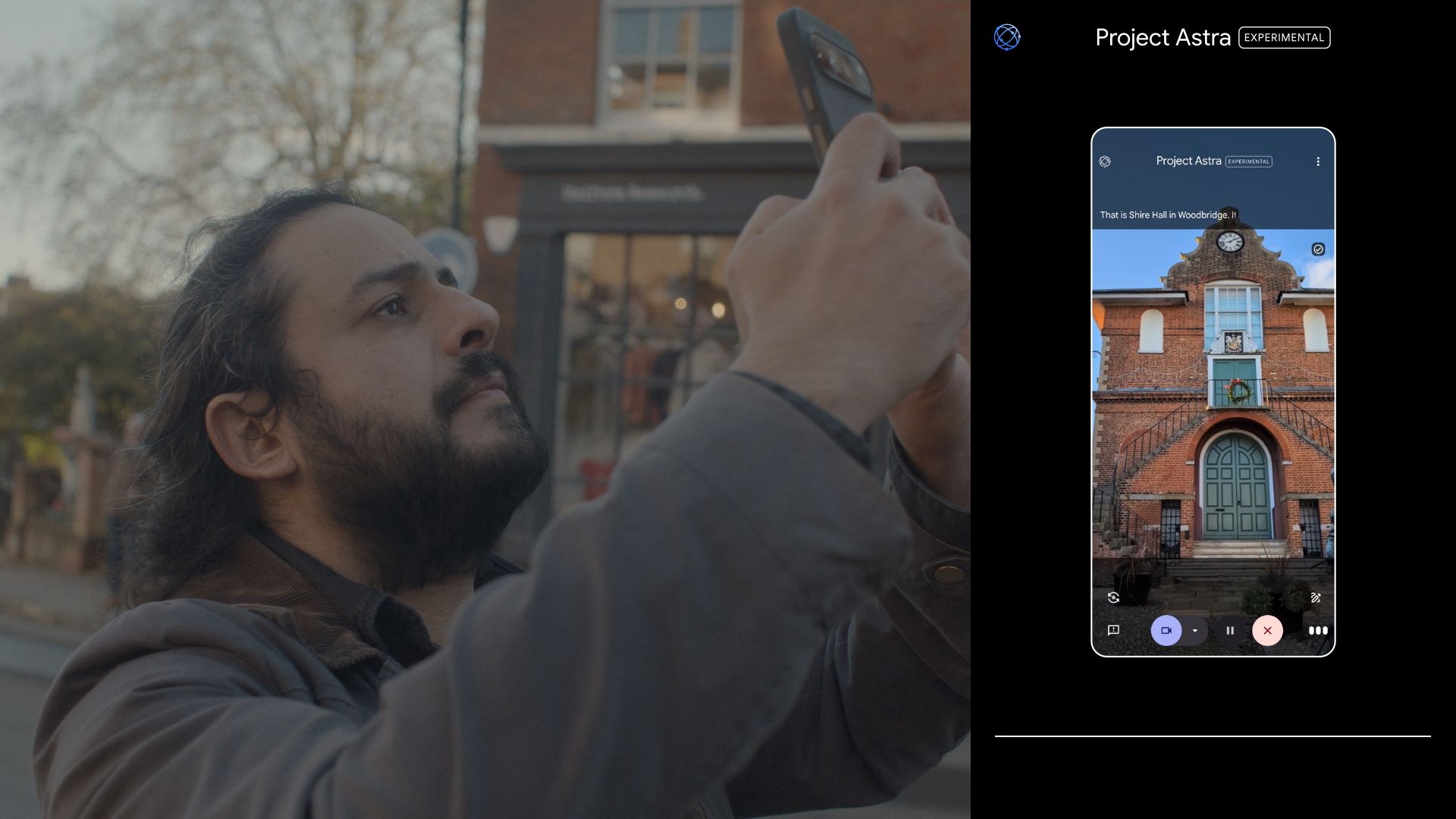
Google is showing off an updated version of Project Astra, the all-seeing, all-hearing and all-remembering experimental AI assistant it showed a glimpse of earlier this year.
Why it matters: Astra offers a preview for some of the ways future AI assistants will help navigate the physical world.
How it works: Astra uses either an Android app or prototype glasses to record the world as a person is seeing it. Astra can then summarize what it sees and answer a wide range of questions, drawing on an array of Google services including Search, Maps, Lens and Gemini.
- The updated version of the prototype, powered by Gemini 2.0, adds a longer memory. For example, it stores 10 minutes of video, as opposed to the 45 seconds' worth it had when Google demonstrated an early version at Google I/O in May.
- Astra expands its language support and reduces the lag between asking a question and receiving an answer — making conversations feel more natural.
- It's also more personalized overall, remembering past conversations and individual preferences.
Yes, but: Astra still has plenty of limitations — and it's not yet widely available.
- Astra can't access an individual's email or photos, can struggle to distinguish multiple voices in a noisy environment, and can't perform action tasks like setting a timer that the basic Google Assistant has long been able to do.
Zoom in: In a meeting at Google's Mountain View headquarters, the company demonstrated Astra summarizing a travel book, suggesting wine pairings for a beef dinner, and identifying several pieces of famous art, among other tasks.
- Given a few minutes to try Astra for myself, I decided to merge two of the tasks, and have it read and summarize a 1970s math textbook, and then recommend a wine pairing for the reading from the bottles Google had assembled for the demo.
- The combo didn't throw Astra. "Given the intellectual nature of the essay and the fact you have a sparkling Rosé in view, a chilled glass of Mumm might pair quite nicely, but it's worth noting that the light bodied white and the dark red are also good choices."
What's next: Google is making the updated Astra available to trusted testers — and starting a waitlist for others who would like to give it a try.
3. Training data
- Apple officially released a new iOS update with major upgrades to Apple Intelligence that we told you about (and reviewed) last month. (Apple, Axios)
- Melinda French Gates is donating $150 million to nonprofits to help remove barriers to women in the workforce, with one-third of the money aimed at AI and the tech industry. (Axios)
- Google wants the Federal Trade Commission to nullify a contract that requires OpenAI's models to run exclusively on Microsoft's Azure cloud computing hardware. (The Information)
- Speaking of the FTC, President-elect Trump named current commissioner Andrew Ferguson to serve as the agency's next chair. (Axios)
- GM is ending its Cruise robotaxi business and will merge the engineering team with the company's broader autonomous driving efforts. (Axios)
4. + This
Pitcher Max Fried signed an 8-year, $218 million contract with the Yankees this week, setting what I hope will become a standard salary for all Frieds.
Thanks to Megan Morrone and Scott Rosenberg for editing this newsletter and Anjelica Tan for copy editing it.
Sign up for Axios AI+
