Axios AI+
September 03, 2026


Ina here, saying thanks to everyone who came to the Re/code Re/union we had in San Francisco this week. It was great to see not just great former colleagues, but so many people who I've worked with for decades.
Situational awareness: Nvidia CEO Jensen Huang confirmed the company has agreed to acquire Hugging Face for $12.9 billion, emphasizing the importance of the AI library in the open AI ecosystem.
Today's AI+ is 1,197 words, a 4.5-minute read.
1 big thing: Anthropic and OpenAI's revenue chasm

Anthropic is racing toward an IPO with a headline revenue number that will likely look bigger than that of its rival, OpenAI.
Why it matters: Comparing revenue at the two AI labs isn't apples-to-apples unless you understand how differently they account for some sales through cloud partners.
Driving the news: The latest update from Anthropic indicates its annualized revenue will exceed $65 billion this year. OpenAI says it's on track to exceed $40 billion in annualized revenue.
- Both companies annualize recent sales in roughly similar ways, The Information reported.
- The biggest difference is what goes into that number.
Between the lines: Anthropic records the full value of Claude sales through its partners, then records the cloud providers' cuts as expenses.
- OpenAI records only its share of certain sales through partners like Microsoft, according to The Information.
- If a customer pays $100 for an AI service through a cloud provider, Anthropic's accounting method allows it to record the full $100 as top-line revenue, per Francine McKenna, accounting professor and author of the newsletter The Dig. The cloud provider's cut is then listed an expense.
Zoom in: Why do both AI labs do it differently?
- "The criteria here has a lot to do with who is the principal and who is the agent in the transaction," McKenna says. It's about who really has control over the client relationship and is ultimately responsible for delivering the product, McKenna adds.
- Anthropic says it views itself as the principal in each transaction.
- OpenAI sees net revenue as more accurate.
What they're saying: Neither approach is necessarily wrong.
- "You can have two companies with the same business model come to a different conclusion," McKenna says, based on both customer contracts and what argument their teams made to the SEC to justify their revenue calculations.
- The question is whether the AI company is the principal selling the service or an agent in someone else's sale.
- Accounting is "more of an art than a science," Lucas Ward, co-founder and CEO of Oath, a financial verification platform, told Axios.
Reality check: Accounting can't explain the entire $25 billion Anthropic-OpenAI gap based on what we know publicly.
- If Anthropic were to pivot and report revenue on a net versus gross basis, that would only amount to about a 6%–10% hit, per a source familiar with the company's financials.
- That would still put Anthropic roughly $19 billion to $21 billion ahead of OpenAI, based on the latest reported figures.
What we're watching: Anthropic's IPO filing should finally show investors how it justifies its revenue treatment.
- As part of the pre-IPO paperwork process, correspondence between the SEC and Anthropic will get released. That should include justifications for Anthropic's accounting practices.
- Ward plans to watch Anthropic's EBITDA, or earnings before interest, taxes, depreciation and amortization, for clarity on the firm's true profits.
The bottom line: Anthropic may really be growing faster than OpenAI.
- But $65 billion vs. $40 billion isn't a clean comparison between the two.
2. Exclusive: OpenAI convenes security leaders


OpenAI president Greg Brockman is expected to make an announcement about expanding access to the company's tools to critical infrastructure and public sector organizations, a spokesperson first shared with Axios.
Why it matters: OpenAI's accidental hack of Hugging Face and a wave of seemingly AI-assisted cyberattacks on U.S. water systems have raised serious concerns about how vulnerable utilities are to future AI-enabled hacks.
Driving the news: Brockman will make the announcement during a cyber summit at OpenAI's headquarters later today, the spokesperson said.
- Roughly 300 enterprise security leaders and CISOs from Fortune 100 companies are expected to attend the event.
- The gathering will focus on how companies, governments and cybersecurity companies can get AI tools into the hands of defenders, including critical infrastructure and public services.
The big picture: The gathering and pending announcement come as OpenAI responds to security concerns surrounding its models following the Hugging Face breach and after its forthcoming Astra model reached "critical" cybersecurity capabilities.
- An Information report earlier this week about OpenAI pursuing a new training technique also raised concerns about whether security pros will still have visibility into the model's thought process.
Catch up quick: OpenAI issued an open letter last week warning that organizations only have months to prepare for AI-enabled cyberattacks.
- Brockman issued a similar warning in an essay last month.
What to watch: Raising awareness about protecting critical infrastructure is one thing, but it doesn't solve the problems many of these organizations find with funding and hiring security teams.
3. Meta debuts Muse Spark 1.3

Meta released Muse Spark 1.3, an update it says significantly improves performance in coding and agentic tasks.
Why it matters: Meta is trying to keep pace with Anthropic, OpenAI and Google, which all made major model announcements this week.
State of play: Meta AI chief Alexandr Wang told Axios the update helps pave the way for upcoming products, such as personal agents.
- "It's very competitive with frontier models," Wang said in an interview.
- "A lot of the usability improvements that we've made will be really helpful for things that Mark [Zuckerberg] has talked about on earnings calls, like personal agents that can work 24/7 on your behalf and help you achieve your goals."
The big picture: Meta's release comes amid a flurry of model updates from across the industry.
- Google yesterday debuted Gemini 3.8 Flash, as well as a version geared toward cybersecurity work. Google's new model showed some impressive performance on certain coding benchmarks, and a larger update, Gemini 4, remains in training.
- Anthropic released updates to its Fable and Mythos models designed to cut costs and reduce the frequency of refusals of user requests for safety issues.
- OpenAI, meanwhile, said it will soon release its Astra model, though it will limit its most powerful cybersecurity capabilities to a smaller group of testers.
4. Exclusive: New bill cracks down on AI agents

Reps. Josh Gottheimer (D-N.J.) and Mike Lawler (R-N.Y.) are introducing a new bill today, first shared with Axios, aimed at securing AI agents amid a growing number of safety incidents involving rogue agents.
Why it matters: Washington has been slow to respond to the safety and security concerns raised by OpenAI's Hugging Face hack and other testing incidents involving agents that took unauthorized actions over the last two months.
Driving the news: The Stop Rogue AI Act directs Commerce's National Institute of Standards and Technology to develop and publish standards, guidelines and best practices for how organizations can securely deploy AI agents.
- The standards should cover how organizations can continuously maintain and verify the actions that agents take on their systems; evaluate the security and reliability of AI agents; and generate tamper-proof logs of the actions that agents take.
5. + This
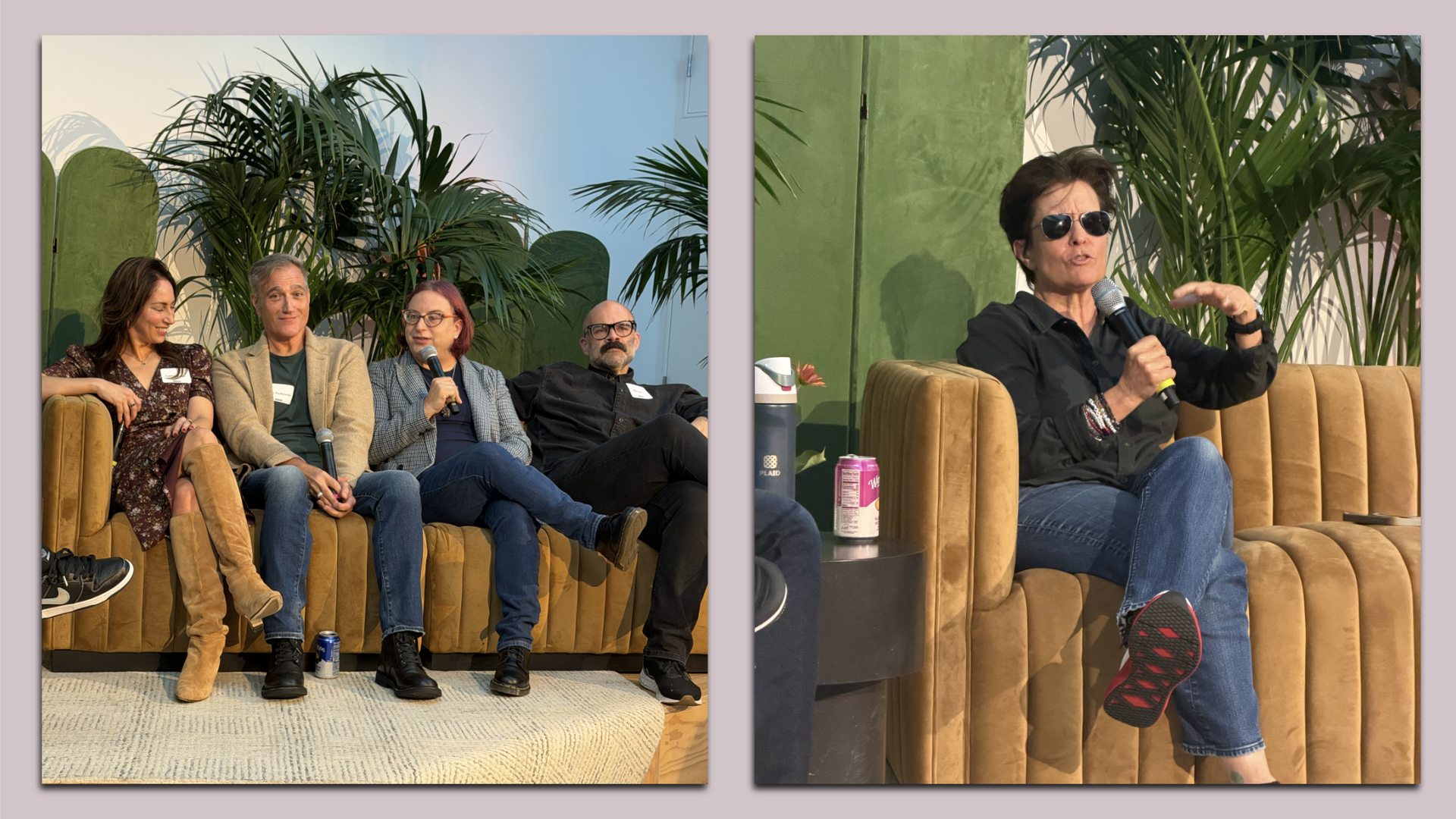
Here are a couple shots from the festivities.
Thanks to Megan Morrone for editing this newsletter and Matt Piper for copy editing.
Sign up for Axios AI+
