Axios AI+

September 01, 2023

Ina here. AI+ will be off Monday for Labor Day — have a great long weekend and we'll see you again Tuesday morning.
Today's AI+ is 1,328 words, a 5-minute read.
1 big thing: Prompt — Create your own AI doppelgänger

Illustration: Allie Carl/Axios
"Hi, mom. Hi, dad." The face in the video was mine, and the voice was mine, too. But I hadn't spoken the words my parents heard.
The video was the product of a company named HeyGen, which allows anyone to create a personal "deepfake" — an AI-generated video double capable of reciting virtually anything you type into a text field.
Why it matters: Experts have been sounding alarms about deepfakes for years, but for better — and worse — the capability is here now and it requires no specialized skill.
How it works: To create a personalized avatar, customers have to send HeyGen a two-minute video of themselves speaking into a camera (your smartphone is fine) — along with another video giving consent for the company to do its thing.
- HeyGen returns a digital avatar that you can use to generate videos by typing the words you want to speak into a text box. A content filter blocks explicit or violent content.
- In addition to creating avatars of customer's own images, HeyGen offers a range of ready-to-use, generic-faced avatars and voices (they come in various genders and races).
Here's a video of my HeyGen avatar in action.
Zoom out: There is of course plenty to worry about with such a tool, from scams and fraud to political misinformation.
- But HeyGen is attempting to harness the utility of "good" deepfakes as a quicker, cheaper and easier alternative to recording everything from customized marketing to instructional videos.
- "We want to build a generative video engine to replace cameras, and make it work for everyone to freely create content," said Joshua Xu, HeyGen's CEO, who spent six years at Snapchat before launching his startup at the end of 2020.
The good: HeyGen's recreation of me was convincing — or convincing and creepy, according to the friends and family I shared it with.
- In making the video to accompany this review, I was able to generate a short segment using my avatar in less than five minutes, all without having to put on makeup, grab a tripod or fuss with lighting.
The bad: HeyGen isn't always good at properly pronouncing names. For example, I had to change my name to "Eena Freed" to get my avatar to say it correctly.
- The lip movements are good, but not flawless, and it took a couple tries to get the video just right. One time, for example, my gaze wasn't right at the camera and the resulting video was less convincing.
Between the lines: While HeyGen requires video consent for its avatars, the technology has clearly evolved to the point where deepfakes won't require much expertise.
- My general assumption is that anything that can be done using AI today with safeguards will very quickly become available without such protections.
And even HeyGen's approach raises some questions.
- A colleague, for example, suggested their tool could make it easier to create work-related videos using AI, rather than having to film each one fresh.
- That might be a convenient time-saver — but who would own the rights to my avatar? I definitely don't want to live in a world where employers can create videos of employees saying whatever the company wants them to say.
Practicalities: HeyGen offers a range of subscription options around $50 to $150 per month that offer a set amount of credits, each good for one minute of video. The higher-end packages offer the ability to create longer and higher resolution videos.
- The average cost is around $3 per minute, while setting up a personal avatar currently costs a flat $199. (A simpler avatar based on just a photo is free, while there's also a $1,000 pro avatar option that requires the use of a studio and green screen.)
- A free trial offers one credit per day, but only with HeyGen's standard avatars or the talking photo.
Our thought bubble: HeyGen's tool is impressive but probably doesn't make sense for casual messages to friends, particularly with the price tag. (Why not just record a selfie video?)
- It could be useful for other purposes, though, such as personalizing professional sales messages without recording something fresh for each customer.
- Such messages might be received as intriguing novelties if they're labeled as AI-generated (which they probably should be). Once the novelty wears off, though, they might end up feeling more spammy than authentic.
Watch the video (it's fun).
2. What to expect when the DOJ takes on Google
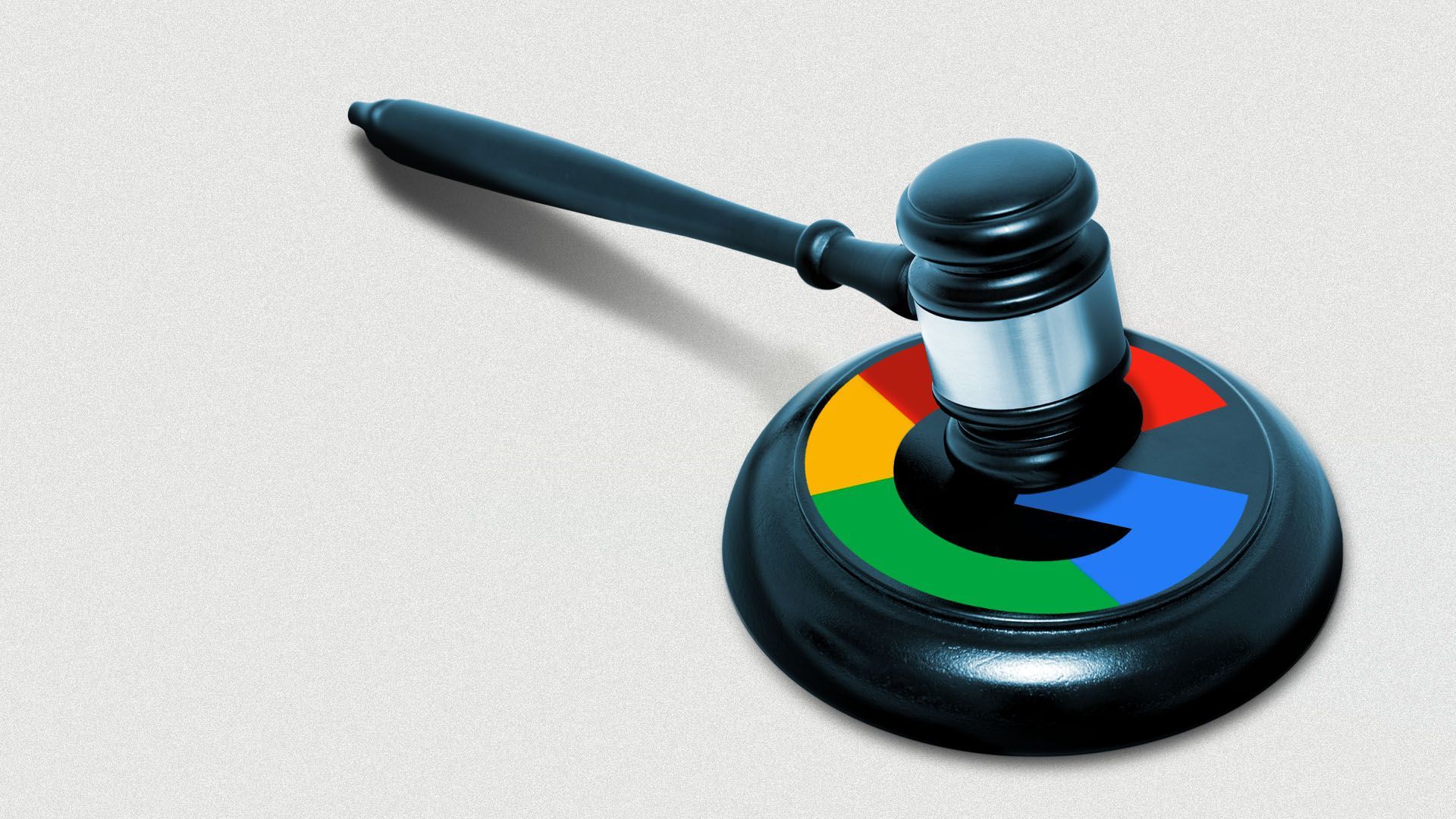
Illustration: Sarah Grillo/Axios
The Justice Department's highly anticipated antitrust case against Google goes to trial Sept. 12 after years of preparation and buildup, Axios Pro's Ashley Gold reports.
What's happening: The initial portion of the case is expected to take eight to nine weeks. Any remedies sought by the judge will be sorted out in another phase of the case, which could take the same amount of time.
At its core, the case now is about two key questions:
- Whether Google's exclusive deals with web browsers like Mozilla and its practice of preloading Google on Android as the default search engine are anticompetitive.
- Whether Google's Search Ad 360 product discriminates against ad features used by other search engines, like Bing, through slower development of ad tools for non-Google products.
What they're saying: "People don't use Google because they have to, people use Google because they want to," Kent Walker, Google's chief legal officer, told Ashley in an interview. "We compete hard for those default positions, we bid for them so that people can easily access our products."
- "Our success comes down to the quality of our products, not the quality of our contracts. It's innovation, not pre-loading," he said. "It's easy for people to find alternatives in the marketplace."
- Walker called it "ironic" that this "backwards-looking case" is happening during an "unprecedented forward-looking innovation" in artificial intelligence in the field.
State of play: Walker said companies like Mozilla and Apple choose to design their browsers using a default search engine because "that's what's easier for users." Open competitions are held for these settings, and "they pick the best search provider for their users."
- On Google's arrangements to be pre-loaded on Android phones, Walker likened it to supermarkets charging cereal companies for their products to be displayed at eye level: "That's never been illegal under American law; if anything, it's pro-consumer."
The other side: For the DOJ, this case is a major inflection point in how competition law applies to the modern internet age. The department is likely to argue that Google got to its position of superiority in search engines not by accident or by having a superior product but through illegal monopoly maintenance.
- That maintenance, the DOJ argues, is due to those exclusivity agreements, which cost billions of dollars and provide Google with billions of daily queries.
- The DOJ may argue that Google's scale hurts American consumers through privacy violations and debraded search results.
What we're watching: Executives from companies like Apple and Mozilla are also expected to testify about negotiations of agreements with Google and why they were made.
- Both Google and the DOJ are likely to bring up the explosion of generative AI and what it means for the search engine market.
A version of this story was published first on Axios Pro. Unlock more news like this by talking to our sales team.
3. Training data
- A federal judge has put on hold a Texas law that would require porn sites to post warnings and verify users' age. (The Verge)
- Meanwhile a different judge has blocked an Arkansas law that would require children to get their parents' permission to create social media accounts. (AP)
- The AI startup boom faces a "trough of disappointment" as initial exhilaration fades. (Wall Street Journal)
- Trading places: SAP has hired Walter Sun as global head of AI. Sun was previously a vice president at Microsoft, working on applied artificial intelligence for Microsoft's business applications.
- On tap: The IFA consumer electronics trade show runs today through Sept. 5 in Berlin.
4. + This
Always check which text field you are using. This AirPods buyer learned this the hard (if hysterical) way.
Thanks to Scott Rosenberg for editing and Bryan McBournie for copy editing this newsletter.
Sign up for Axios AI+

Scoops on the AI revolution and transformative tech, from Ina Fried, Madison Mills, Ashley Gold and Maria Curi.