Axios AI+
October 16, 2024

I have not yet seen the comet — or the Northern Lights. Have you? Send in your pics and I'll feature some in an upcoming newsletter.
Today's AI+ is 1,074 words, a 4-minute read.
1 big thing: Data centers are everywhere — but some say "no thanks"


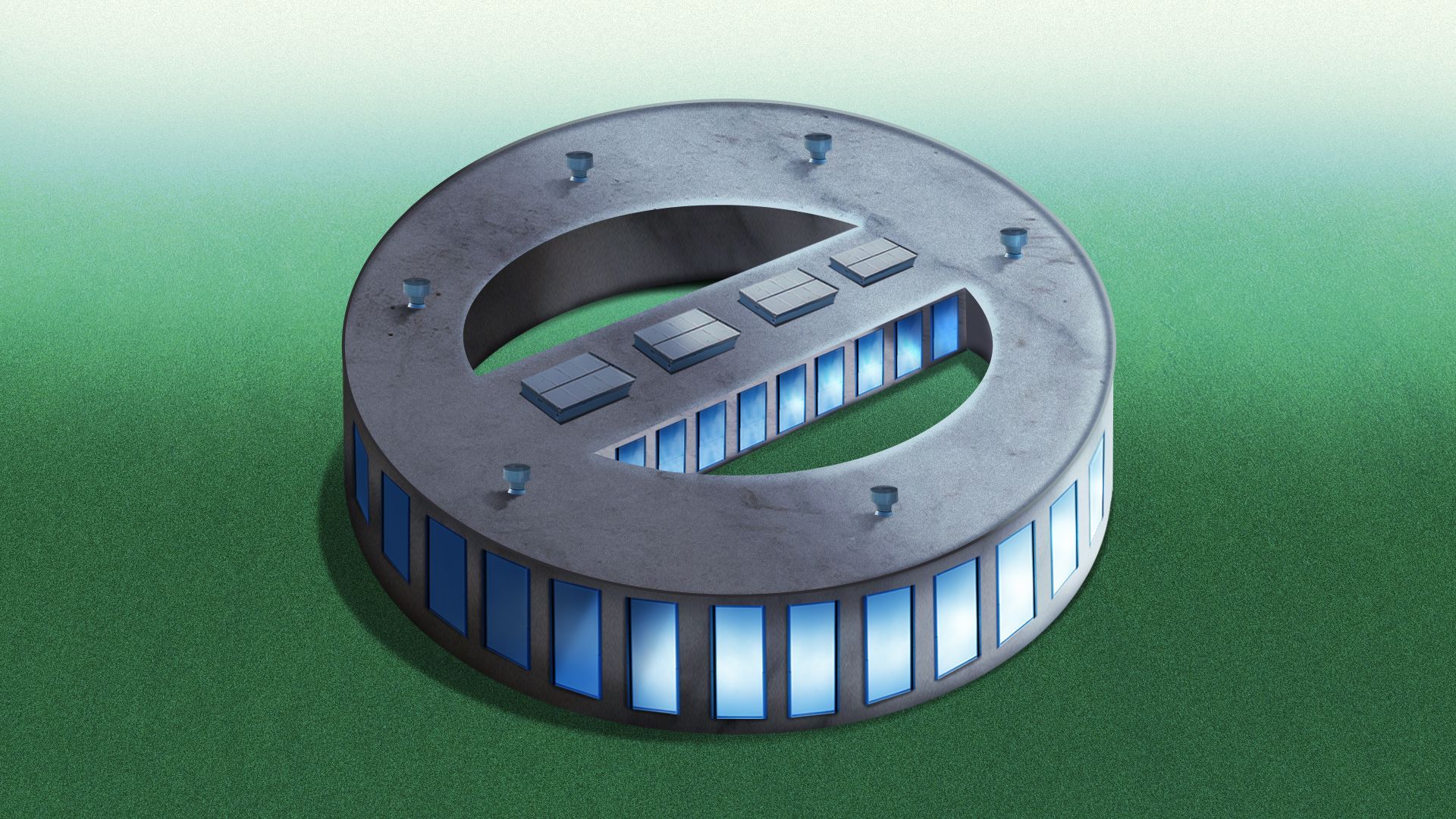
Some communities and politicians are pushing back against data centers — vital yet sometimes controversial facilities that underpin our digital lives and the AI explosion.
Why it matters: More than 5,000 of these key tech facilities now dot the American landscape, often requiring massive amounts of energy and land and receiving big government incentives.
Driving the news: Data center builders promise new jobs and other benefits, but there's rising bipartisan opposition on issues from aesthetics and noise to housing costs and national security.
- Atlanta's city council in September banned data centers near transit stations, with one member arguing that they conflict with housing, parks and other land use demands.
- Earlier this year, the White House ordered the Chinese owners of a Wyoming cryptomining data center near a U.S. nuclear missile base to shut down and sell the facility, citing national security.
Threat level: Data centers are also driving a surge in electricity demand — especially amid the rapid growth of new AI tools.
- Utilities estimate data centers will need nearly 40 gigawatts of additional electricity by 2028, per a December 2023 report from consulting firm Grid Strategies — nearly double their prior guess.
- Barclays researchers see data centers accounting for at least 9% of overall electricity demand by 2030, up from 3.5% today.
- Demand is so high that at least one mothballed nuclear reactor, Pennsylvania's infamous Three Mile Island, might come back online.
Between the lines: Building data centers close to end users often means lower latency — the amount of time it takes data to travel — and other benefits.
Friction point: Politicians are starting to act on data center skepticism.
- In Texas, where electricity consumption is growing fastest nationwide, Republican Lt. Gov. Dan Patrick has asked lawmakers to evaluate the state's ability to keep pace with the increasing demand.
- Data centers and cryptocurrency mining "produce very few jobs compared to the incredible demands they place on our grid," Patrick wrote after the Texas grid operator predicted electricity demand could nearly double in six years.
- "Texans will ultimately pay the price. ... We want data centers, but it can't be the Wild Wild West of data centers and crypto miners crashing our grid and turning the lights off."
Zoom in: In Northern Virginia, which houses the world's biggest collection of data centers, some residents are advocating for regulations on what they consider noisy eyesores gobbling up land and power.
- A contentious meeting last year to approve a huge data center complex in Virginia's Prince William County lasted 27 hours.
- Residents are suing to stop its construction.
What they're saying: Data centers are "driving up the price of land, and it's hard for anyone else to compete with them," says Deshundra Jefferson, chair of the Prince William Board of County Supervisors, who adds that data center pushback helped her get elected.
The latest: Virginia's Fairfax County recently greenlit regulations on data center development, requiring noise studies and that sites be located a certain distance from homes and transit stations.
- Nearby Loudoun County is considering similar restrictions.
Reality check: Data centers are still getting built left and right, often with cushy incentive packages.
- In Columbus, Ohio, Microsoft is getting a 100% property tax abatement on a $420 million data center investment for 15 years. It's also eligible for a sales tax credit on its hardware investment.
- Microsoft officials have said the center will create 30 jobs with a total payroll of roughly $50,000 per worker.
- At least 30 states have passed legislation providing tax incentives to attract data centers.
The other side: "While data centers do not directly create large employment opportunities, they do create a significant amount of high-end construction employment for a period that typically runs around 24 months," per researchers at investment firm CBRE.
- "Additionally, these assets, once built, are a key component of a company's overall operating environment and can create a long-term investment in a community."
- "Data centers are dedicated to being good neighbors in their communities," Dan Diorio, director of state policy at the Data Center Coalition, which represents data center operators, tells Axios.
The bottom line: America needs data centers — what's less clear is where to put them.
2. AI-written local news not ready for primetime

Local news site Hoodline, which made news of its own earlier this year by announcing it would run articles created with generative AI, has wrongly accused a California DA of murder thanks to an obvious AI goof.
Why it matters: AI's critics keep saying the technology isn't ready to create journalism on its own. Here's why, courtesy of Techdirt's Mike Masnick.
Driving the news: "San Mateo County DA Charged with Murder Amid Ongoing Search for Victim's Remains," the Hoodline headline read before it was corrected yesterday.
- If you read two sentences in, you learn that the DA is actually charging someone else with murder.
- That's typically how this sort of thing goes, as most people know. But today's AI doesn't understand the world at all — it just guesses words.
Between the lines: Hoodline's AI is apparently writing its story directly off posts on X — a post by the DA's office even appears at the bottom of the story.
- The AI program appears to have run together the name of the X account ("San Mateo County District Attorney") with the name of the murder suspect, which starts the X post.
- Hoodline includes a tiny "AI" icon next to the (apparently fake) bylines of AI-written stories.
The bottom line: At the least, editors and publishers should be subjecting any AI-generated articles to review — and readers should always apply a common-sense gut check, too.
3. Training data
- Character.ai allows users to create chatbots based on anyone's identity — and that means many are being created without consent. (Wired)
- Apple released a new iPad mini with support for Apple Intelligence, the iPhone maker's new genAI offering. (MacRumors)
- OpenAI hired Dane Stuckey as its CISO. Stuckey previously held that role at Palantir. (TechCrunch)
- Longtime rivals Intel and AMD, threatened by the rise of Arm-based systems, are teaming up to outline the future of the x86 architecture used by most PCs and servers. (Reuters)
4. + This

Former AOL executive Ted Leonsis used ChatGPT to help pick his outfit for a recording of the Washington AI Network podcast — and ended up sporting an outfit nearly identical to the show's other guest, Red Cell Partners CEO Grant Verstandig. The podcast, which just dropped, also features a lively chat on the future of healthcare in the age of AI.
Thanks to Megan Morrone and Scott Rosenberg for editing this newsletter and to Caitlin Wolper for copy editing it.
Sign up for Axios AI+
