Axios AI+
September 23, 2025

As Rosh Hashanah continues, we wish a happy new year to those observing. Ina is off today to celebrate. Today's AI+ is 1,266 words, a 5-minute read.
1 big thing: A guide to AI's many dazzling futures


The makers of AI keep pushing the art of utopian forecasting to new levels of hyperbole.
Why it matters: Technology revolutions always come with promises, but the AI industry has set such impossibly high targets for itself that it's bound to face a sobering reset.
Driving the news: Speaking at a forum earlier this month hosted by the "All-In" podcast, Elon Musk predicted that by the 2030s, "probably AI is smarter than all humans."
Musk is known to overpromise. But when it comes to predictions of inconceivably wonderful AI advances, he is joined by nearly every CEO or leader in the AI industry.
Here's a brief guide to AI's notable utopian manifestos over the past two years.
1. "The Techno-Optimist Manifesto"
- Author: Marc Andreessen, founder/partner at Andreessen Horowitz
- Date: Oct. 16, 2023
- Length: 5,152 words
- Tone: Nietzschean aphorisms, with a hallucinatory edge
- Utopia meter (1-5): 5
Key excerpts:
- "We believe we are poised for an intelligence takeoff that will expand our capabilities to unimagined heights."
- "We believe Artificial Intelligence is our alchemy, our Philosopher's Stone — we are literally making sand think."
- "We believe Artificial Intelligence can save lives — if we let it. ... There are scores of common causes of death that can be fixed with AI, from car crashes to pandemics to wartime friendly fire."
- "We believe any deceleration of AI will cost lives. Deaths that were preventable by the AI that was prevented from existing is a form of murder."
2. "The Intelligence Age"
Author: Sam Altman, CEO of OpenAI
Date: Sept. 23, 2024
Length: 1,132 words
Tone: The nerd next door, exuding quiet confidence
Utopia meter (1-5): 5
Key excerpts:
- The emergence of AI "may turn out to be the most consequential fact about all of history so far. It is possible that we will have superintelligence in a few thousand days (!); it may take longer, but I'm confident we'll get there."
- "AI is going to get better with scale, and that will lead to meaningful improvements to the lives of people around the world."
- "I believe the future is going to be so bright that no one can do it justice by trying to write about it now; a defining characteristic of the Intelligence Age will be massive prosperity."
- "Although it will happen incrementally, astounding triumphs — fixing the climate, establishing a space colony, and the discovery of all of physics — will eventually become commonplace."
3. "Machines of Loving Grace"
Author: Dario Amodei, CEO of Anthropic
Date: October 2024
Length: 14,700 words
Tone: Middle-aged professor riffing on ideas after a drink — but "avoiding grandiosity"
Utopia meter (1-5): 3
Key excerpts:
- "I think that most people are underestimating just how radical the upside of AI could be, just as I think most people are underestimating how bad the risks could be."
- "My basic prediction is that AI-enabled biology and medicine will allow us to compress the progress that human biologists would have achieved over the next 50-100 years into 5-10 years. ... The framework of '100 years of progress in 5-10 years' applies to neuroscience in the same way it does to biology."
- "If all of this really does happen over 5 to 10 years — the defeat of most diseases, the growth in biological and cognitive freedom, the lifting of billions of people out of poverty to share in the new technologies, a renaissance of liberal democracy and human rights — I suspect everyone watching it will be surprised by the effect it has on them. ... I think many will be literally moved to tears by it."
4. "Personal Superintelligence"
Author: Mark Zuckerberg, CEO of Meta
Date: July 30, 2025
Length: 622 words
Tone: Written by AI? Or a person imitating an AI
Utopia meter (1-5): 4
Key excerpts:
- "I am extremely optimistic that superintelligence will help humanity accelerate our pace of progress. But perhaps even more important is that superintelligence has the potential to begin a new era of personal empowerment where people will have greater agency to improve the world in the directions they choose."
- "As profound as the abundance produced by AI may one day be, an even more meaningful impact on our lives will likely come from everyone having a personal superintelligence that helps you achieve your goals, create what you want to see in the world, experience any adventure, be a better friend to those you care about, and grow to become the person you aspire to be."
5. The other side: "AI 2027"
Authors: Daniel Kokotajlo, Scott Alexander, Thomas Larsen, Eli Lifland and Romeo Dean
Date: April 3, 2025
Length: 9,974 words
Tone: Stats geek crossed with science fiction author
Utopia meter (1-5): 0 — or maybe 4? Depends on your choice of ending
Key excerpts:
- "We predict that the impact of superhuman AI over the next decade will be enormous, exceeding that of the Industrial Revolution."
- The scenario lays out a future in which a series of AI models supervising the development of newer AI models quickly "misaligns" from its human makers' instructions and goes off the rails.
- In one ending, an all-out AI race between the U.S. and China leads to humanity's extinction. In an alternate version, caution prevails and our species finds its way, with a few bumps, to an abundant future.
The big picture: The AI world is now largely split into two camps.
- The manifesto authors above see AI as a uniquely transformative, "singularity"-like event that changes everything. "Doomers" fearful that AI will destroy the human species also share the utopians' belief that AI's exponential power is unprecedented.
- A different set of experts argue that AI is simply the latest in a long series of "normal" technologies like the personal computer, the internet and the smartphone. These innovations did reshape the world in important respects — but otherwise, life went on.
The bottom line: If your industry requires hundreds of billions of dollars in new investment to keep developing, you may have no choice but to promise paradise.
2. Exclusive: Meta launches AI super PAC

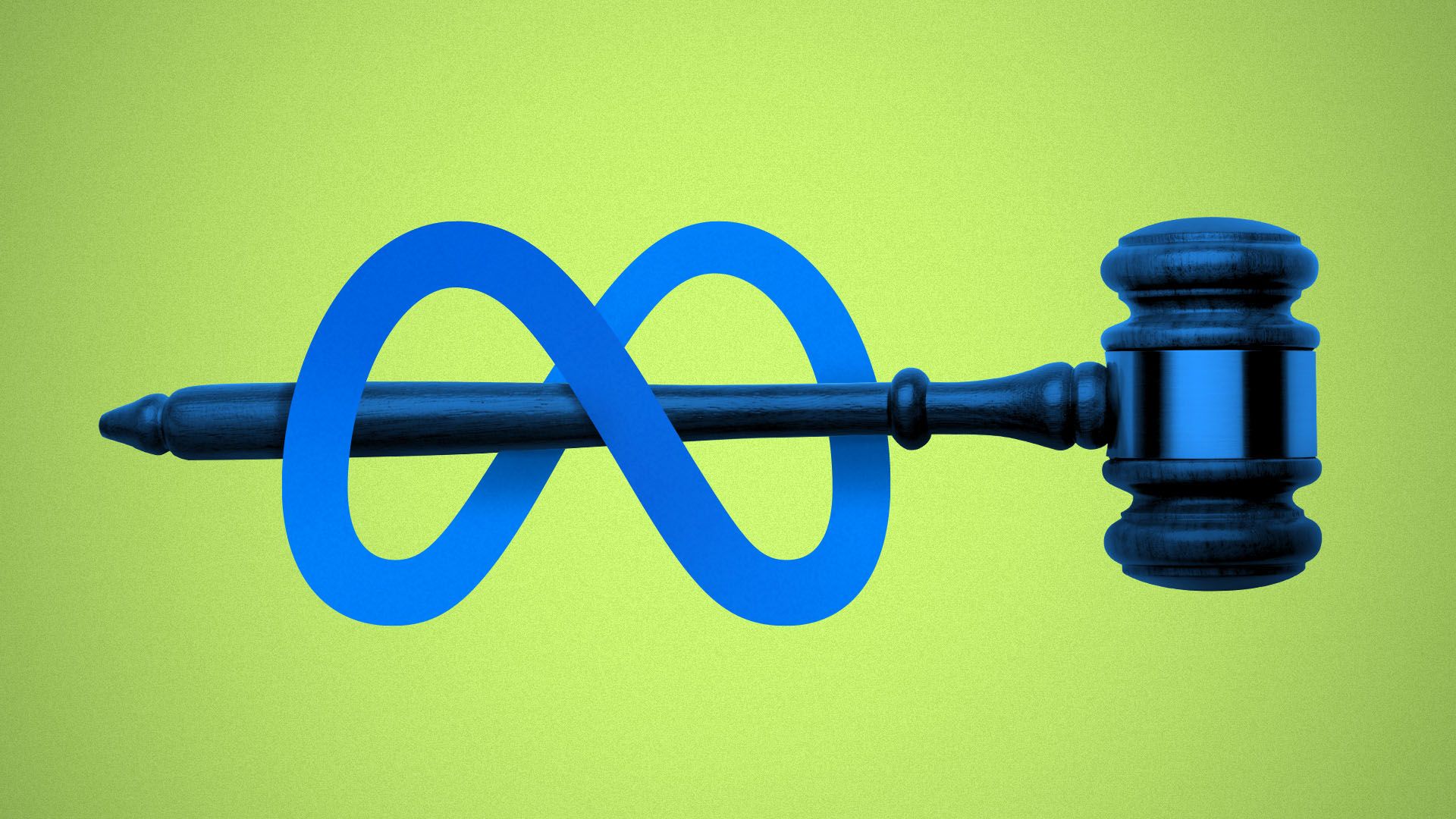
Meta launched a new super PAC today to help fight off what it sees as onerous AI and tech policy bills across the country, per an announcement shared exclusively with Axios.
Why it matters: As the federal government fully embraces AI and looks unlikely to pass significant tech policy regulation any time soon, busy state houses are tech companies' biggest problem.
- Meta's nonfederal PAC — which will be run by longtime Republican operative Brian Baker and Democratic consulting firm Hilltop Public Solutions — will focus on electing state candidates from both parties.
The super PAC is called the American Technology Excellence Project, and Meta spokesperson Rachel Holland said the company is investing "tens of millions" into the project.
3. Training data
- Nvidia will invest up to $100 billion in OpenAI in a staged deal to support the ChatGPT maker's massive infrastructure buildout, with the first new project planned to come online in the second half of 2026. (Axios)
- More than 200 notable figures — including Nobel Prize winners, former heads of state and senior employees at OpenAI, Google and Anthropic — are calling for "red lines" in AI development. (Transformer)
- Lenovo says it will need to transition to AI to survive. (Axios Raleigh)
4. + This
Once a "meet-cute" meant bumping into a future soulmate at your local independent bookstore. Now it's the name of Facebook's AI tool for online dating, launched yesterday.
Thanks to Scott Rosenberg for editing this newsletter and Matt Piper for copy editing.
Sign up for Axios AI+
