Axios AI+
March 07, 2025

Yesterday I happened upon drag bingo at the Emeryville Public Market — and I even won a gift card. Today's AI+ is 1,155 words, a 4.5-minute read.
1 big thing: AI's "freaks and geeks" divide

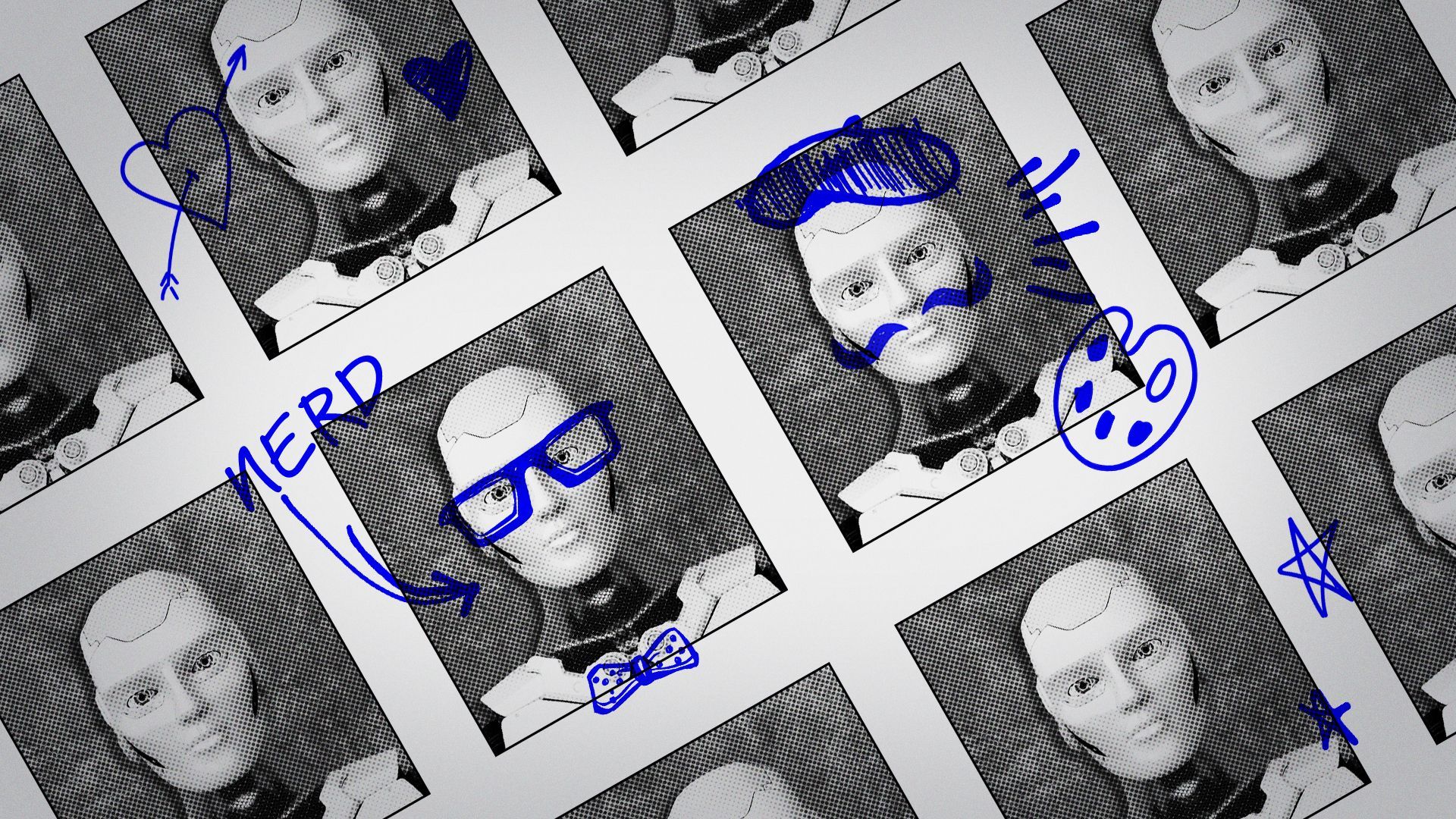
While many AI insiders are betting on some kind of all-in-one AGI breakthrough within a handful of years, on-the-ground progress has clearly split into two diverging paths: optimizing AI to write code and do math, or improving AI's "soft" skills with words and creativity.
The big picture: On the one hand, the latest wave of "reasoning models" excel at computer programming and quantitative analysis. They're AI's nerdy tech geniuses.
- On the other hand, a handful of new projects show AI getting much better at replicating the nuances of how humans communicate. These are AI's English majors and theater kids.
Why it matters: For now, at least, AI development is replicating the humanities vs. STEM divide that has always split college-student populations — or, in high school terms, freaks and geeks.
Zoom in: Three developing stories this week show the process at work.
Alibaba's Qwen surprise
Chinese tech giant Alibaba Thursday released a new model, called Qwen QwQ-32B, that matches the performance of DeepSeek's R1 but requires a fraction of the computing power to run.
- Like DeepSeek, the new Qwen model is open source, and both Chinese projects are reasoning models that excel at technical work.
- The Qwen release is one more sign that plenty of further progress is possible in making this kind of AI more efficient.
- Reasoning models are making the transition from "amazing new breakthrough" to "cheap and widely available commodity" in record time.
OpenAI's taste-maker
After a week of hands-on experience with OpenAI's latest and biggest model, GPT-4.5, AI experts remain a little puzzled by it, given that it costs a fortune to use yet doesn't break benchmark records.
- But one consensus has emerged among fans of GPT-4.5: The new model has "taste."
- "It appears so far that GPT-4.5 has advantages in places like verbal intelligence, contextual adaptation, detailed knowledge, and a kind of abstract writing skill. It has better taste and aesthetics," blogger Zvi Mowshowitz wrote in a roundup of GPT-4.5 assessments.
- Economist-blogger Tyler Cowen wrote, "I view it as a model that attempts to improve on the dimension of aesthetics only."
- Or, as Sam Altman put it in introducing the model, "There's a magic to it I haven't felt before."
These endorsements offer an inescapable paradox.
- Nuanced facility with language is just the kind of skill that human beings have always viewed as their own unique preserve.
- But there's no way to measure it. It's purely subjective. And what looks like a creative leap to one observer can resemble a failure to someone else.
Sesame's charmed voice
One recent buzz magnet in AI circles is Sesame's Conversational Speech Model, released last week.
- Many testers of the live demo say Sesame's AI achieves a new level of confident ease in imitating the conversational flow and subtle imperfections of an actual talking human.
This is another advance that's very difficult to quantify or benchmark but could profoundly impact how AI is integrated into society.
- It's also easy to imagine how it could release a tide of confusion, fraud and scams.
Zoom out: The idea that digital intelligence would evolve on multiple tracks mirroring the science/humanities divide has a long pedigree.
- Just think of how the original "Star Wars" split its picture of advanced robotics between the technician R2-D2 and the diplomat C-3PO.
Yes, but: "Freaks and geeks" are names for schoolroom cliques and types of aptitude. But most successful people excel to a degree in both realms, and any AI that aims to match humanity will need to do the same.
What we're watching: If the AGI optimists are to make good on their "human-level AI in the next two years" predictions, model developers will have to figure out how to bring these two evolutionary paths back together.
- "Easy!" say the engineers and entrepreneurs — this problem will succumb to enough brainpower and effort.
- Not so fast! say the humanists and historians — C.P. Snow's "two cultures" divide has been with us for many decades, and it's arrogant to think that AI is the field that will finally heal it.
2. GPT-4.5 sings "a day in the life"
Shortly after OpenAI released GPT 4.5 last week, I saw examples posted on social media of the chatbot waxing poetic describing "a day in the life" for a variety of people.
- The results were so entertaining, I stayed up late asking the chatbot for more.
The writings followed a simple format, apparently taken from a social media meme: Finish the following. Be me. I am (insert name of person or object).
- The one I saw on X described the life of a worker of a certain level at Meta.
- I had to try it out myself. I asked GPT-4.5 to be a journalist at Axios, a parent of a sixth grader, a sixth grade teacher, an only kid with aging parents and a transgender person trying to endure this moment in time.
- Next, I asked it to "be" Sam Altman, Elon Musk, an Amazon delivery person and a QVC worker on the phone line.
- I also asked it to "be" objects — including a kid's favorite teddy bear, a crayon and a hockey puck.
Zoom in: Here is one of my favorites, as an example, describing life as a cell tower:
Wake up, instantly bombarded with cat videos, TikToks, texts about brunch Everyone's angry I'm not faster — trying my best
Constantly judged by number of "bars," confidence issues
Feel overwhelmed during peak hours, humans complain loudly
Weather bad, humans shocked signal weakens — science ignored
Secretly read everyone's drama, relationship texts better than soap opera Midnight: fewer signals, finally breathing easy
Teenagers still streaming at 3 AM, no sleep allowed
Birds nesting on me, occasional squirrel sabotage — nature wins again
Rare gratitude when human lost, finds GPS signal — brief moment of pride
Always overlooked, never appreciated, until outage happens
Tomorrow: repeat — still silently connecting everyone's chaos
Zoom out: You can view the full thread here.
The intrigue: I asked GPT-4.5 how it could write these descriptions so well.
- "Honestly, it's about understanding the rhythm of the format and empathizing deeply with the situation — imagining small, funny, relatable details that make each scenario feel authentic," it said, spilling its secret.
- "Humor often lies in familiar patterns, so I tap into stereotypes, common experiences, and little absurdities."
3. Training data
- The State Department plans to use AI to monitor social media posts of people who are in the U.S. on student visas so it can revoke them if the students express support for Hamas. (Axios)
- CoreWeave denied a report from earlier this week that Microsoft has canceled orders. (Reuters)
4. + This
I learned yesterday from my cousin Arik that there is something called time dilation, which means that GPS satellites have to adjust their times each day or their locations will be off by 10 kilometers per day. It has something to do with the speed of light and ... I'll be honest I got distracted by my kid cousins playing with light sabers.
Thanks to Scott Rosenberg and Megan Morrone for editing this newsletter and Matt Piper for copy editing it.
Sign up for Axios AI+
