
Axios AI+

October 10, 2023
Hi, it's Ryan. Today's AI+ is 1,242 words, a 5-minute read.
1 big thing: Democracies at a tipping point


Experts are blaming AI and misinformation on social media for pushing embattled democracies around the world toward a tipping point of distrust.
Why it matters: The rise of cheap and easy-to-use generative AI tools, the lack of legal guardrails for their deployment and relaxed content moderation policies and layoffs at tech companies are creating the conditions for a perfect misinformation storm.
Driving the news: X, which in its former incarnation as Twitter was the go-to platform for breaking news developments, has flooded with misinformation in the wake of Hamas' attack on Israel.
- X users were presented with false information ranging from video game footage and fireworks footage passed off as deadly attacks to fake pictures of soccer superstar Ronaldo holding the Palestinian flag, Wired reported.
- X owner Elon Musk was part of the problem: In a post he later deleted, he recommended that his 150 million-plus followers get their info from accounts known for spreading unverified, debunked and anti-semitic content.
- The problems at X come less than two weeks after the company made further cuts to its civic integrity team and EU officials slammed it as the social media platform harboring the most political disinformation.
What's next: India, the U.S. and Indonesia — the world's three biggest democracies — will hold national elections in 2024, alongside the 27-country European Parliament.
- Nations at geopolitical flashpoints — including Ukraine, Taiwan and South Korea — will also hold elections, and Israel, which has held five elections since 2019, could head back to polls.
- Sen. Mark Warner (D-Va.), who co-led the investigation into Russian interference in the U.S. 2016 election, told Axios that Russia's actions were "child's play, compared to what either domestic or foreign AI tools could do to completely screw up our elections," given the scale of information AI can now generate.
The big picture: A global trend in the late 20th century toward democracy has reversed today, and there are now more autocracies than liberal democracies in the world.
- Experts differ on the percentages but agree that the number of people living outside free countries is growing: Freedom House says it's 56%, while Sweden's University of Gothenburg says it's 72% and "back to 1986 levels."
- "If these trends since 2016 are not changed, democracy falls off the cliff," Rappler CEO and Nobel Peace Prize winner Maria Ressa told Axios.
Be smart: The Poynter Institute recommends users ask themselves three questions when encountering social media posts about the Hamas-Israel war: Who's behind the information? What's the evidence? And what do other sources say?
What they're saying: "The goal of information warfare is not to make you believe one thing, it's to make you doubt everything," Ressa told Axios. "When you don't have facts, you don't have election integrity," she said.
- "Online violence became real world violence in America — and we saw how fragile institutions are, even in America," Ressa said.
2. Getting ahead of AI-driven election misinfo

Illustration: Maura Losch/Axios
New guides and accountability initiatives are flooding the inboxes of election authorities and participants in response to the wave of generative AI tools that have been released in 2023.
Why it matters: Major tech companies have been cutting back their internal investments in election integrity work, and the newest AI companies lack the resources and relationships to effectively manage the risks their tools pose to elections.
- AI deepfakes moved from curiosity to serious problem in the Slovakian election Sept. 30, including a fake video that purported to show the defeated candidate buying votes.
- Audio deepfakes became a flashpoint at the U.K. Labour Party's annual conference, when fake audio of Keir Starmer — the poll favorite to become Britain's next prime minister — was circulated purporting to show him bullying staff and criticizing the conference's host city.
What's happening: Columbia University and Sciences Po in Paris have launched an innovation lab to monitor AI influence on elections and "design and test interventions that strengthen democratic societies."
- Led by Rappler CEO and Nobel Peace Prize winner Maria Ressa and Camille François, a researcher known for her work uncovering Russia's 2016 election disinformation campaign, the project is backed by $3 million from the French government.
- The Integrity Institute, led by former Meta elections staff, has expanded its election integrity best practices guide — urging platforms and new AI players alike to set public benchmarks for their efforts.
- AI and You, founded by National AI Advisory Committee member Susan Gonzales, plans a campaign showing viewers what AI-generated deepfake election ads look like. The end goal, Gonzales told Axios, is to educate the target audience of young people of color, who can then educate older family members.
Be smart: The economics of misinformation favor AI.
- AI companies and platforms could try to make it costlier for malicious actors to generate fake posts than to have people write them. But former Georgetown researcher Micah Musser calculates that would require AI companies and platforms detect and impose penalties (such as blocking model access) on around 10% of the fake posts.
What they're saying: "If you are at a platform, you need to have metrics and should be prepared to show your work publicly," Integrity Institute's Katie Harbath said.
3. AI app dubs videos in different languages
Images courtesy of Captions
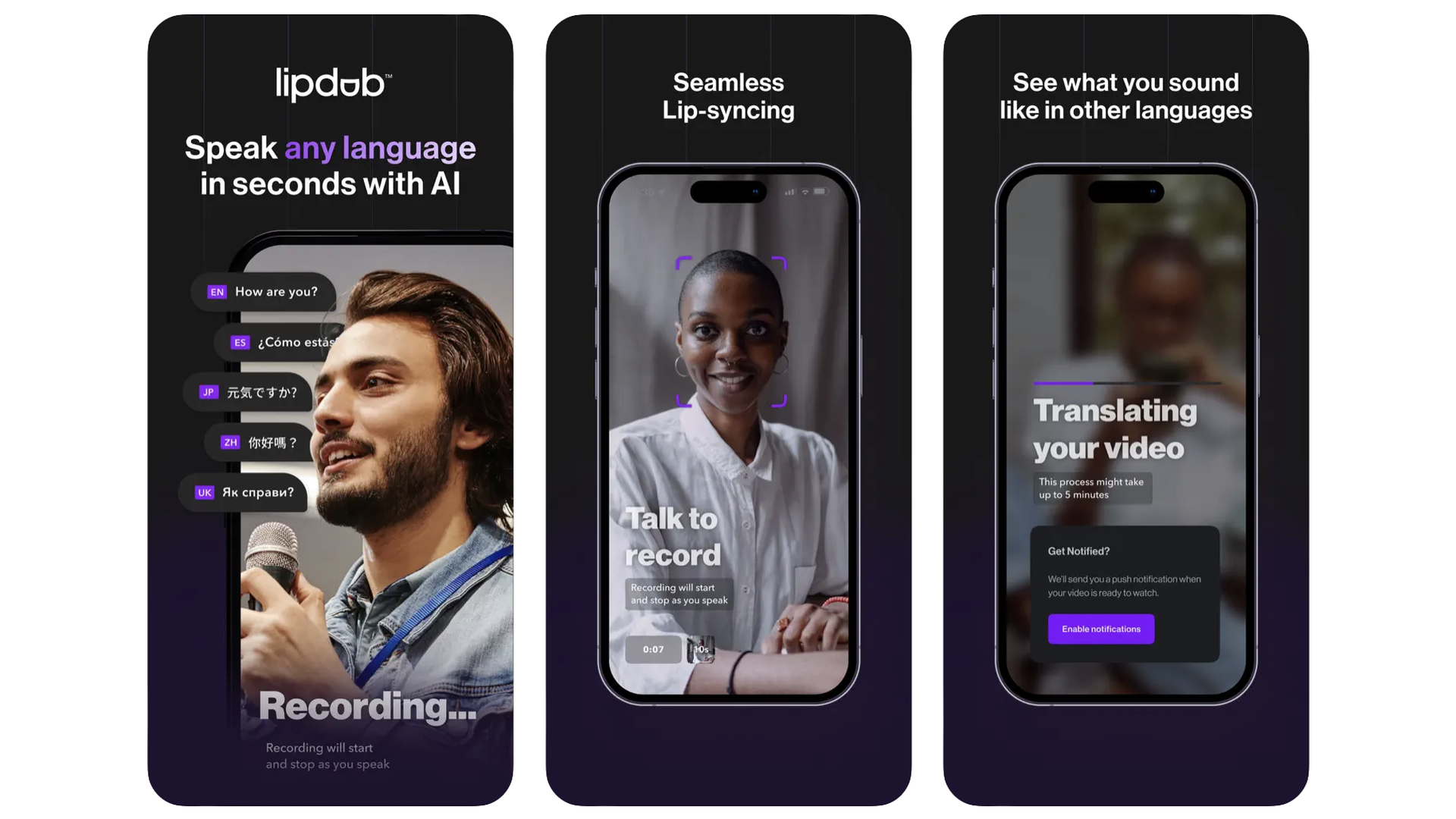
A new free app allows people to get their videos dubbed into 28 languages — in their own voice and with their lips synchronized to the translated audio, Ina reports.
The big picture: Lipdub, a free iOS app available for pre-order from New York-based AI startup Captions, demonstrates just how useful generative AI can be — but it also illustrates the technology's immense potential to create realistic looking fakes.
How it works: Lipdub requires people to record a video on their phone with only their face in view. The app uploads the video and returns it to the user in a few minutes with the new language overdub applied.
- In addition to foreign languages, Lipdub has added options like Texas slang, Gen Z, pirate and baby talk.
What they're saying: "Our hope is that the Lipdub technology will remove language barriers and ultimately allow more people to have their stories heard — stories that otherwise might be lost in translation," Captions CEO Gaurav Misra told Axios.
- Misra said Captions is clearly marking videos made using Lipdub as having been generated with AI.
- The 25-person startup first created a video studio app that offers automatic captioning using OpenAI's speech-to-text technology.
Between the lines: Misra said the hardest part of creating Lipdub was training its algorithms to mirror natural lip movement without training on individual speakers.
- "As you'll notice, the facial expressions of a person remain unchanged pre- and post-translation — only their lip movements change — resulting in a more natural appearance," Misra added.
What's next: Misra says generative AI should allow for real-time translation for broadcasts or video conferencing.
Go deeper: Watch the demo video. (Really, you should watch it.)
4. Training data
- Nvidia has canceled an AI summit planned for Oct. 15-16 in Tel Aviv, because of the war between Hamas and Israel. (CNBC)
- Disney has yet to respond to accusations that the new Loki poster uses AI-generated stock imagery from Shutterstock. (The Verge)
- Trading places: John Riccitiello is retiring as CEO and chairman of Unity in the wake of a controversy over a new pricing model that had game developers up in arms. James Whitehurst will be interim CEO, and Roelof Botha, chairman. (The Verge, Axios)
- Also trading places: Yelp's veteran antitrust campaigner Luther Lowe is joining Y Combinator as policy chief. (Axios)
5. + This
How cats purr. Think of it as feline vocal fry.
Thanks to Megan Morrone and Scott Rosenberg for editing and Bryan McBournie for copy editing this newsletter.
Sign up for Axios AI+

Scoops on the AI revolution and transformative tech, from Ina Fried, Madison Mills, Ashley Gold and Maria Curi.

