Axios AI+

November 25, 2026



Mady here after welcoming family to my NYC apartment last night ahead of the holiday!
Today's AI+ is 1,226 words, a 4.5-minute read.
1 big thing: Scoop: AI leaders clash over surrendering human free will

Top AI executives are increasingly pushing back against a common view inside Anthropic: that humanity should surrender some decision-making power to superintelligent AI systems, sources told Axios.
- That would put us on a slippery slope to forfeiting free will, critics say.
Why it matters: The debate has picked up steam as top AI companies develop models certain employees consider too powerful to ever release. Many see Anthropic as the first company that will confront these questions due to its lead at the frontier of AI development.
- While critics have yet to call out the company by name, their public defenses of human agency and control take direct aim at what some have come to see as the worldview of Anthropic CEO Dario Amodei.
- When AI systems far surpass human intelligence, Amodei has said repeatedly that it will be preferable to turn over decision-making for "life-critical" cases to AI, and also said AI should oversee research and potentially distribute economic resources.
Flashback: A product vision slide from several years ago that was revealed during litigation described Anthropic's "vision for a better world" as a "utopia ruled by god in a box."
The big picture: The thinking for Amodei and others is that once AI can demonstrably cure diseases, safeguard humans from harming themselves or prevent disasters better than any person, refusing to hand over control becomes irrational — or even unethical.
- Proponents point to self-driving cars to make their case: Once statistical evidence points to autonomous vehicles being safer than human drivers, it is logical for humans to drive far less, if at all, they say.
- An Anthropic spokesperson said Amodei has advocated for human control of AI in many public remarks and has developed the technology to ensure Claude doesn't undermine human oversight.
Driving the news: Rival executives are increasingly rebuking the notion that humans will surrender agency, even as major math and reasoning breakthroughs convince insiders that superintelligence is imminent.
- "We should not be okay with a 'handover' of society to AI," Meta's top AI leader, Alexandr Wang, wrote on X, reflecting on the importance of a coming superintelligence moment after an Anthropic breakthrough on a "Holy Grail" mathematics problem.
- OpenAI CEO Sam Altman rebuked this view earlier this month: "I want people to have the agency over the future. ... I think it's really important that we advocate for this."
Zoom in: Across podcasts and public interviews and in his writing, Amodei has for years pointed to specific arenas where he believes the best choice will be for humans to step back, although he has also said there will be "many cases where we do want to stay in charge" even if humans make worse decisions:
- Safety: In a February New York Times interview, Amodei said that in "life-critical, safety-critical cases, we really want to turn it over" to AI, noting society will simply need time to adapt.
- Defense: In a CBS discussion that month, he argued that fully autonomous weapons may eventually be "needed for the defense of democracy" if adversaries deploy them first.
- Education: In November 2024, Amodei noted that the traditional system of a professor supervising graduate students could be reversed, as "the AI systems will be the PIs, will be the leaders, and they'll be ordering humans or other AI systems around."
- Writing: In his 2024 essay "Machines of Loving Grace," Amodei suggested one possible future economy in which superintelligent AI systems distribute resources based on "what the AI systems think makes sense to reward in humans." He notes that the distribution could be "derived from human values."
The bottom line: The debate over superintelligence is no longer just about how to keep rogue machines from destroying humanity — it's about whether humans should be willing to voluntarily step aside.
2. Wes Moore's plan for an "AI earthquake"
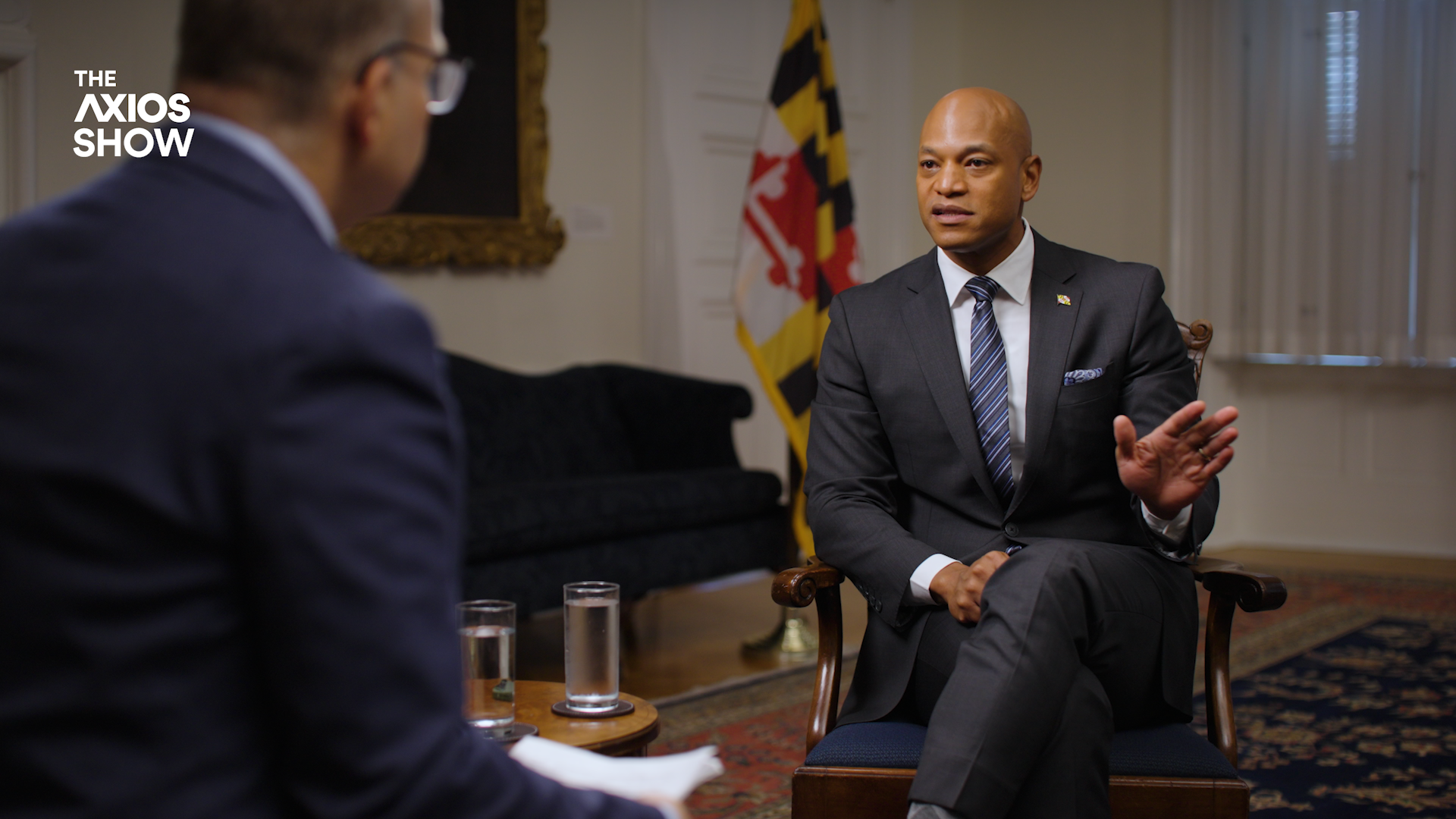
Maryland governor and potential 2028 presidential contender Wes Moore is sharpening his criticism of Washington's approach to AI, warning that political greed and billionaire influence are leaving Americans unprotected.
Why it matters: After an "AI earthquake" helped propel Democrats to a blue wave, Moore is urging Congress to treat oversight as a "100-hour emergency," noting that voters hate the technology because they fear losing control.
What he's saying: Moore's focus on AI in an interview with "The Axios Show" with Mike Allen is a testament to how central the issue is set to become in the 2028 presidential race. Here's what he said on a host of AI topics:
- On the pace of regulation: "We are watching a fast-moving technology that is being protected at a snail's pace."
- On why people hate AI: "Genesis 1 talks about how God gave humanity dominion over all land, air and sea. And that dominion was given to humanity, not to robots."
- On whether regulating AI lets China win: "This is not a question of U.S. versus China. This is a question of man versus machine."
- On a bubble: "We are in a bubble because you cannot have that much influence by such a small group of companies."
- On Nvidia and Trump: "It seems like it's rules for me, but not for thee. ... We are talking about not just millionaires, but billionaires who are sitting in a quiet room by themselves making this decision."
Watch the episode and subscribe to "The Axios Show" on YouTube.
3. How I use AI: Airbnb CTO Ahmad Al-Dahle

Airbnb CTO Ahmad Al-Dahle is both a person and a "skill" — an agentic tool he uses that's based on him, trained on his feedback and perspective so he can bounce ideas off of it any time.
Why it matters: Al-Dahle, who previously led Meta's generative AI efforts, is embracing AI agents in his own work, but he's cautious on broader AI agent access for customers.
- Even the most bullish AI users at companies are grappling with AI safety questions.
What follows is an edited version of our conversation:
Axios: Take me through a day in your life of AI usage.
- Al-Dahle: "I own a lot of different things, so part of what I have to do is broadly sweep all of the information that I need in order to be informed of what's happening across the company."
- Autonomous agents "scan all of my workplace tools and communication channels" like Slack and email, providing a read on various areas of the company on "almost an hourly basis if I choose."
- "I don't always trust exactly what it is, but it gives me enough signal to actually dive deeper."
Axios: What's one AI use case you can't live without?
- Someone at Airbnb built a tool Al-Dahle describes as "the CTO skill," trained on his feedback. "It's not bad, actually ... it has a kind of perspective I might have," he said, adding it's a helpful brainstorming tool.
4. Training data
- Jensen Huang acknowledged "terrible mistakes" in an Nvidia meeting but pushed back on succession planning and the notion that he was a "tech bro" who was "above the law." (Wired)
- Another day, another breach of a federal IT system — this time the CIA — using the "Artex" hacking tool. (New York Times)
5. + This
AI+ is dark the next two days as we celebrate the holiday. Hope you all have happy Thanksgivings. We're grateful for your readership!
Thanks to Bradley Olson for editing this newsletter and Matt Piper for copy editing.
Sign up for Axios AI+
