Axios AI+
April 11, 2024

Good morning, it's Ryan. I'm coming down from the clouds, literally: Axios' Building an AI-Powered Workforce event last night took place on the 102nd floor of New York's Freedom Tower. Today's AI+ is 1,190 words, a 4.5-minute read.
1 big thing: AI's bogus human benchmark
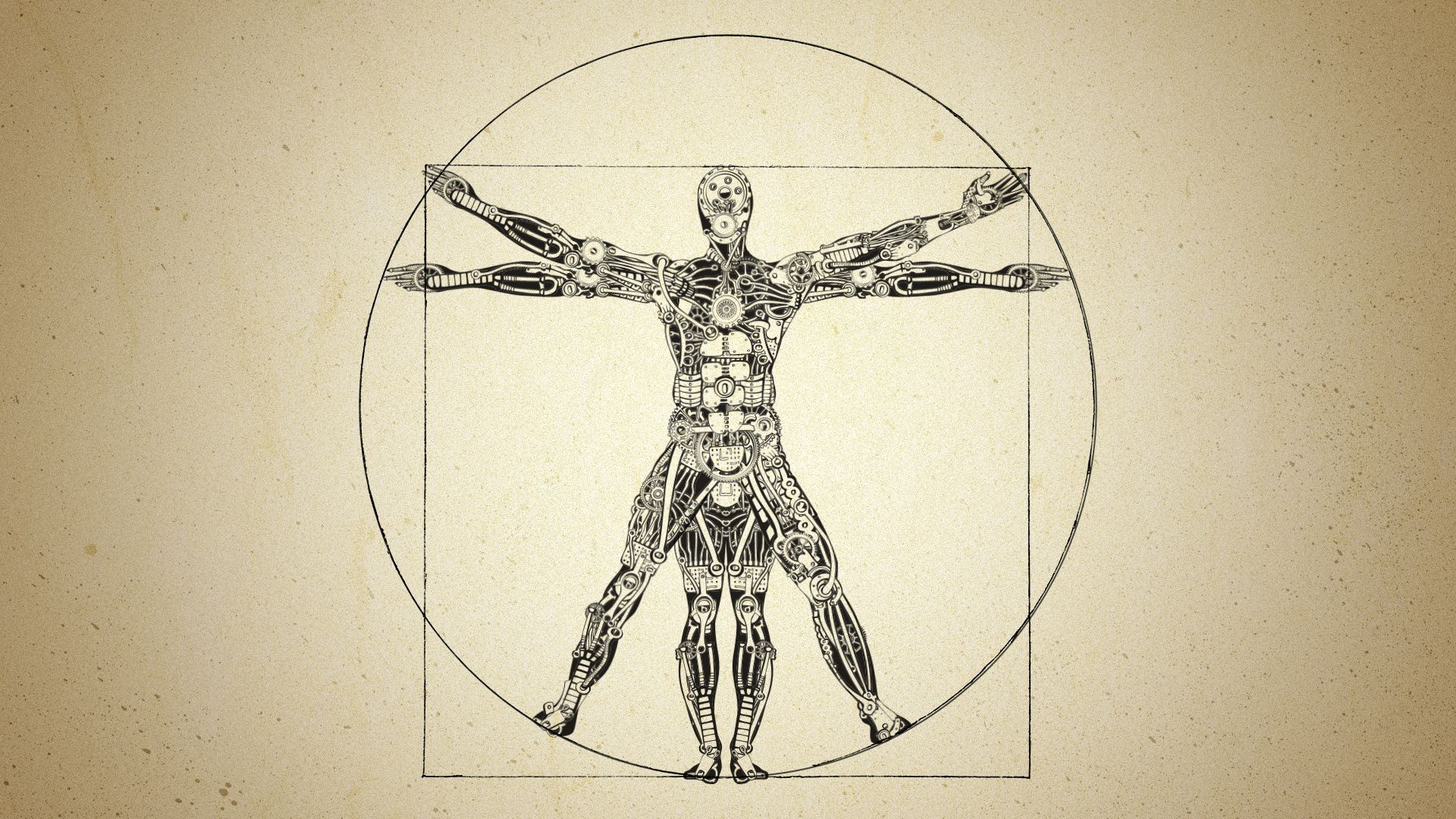
Illustration: Aïda Amer/Axios
Some of the tech industry's loudest voices — most recently Elon Musk — keep aiming for AI to become "smarter than humans," yet there isn't agreement on what that bar is, reports Axios' Alison Snyder.
Why it matters: If we obsess over this fuzzy human-centric yardstick for AI's abilities, we could miss out on promising — but decidedly non-human — ways machines could meet actual human needs.
- "The real problem is that we view AI systems as similar to humans," Konrad Kording, a neuroscientist at the University of Pennsylvania who studies machine learning, tells Axios.
- "We anthropomorphize them. They are different."
Driving the news: Musk on Monday (again) shared his prediction that "we'll have AI that is smarter than any one human, probably, by the end of next year."
The other side: Meta AI chief Yann LeCun this week (again) said human-level AI is still far in the distance.
The big picture: These conflicting timelines and predictions swirl around decades-old questions about artificial intelligence that are being recast through the lens of ChatGPT and other generative AI tools driving a new AI era.
As the field notches technical advances, experts warn that "smart" isn't a meaningful metric.
- "There is no widely accepted definition of intelligence or 'smart,' so there is no general test that people use," says Blake Richards, a professor of computer science and neuroscience at McGill University.
State of play: For years we tracked AI performance against chess games and the Turing test. Today, AI models can be evaluated with SATs, legal exams and other human tests.
Yes, but: "That's partly because these measures are more meaningful in constrained settings," says Michael Littman, a computer scientist who directs the Division of Information and Intelligent Systems at the National Science Foundation.
- But while today's general models have "remarkably broad capabilities" that can be tested with these benchmarks, "I wouldn't exactly use the word 'smart,' that's a bit too human," says Zachary Lipton, a computer science professor at Carnegie Mellon University and CTO and CSO of Abridge, a health care AI company.
- Lipton points to the calculator. It's "much 'smarter' than humans at performing arithmetic calculations, and yet much less capable at higher math," he says.
Reality check: These tests don't capture key aspects of intelligence, including reasoning, planning and the smarts that come from interacting with the surrounding world in order to survive and thrive in it.
Zoom in: Human intelligence is tied to our experience of ourselves in the world. "We all face the undeniable truth of death at some point," says Songyee Yoon, president and chief strategy officer at NCSOFT.
- "When young, we tend to explore more and take risks. As we age, we exploit what we've learned or accumulated, paving the way for future prosperity," she says. "Deciding when to transition between these phases gradually is also a trait of 'smartness.'"
- "AI, however, doesn't have a fragile body or limited lifespan like us. Its understanding of life and humility towards death is significantly different."
Zoom out: The University of Pennsylvania's Kording suggests one specific way we could identify an AI that's smarter than an individual human: It would have to be "better than humans at dealing with completely new problems that emerge in this world."
- The "key is new," Kording adds. He wrote in an email that "having data from humans solving roughly the same problems does not count."
The intrigue: Humans may not even be the goal to match. "Intelligence is not a one-dimensional quantity," says Kyunghyun Cho, a computer scientist at NYU.
- Humans, primates, mammals, reptiles, fish, insects and bacteria are "all intelligent in their own ways and along different axes," he says.
- "It would be a silly question to ask whether AI, which would be just one dot in this high-dimensional space of intelligence, is smarter or dumber than any other dot, including ourselves," he says.
The bottom line: "Our conception of intelligence is still quite incomplete, and by creating software that can match certain attributes of it, it brings more clarity to what intelligence actually is and is not," Littman says.
2. Docusign's pivot to making contracts smarter
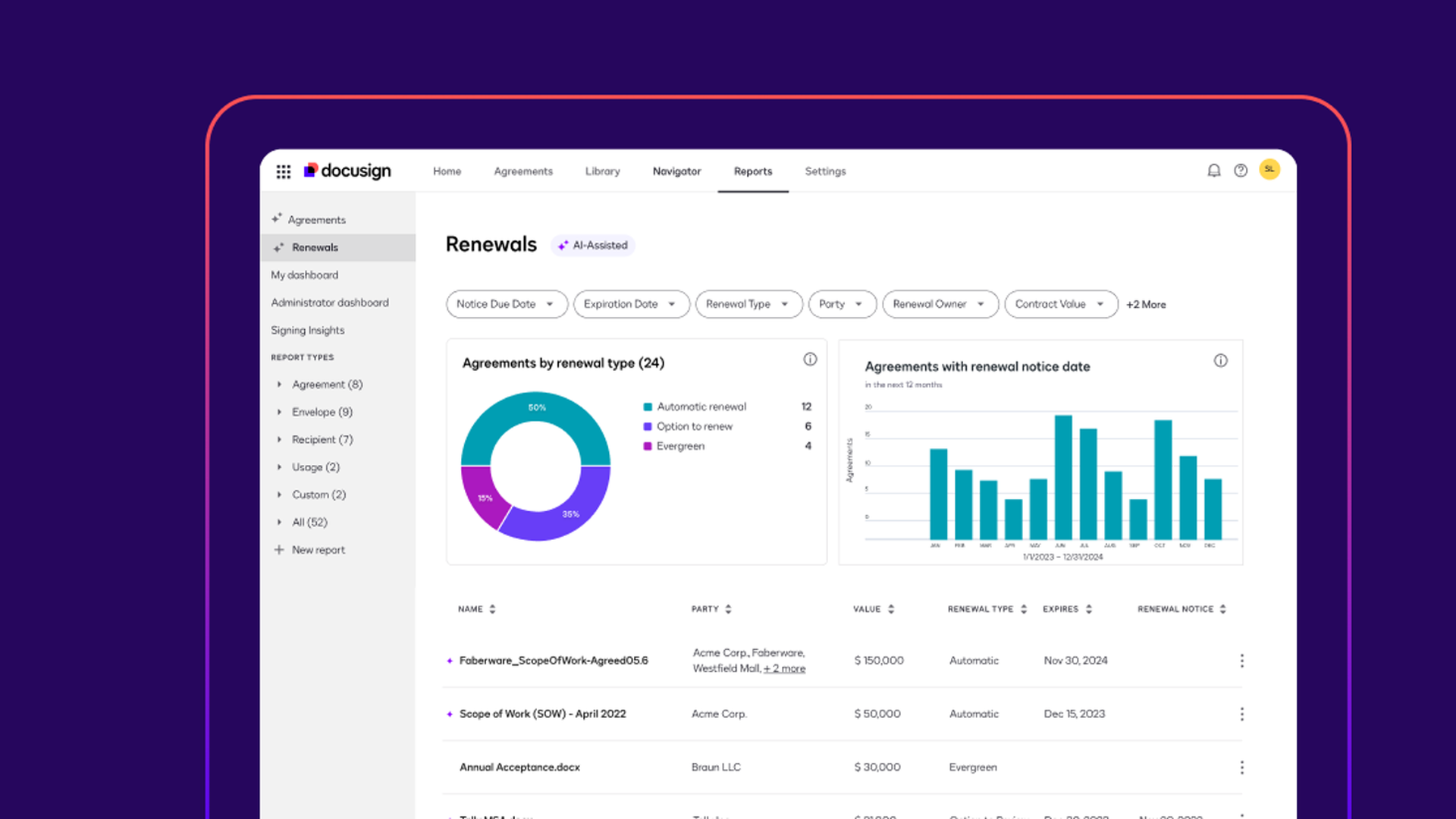
Image: Docusign
Docusign, the e-signature giant, announced today it is moving into a new software category — contracts — and will soon offer an AI-powered "intelligent agreement management platform."
Why it matters: Contracts are at the heart of most businesses — but they're a frequent pain point.
- Employees and lawyers waste huge amounts of time and money drafting, reviewing and signing them — then they discover that they failed to get what they intended, or allowed them to accidentally lapse.
- Deloitte calculates the total global economic loss to slow and error-prone contracting processes at an eye-watering $2 trillion.
Docusign CEO Allan Thygesen said in a blog post that he believes its new contract tools are "the first entrant in a new Intelligent Agreement Management SaaS category."
- The company's goal is to provide a central place for all agreements drafted or signed by an organization.
- Docusign says its new platform is to paper contracts what digital maps are to paper ones.
Between the lines: The "intelligent agreements" Docusign will be offering are not to be confused with the "smart contracts" common in the blockchain and cryptocurrency world, which are more like agreements that execute themselves when certain conditions are met: self-driving deals.
- Intelligent agreements incorporate AI and advanced analytics to help users spot contract risks and speed up contract processes.
How it works: Docusign is taking a hybrid approach with its AI models: a mix of its own foundation models and external LLMs.
- Retrieval augmented generation is used to provide assurance to customers that the tools are not "hallucinating" or making stuff up, which could be disastrous in reviewing contracts.
- The promise is that using generative AI models will make all contracts fully searchable and summarizable, helping to ensure coherent standards across an organization's contracts, avoid lapsed contracts and ease enforcement.
Yes, but: Docusign's new platform won't launch until late May, the company said.
- That could create an opportunity for larger companies — including Box, which already offers central repositories and automation services for contracts — to upgrade their offerings.
Context: Other specialized players such as Robin, which offers an AI copilot for contract lawyers, are aimed at law firms and in-house counsel.
What they're saying: "Companies managing more than 20,000 agreements each year can increase revenue by $44 million or more by improving systems and processes," says Rohan Gupta, principal at Deloitte Consulting, which works with large companies.
3. Training data
- Last year, Microsoft pitched OpenAI products such as DALL-E at Defense Department events. (The Intercept)
- Trading places: Radha Plumb is the new DoD chief digital and artificial intelligence officer.
- OpenAI CEO Sam Altman is continuing efforts — this time in the UAE — to mobilize investments in the chips, energy and data centers needed to scale up AI around the world. (Bloomberg)
- Russian-owned cybersecurity firm Kaspersky Lab may be prevented from providing software to U.S. firms and residents under a draft executive order the White House is considering. (CNN)
4. + This

Photo: Samantha Hill
The view you missed if you weren't at Axios' AI event last night in New York City (h/t to AI+ reader Samantha Hill for the pic).
Thanks to Scott Rosenberg for editing this newsletter and to Caitlin Wolper for copy editing it.
Sign up for Axios AI+

Scoops on the AI revolution and transformative tech, from Ina Fried, Madison Mills, Ashley Gold and Maria Curi.