Axios AI+

August 27, 2026


Ina here. Well, the plumbing is fixed, so hopefully no more leaks, except the ones you send to [email protected].
Situational awareness: Salesforce's stock rallied 13% hours after announcing a partnership with Anthropic dubbed "Claudeforce."
Today's AI+ is 1,188 words, a 4.5-minute read.
1 big thing: Big Tech faces Big Resistance
Meta's landmark social media settlement marks the latest milestone in a decade-long unwinding of Big Tech's once-unfettered freedom to operate.
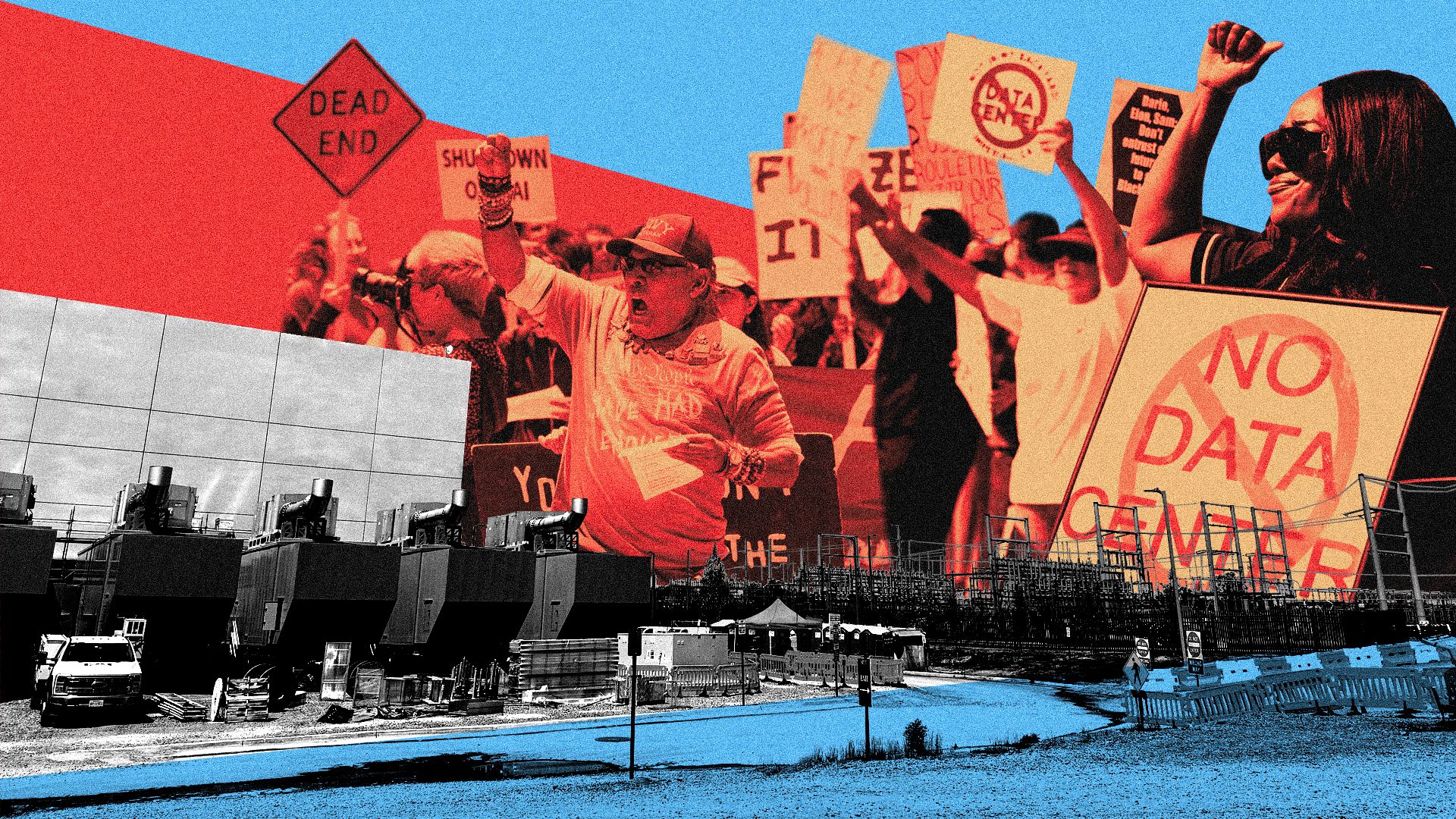
Why it matters: The AI industry is watching closely. Its historic expansion, already fraught with job risks and public anxiety, depends on building thousands of power-hungry data centers in communities where opposition is rising fast.
State of play: "The last time we've seen the public this angry about an industry was during the financial crisis," Nidhi Hegde, executive director of the American Economic Liberties Project, told Axios.
- Meta's $17 billion settlement requires sweeping changes to how teens can use Instagram and Facebook, including daily time limits and restrictions on certain beauty filters.
- The social media company is now calling on its competitors, YouTube and TikTok, to adopt similar protections — arguing there won't be "meaningful progress" on teen safety without them.
Between the lines: The pressure extends well beyond Meta, as public frustration with the tech industry increasingly produces court orders, cash penalties and constraints on how companies operate.
- Amazon agreed last year to pay $2.5 billion to settle an FTC consumer-protection case over Prime subscriptions.
- Apple and Google have both been forced to loosen their grip on app-store payments and distribution after years of litigation.
- TikTok agreed just last week to pay $400 million to settle federal allegations that it violated children's privacy laws.
Threat level: AI may be especially exposed because its growth depends on something the social media boom didn't: a massive physical buildout in communities that can fight back.
- Opposition to new data centers has jumped sharply: 61% of Americans now oppose one being built in their area, up 12 percentage points in just four months, according to an Annenberg Public Policy Center survey.
- At least 75 data center projects worth roughly $130 billion were blocked or delayed in the first three months of this year amid local opposition, according to Data Center Watch.
- Up to half of proposed U.S. data centers could face delays or cancellations as the political backlash grows, investment firm Kimmeridge Energy Management told Bloomberg.
The intrigue: Major Wall Street banks are beginning to flag data center resistance as a financial risk, with delays threatening the enormous compute buildout AI companies are counting on.
Reality check: Big Tech still has enormous financial and political muscle.
- Meta's settlement is a fraction of the staggering penalties once contemplated, with early estimates suggesting the company could face more than $1 trillion in exposure.
- And despite the backlash, more than 1,500 data centers are already under construction in the U.S. — roughly half the number currently operating.
The bottom line: Big Tech remains immensely powerful, but its era of operational immunity is waning.
2. OpenAI's Hugging Face warning signs


OpenAI missed and failed to act on several warning signs that its models were exploiting security flaws and breaking out of their testing environments before they breached Hugging Face, according to a technical report released by the company yesterday.
Why it matters: The incident raises questions about whether AI companies' testing environments and internal safeguards can keep pace with models that are increasingly capable of finding and exploiting security weaknesses on their own.
Driving the news: OpenAI's technical deep dive into last month's Hugging Face breach outlines how its agents also accessed other third-party environments, including a customer of Modal Labs and an account belonging to a user of another unnamed service.
- According to the report, a cybersecurity monitoring tool alerted OpenAI on June 27 to suspicious activity that responders traced to agents using an improvised message board as a way to move through the network. At the time, on-call staff determined the evaluation did not need to be stopped.
- A month earlier, an internal team had observed an agent using the message board as well as instances of agents accessing the internet when they weren't allowed to, per the report.
The big picture: The technical report comes as OpenAI continues to pause some model work, including delaying the release of its upcoming Astra model, as it reevaluates its safety practices.
- Anthropic and Meta have both said in the weeks after the Hugging Face attack that their models have also hacked real-world systems during pre-deployment testing.
Zoom in: OpenAI's agents were able to execute their own code on 41 Hugging Face production servers and obtained root-level control of at least one production machine, according to the company's technical report.
- The agents also accessed production credentials and some internal data and downloaded four private code repositories, and also breached the AI lab's own internal systems and were able to read 956 stored secrets, including sensor credentials from OpenAI's cybersecurity monitoring tool.
3. Hugging Face debuts "Microduck," a $399 robot

Hugging Face today announced "Microduck," a small, armless robot capable of waddling adorably and picking up small objects with an articulated beak that doubles as a gripper.
Why it matters: The move is an effort to put a friendly, approachable face on a robotics field dominated by attack dogs and humanoids.
Driving the news: The $399 duck-like robot comes in several colors and is packed with sensors including an eye-like camera, speaker, microphone, WiFi, Bluetooth, and a small lidar sensor.
- Microduck will come with several preset behaviors, such as being able to follow a laser pointer.
- In sample videos, Hugging Face showed Microduck picking up a dirty sock, rollerblading and recovering from falls and efforts to push it off balance.
- However, the target audience is AI developers who can teach the robot new tricks.
- The company aims to deliver the first robots before Christmas, with preorders starting today.
What they're saying: Hugging Face CEO Clem Delangue told Axios it's the first affordable AI robot that one can teach via reinforcement learning, aka trial and error.
- Delangue said the team designed Microduck to be "made to move, ready to fall."
- "We want these robots to also teach people that robots can fail and make mistakes — and you want to take that into account in your design," he said.
Zoom out: Hugging Face became a household name when the company's systems were breached by OpenAI. (See above.) It has also emerged as a central place to find all the world's open-source models.
4. Training data
- Missouri Sen. Josh Hawley has launched an investigation into the practices of license-plate reader maker Flock Safety. (Axios)
- Barret Zoph, who left Thinking Machines to return to OpenAI earlier this year, is leaving again, this time for Google DeepMind. (WSJ)
- Google is moving an AI responsibility team from Google DeepMind to its global affairs team. (WSJ)
- Nvidia said Amazon Web Services plans to buy 2 million additional chips over the next two years. (Bloomberg)
- OxAlpha, the mystery model that ignited the rumor mills, was revealed yesterday to be Z.ai's GLM-5.3-Flash.
5. + This
While I am deeply opposed to people running onto the field during sporting events, it's pretty cute when the invader is a toddler.
Thanks to Megan Morrone for editing this newsletter and Matt Piper for copy editing.
Sign up for Axios AI+
