Axios AI+
July 18, 2025

🤖 Mark your calendars: Axios will host our second of three AI+ Summits this year on Sept. 17 in Washington, D.C., featuring top voices from government, tech and business exploring the urgent questions around AI regulation, geopolitics, misinformation and real-world impact. Interested in attending? Sign up for updates here.
Today's AI+ is 957 words, a 3.5-minute read.
1 big thing: Inside Trump's AI action plan


The Trump administration's AI action plan, set to roll out by the end of the month, is largely about messaging a hands-off, pro-growth approach to AI, according to two people who have been briefed on the document.
Why it matters: The action plan is a major opportunity for the Trump administration to outline its AI agenda.
What's inside: The 20-page plan has involved dozens of stakeholders from the White House and across federal agencies, per sources.
- The action plan includes some requests for information from the private sector and guidance documents.
- But sources said the plan largely lays out the Trump administration's aspirations for AI, some of which officials have already stated, including promoting innovation, reducing regulatory burdens and overhauling permitting.
- The plan details specific goals that officials believe can be completed in Trump's second term.
The plan is unlikely to wade far into debates on copyright and model transparency, per one source familiar with the matter.
What they're saying: "As called for in the January EO and as Admin officials have discussed publicly, the AI Action Plan is due to the President at the end of July," White House Office of Science and Technology Policy spokesperson Victoria LaCivita said in an email.
- "The Plan will deliver a strong, specific, and actionable federal policy roadmap that goes beyond the details reported here and we look forward to releasing it soon."
What we're watching: Executive orders are also in the works, but details aren't set in stone, and some may still face legal hurdles, according to the same sources.
- One EO is expected to be on AI infrastructure and another is on promoting exports to enhance access to U.S. tech.
- A third led by AI czar David Sacks would aim to combat "woke" AI by requiring that the government only acquires neutral tech. It would be modeled after Trump's first-term EO to combat alleged censorship, sources said.
If you need smart, quick intel on federal tech policy for your job, get Axios Pro Policy.
2. ChatGPT's new agent blends research and action

OpenAI says its new ChatGPT Agent, introduced yesterday, is capable of starting and finishing complex web and computing tasks independently.
Why it matters: Agents are a buzzy concept in AI right now, but exactly what they can do in real-world settings without humans is just beginning to come into view.
Zoom in: ChatGPT Agent can follow prompts like "look at my calendar and brief me on upcoming client meetings based on recent news," "plan and buy ingredients to make Japanese breakfast for four," and "analyze three competitors and create a slide deck," per OpenAI's blog post.
- The tool combines the web activity features of Operator, the agent OpenAI released last year, with ChatGPT's deep research capabilities and conversational interface.
- Like Operator, ChatGPT Agent will ask permission "before taking actions of consequence," like entering passwords or payment information. Users can also take over the browser at any time.
- OpenAI CEO Sam Altman cautioned in a post on X that the tool could still be exploited by "bad actors."
- "I would explain this to my own family as cutting edge and experimental; a chance to try the future, but not something I'd yet use for high-stakes uses or with a lot of personal information until we have a chance to study and improve it in the wild."
Zoom out: Subscribers to the Pro, Plus and Team paid versions of ChatGPT can start using the new agent now, according to OpenAI.
Yes, but: Users found Operator didn't save them much time because it required a lot of human interaction. OpenAI says this new tool broadens its agent's "real-world utility."
3. Getty wants humans to outshoot AI at World Cup


Getty is working hard to ensure its photographers remain the visual storytellers at the upcoming FIFA World Cup.
Why it matters: "We feel a lot of pressure to overdeliver and not have clients wondering what else is out there," Getty staff sports photographer Carmen Mandato tells Axios.
- "We need to figure out how to get something in their hands fast enough so that they're not tempted to go see what AI could do for them."
Reality check: The authorized photographic agency of FIFA offers its own generative AI tools but disallows the use of AI in the creation of images contributed by third parties.
- Editorial photos used by the media are still shot by human photojournalists.
- They rely on their own wired internet connection in addition to mobile hotspot devices "the size of a small baby" that each photographer has to carry.
Getty prepares for major events years in advance to ensure staff have all the necessary technology at each venue, Mandato says.
By the numbers: Over 35 editorial photographers took more than 1 million images over the course of a different event, the recent FIFA Club World Cup, according to Getty.
- The digital photography company estimates it will capture 2.5 million images at the 2026 World Cup.
The bottom line: Although "AI has taught everybody that anything's possible," Mandato says, Getty is "afraid to be complacent."
4. Training data
- Authors can now bring a class action lawsuit against Anthropic for allegedly pirating their books to train its AI models, a judge ruled. (Reuters)
- Nvidia said its new AI weather tool can generate an accurate 15-day global forecast in just 64 seconds. (Axios)
- Mistral added deep research and advanced imaging to its Le Chat chatbot. (TechCrunch)
- Critics say Delta's plan to do away with fixed pricing for flights and use AI to determine what travelers should pay will be "predatory." (Ars Technica)
5. + This
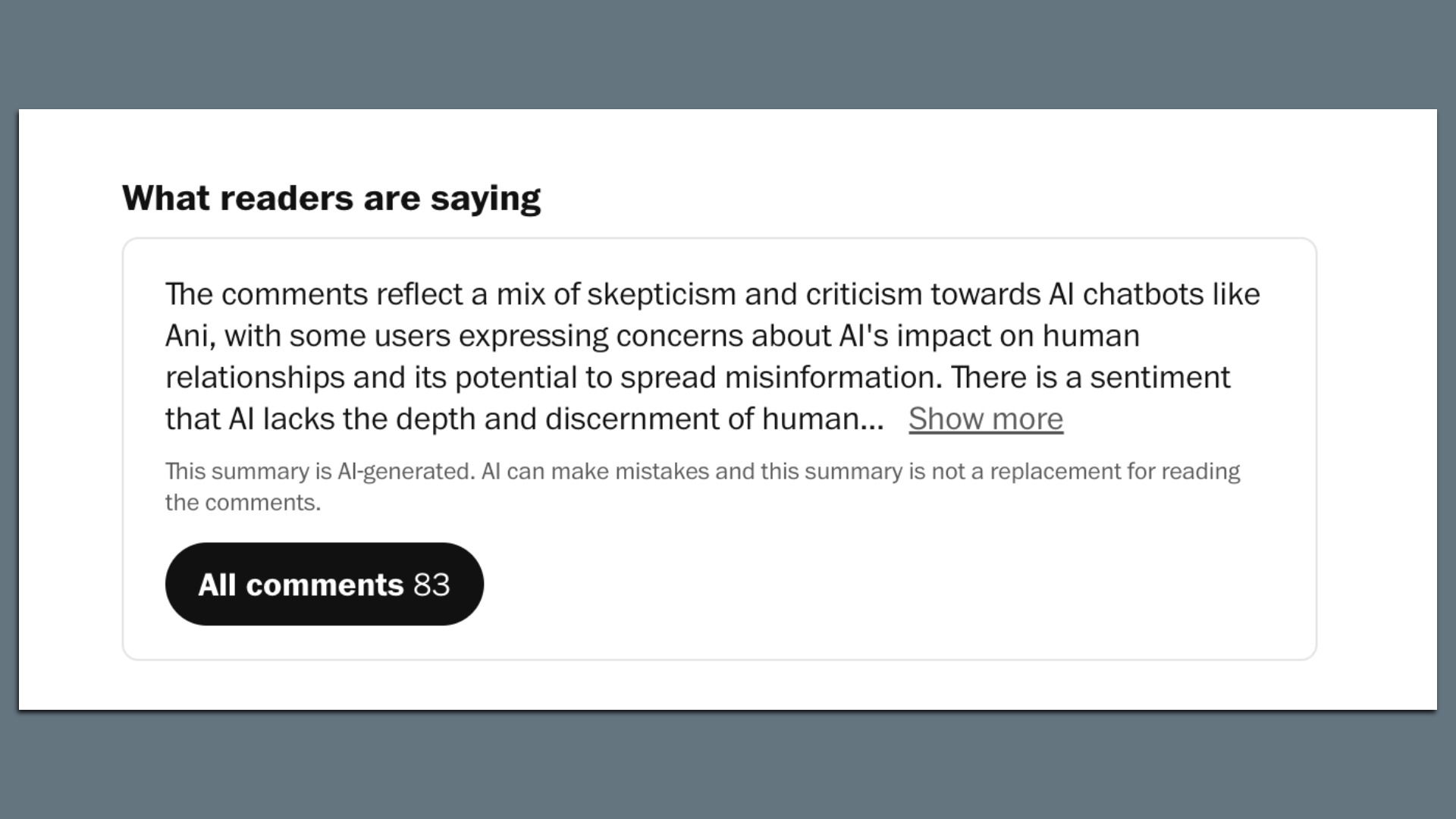
If you read to the end of Washington Post opinion writer Monica Hesse's beautiful essay about Grok's new companion bot and the death of poet Andrea Gibson, you will find the AI-generated summary of the reader comments, which is the most meta thing I've read in a long time.
Thanks to Scott Rosenberg for editing this newsletter and Matt Piper for copy editing.
Sign up for Axios AI+
