Axios AI+

March 18, 2025

1 big thing: AI is "tearing apart" companies, survey finds

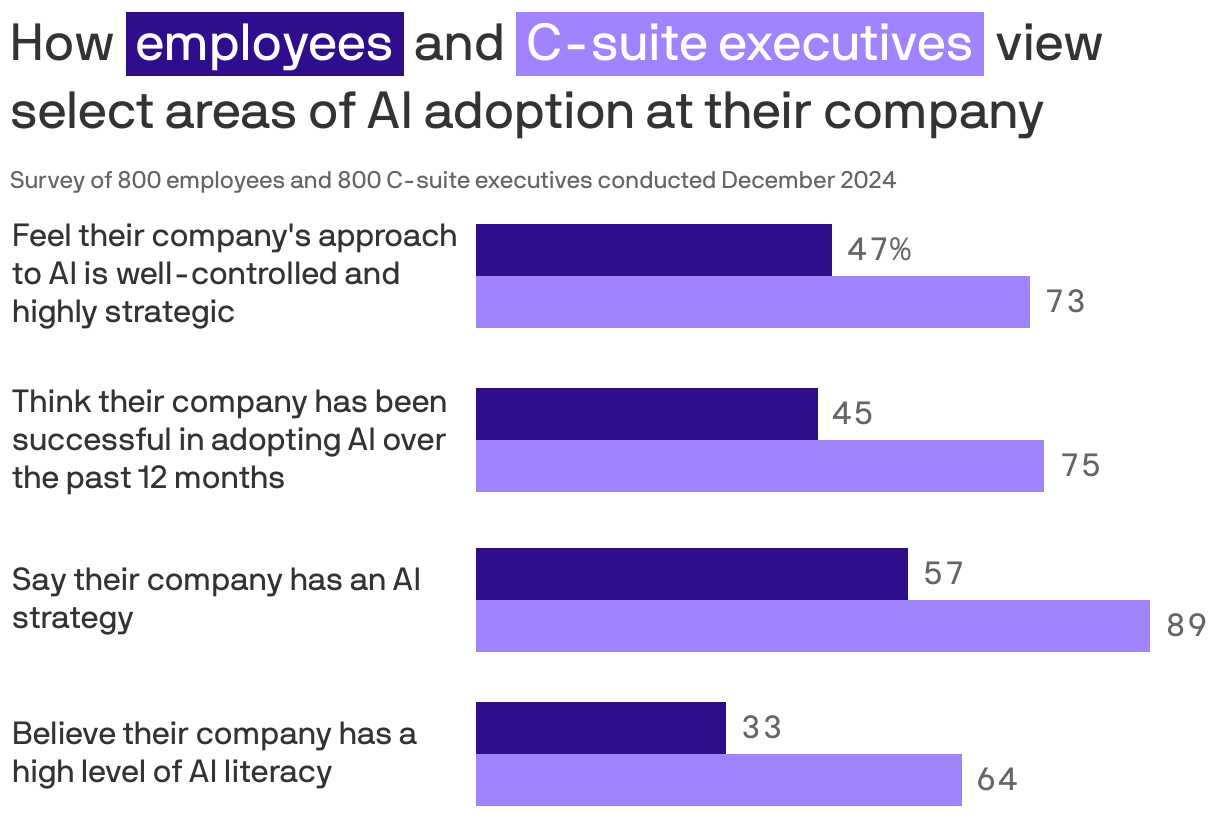
AI adoption in the workplace is deepening divisions and sparking new power struggles between leaders and workers, with half of executives saying that AI is "tearing their company apart," according to new research from Writer, the enterprise AI startup.
The big picture: Executives are pushing AI as an inevitable revolution, but workers aren't buying it.
Driving the news: Nearly all (94%) C-suite execs surveyed say they're not satisfied with their current AI solution.
- 72% of C-suite leaders say their company has faced "at least one challenge" in adopting AI.
- 71% of these leaders complain that their AI applications are being created "in a silo."
Stunning stat: 59% of the executives say they're "actively looking for a new job with a company that's more innovative with generative AI."
- Among employees, the number is 35%.
How it works: The study surveyed 800 C-suite executives and 800 employees in December 2024 at enterprise organizations from 100 to over 10,000 employees in industries including technology, financial services, retail and consumer goods, health care, pharmaceuticals, and life sciences.
- Employee respondents had to be using generative AI at work, and C-suite respondents were from companies that permit genAI use.
- Employees had to work in finance, HR, legal, marketing, sales or customer support.
Zoom in: Even those C-suite leaders who believe their AI integration is proceeding smoothly are handing down policies and tools to a workforce that is more frustrated than they are.
- Less than half (45%) of employees — versus 75% of the C-suite — think their company's AI rollout in the last 12 months has been successful.
- Only 57% of employees say that their company even has an AI strategy — but 89% of the C-suite believes they do.
Catch up quick: Workplace tensions have proven tough to resolve, with discontent building at least since the ChatGPT-led AI boom started at the end of 2022.
- According to a May 2024 study from IBM, nearly two-thirds (64%) of leaders said their organization needs to embrace AI despite the fact that it will change jobs faster than employees can adapt.
- According to a 2024 LinkedIn report, 53% of employees said they hid their AI use from employers for fear that it would make them look replaceable.
- Last July, performance management company Lattice loudly proclaimed that AI bots should be "part of the workforce," including taking spots in corporate org charts. The company quickly reversed course after a backlash.
The intrigue: May Habib, CEO of Writer, says the pushback from employees stems both from fear of being replaced by AI and AI tools that aren't suited for the job.
- Around half of employees say AI-generated information is inaccurate, confusing and biased.
- 41% of Millennial and Gen Z employees confess to sabotaging their company's AI strategy by refusing to use AI tools or outputs.
Many workers believe that AI is going to change their jobs so much that they're no longer going to be in a job. Asking those employees to embrace AI is like "asking a turkey to vote for Thanksgiving," Habib tells Axios.
- Execs are often so far removed from the actual implementation of AI on a worker level that they don't see or understand this fear and resistance, Habib says.
- To counter it, Habib argues, leaders need to show employees that they're using AI to grow the company's output and that there's no way to do that without keeping the company's current workers.
Yes, but: Even employees who are optimistic about AI's potential still struggle to embrace tools that simply don't work.
- "Employees are so unhappy with their employer's tools that 35% are paying out-of-pocket for the generative AI tools they use at work," according to the study.
Habib has little patience with companies that view workplace AI as synonymous with chatbots.
- "We're all sick of the f---ing chatbots," she says. "Don't ask me to use another chatbot."
- Instead of chatbots, Writer offers enterprise companies pre-built agents to do what Habib calls "big work orchestrations."
The bottom line: C-suite execs tout AI as a competitive necessity and urge workers to get on board — but broken tools and employees' job fears continue to make the road to AI adoption rocky.
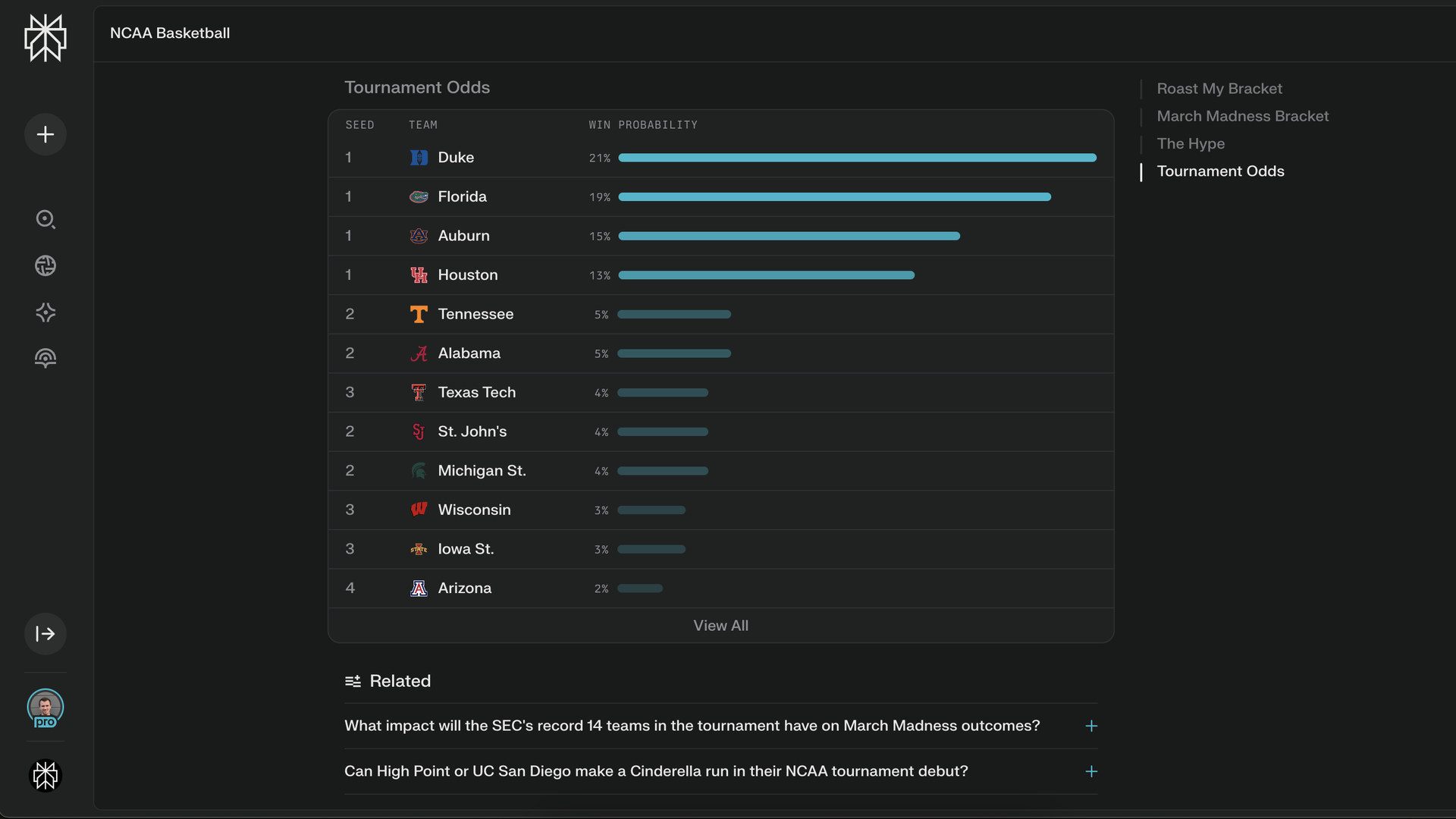
2. Exclusive: Perplexity, Kalshi partner on hoops
3. Training data
4. + This
Axios AI+
