Axios AI+
January 28, 2026

We're only starting to grapple with the risks of giving kids open access to chatbots. The social media lawsuits Ashley and Maria wrote about yesterday offer a preview of what could come next.
Today's AI+ is 1,078 words, a 4-minute read.
1 big thing: Google sharpens pitch to mayors


Google is rolling out an updated "Mayors AI Playbook" with the U.S. Conference of Mayors at the group's Winter Meeting in Washington today, the company first told Axios.
Why it matters: Cities are spending more on technology, but staff often lacks the expertise to deploy AI safely and at scale. Whoever helps them cross that gap could lock in years of government contracts.
The big picture: Google's first AI playbook for mayors was about awareness. Now, it's about action: a blueprint for implementing AI strategies at the local level.
What they're saying: "[T]he most important step you can take now is to just start. Don't wait for the perfect moment, the opportunity is now," Tom Cochran, USCM CEO and executive director, said in a statement.
- "AI is a tool that allows us to punch above our weight, while still being fiscally responsible," Michael Owens, mayor of Mableton, Georgia, said.
- Google says the playbook aims to help local leaders experiment with and scale AI.
Between the lines: This isn't benevolence. It's customer acquisition.
- Mayors don't just buy "AI." They buy cloud, data modernization, cybersecurity, services, and long-term support — the tech stack underneath any serious deployment.
- In return, cities get tools that could fix long-standing challenges, Cris Turner, vice president of government affairs at Google, told Axios last June when it first released its playbook.
Zoom out: Google's Mayors AI Playbook is designed to help city leaders scale AI-driven solutions and programs through two parts:
- How to build an "AI-ready city" — governance, procurement, staffing and the basics needed to roll out tools safely and effectively.
- "AI in action" — use cases for city services like multilingual resident communications, call center modernization, document review and research.
Threat level: Google's competitors want their tech to run cities too.
- Nearly 30,000 San Francisco city employees use Copilot, powered by ChatGPT.
- Anthropic is building out a public sector team and offers partners across all branches of government access to Claude for $1.
- OpenAI, Google and Anthropic are government-approved AI vendors, which could simplify adoption for local entities.
Reality check: Demand is there, but execution lags.
- Almost half of 650 local government officials surveyed said AI use is low priority, according to a 2024 study from the International City/County Management Association.
- 77% said the biggest barrier to adoption was a lack of awareness and understanding.
- Any AI skills gap among government leaders could lead to tech disparities across cities, with those with leaders who embrace AI potentially getting a head start.
Zoom in: Google provided several examples of cities already deploying AI to save time.
- NYC faces over 100 billion weekly cyber threats. An AI-enabled platform analyzes risks, whittling them down to under 60 that staff can focus on.
- Miami is automating parts of the zoning verification process to speed up housing projects.
- San José has deployed the technology to allow for real-time language translation on its 311 portal.
The bottom line: Google and its rivals stand to profit as cities adopt AI.
- Early deployments suggest the technology can save overworked staff time, as long as it's implemented efficiently.
2. Bill Gates and others reflect on AI


We're all humans first, and only then journalists, founders, philanthropists or experts. And AI is fast reshaping how we work, think and find meaning.
Catch up quick: Anthropic CEO Dario Amodei warned this week of the imminent "real danger" that superhuman intelligence will cause civilization-level damage absent smart, speedy intervention.
What they're saying: Other tech leaders share similar fears.
- "I'm certainly most scared about the loss of meaning in human life," said Varun Sivaram, founder of startup EmeraldAI. He's referring to the loss of reason to do economically useful work, which gives people initiative in life.
- Some people may see AI as helping liberate them from their jobs, Sivaram said, instead spending their time just seeing art and music.
- "But a lot of people don't want only that right? And I really worry about that a lot for the human soul," Sivaram said.
Reality check: Others emphasize agency over inevitability.
- "I think what's missing in this conversation is the idea we have agency. We get to make choices," said Mike Schroepfer, former CTO of Meta, now a founder of cleantech venture capital firm Gigascale Capital.
- He can choose not to use GPS to preserve his sense of direction, Schroepfer tells Axios.
- "I have faith in people to make good decisions about it and figure it out as we go along," he said.
Inside the room: In a live interview last fall with philanthropist Bill Gates at Caltech, he responded with humor that carried an uncomfortable truth.
- "Someday the AI is going to say to me, 'Hey, stop messing around trying to eradicate malaria. I'm so much smarter than you. You just go play pickleball, and I'll get back to you.' And I'm going to be a little disappointed, like 'Oh geez, I'm not that good at pickleball,'" Gates told me.
3. Pinterest layoffs show job market's AI cracks


Pinterest announced that it plans to lay off "less than 15%" of its workforce.
Why it matters: The broader corporate landscape has so far suggested that artificial intelligence isn't triggering a job apocalypse, but Pinterest has now directly linked cutting human roles to AI.
Driving the news: The image-sharing site announced the coming layoffs in a securities filing, saying that it expects the cuts to be complete by the end of its third quarter in late September.
4. Training data
- Chinese AI company Moonshot says its new model — K2.5 — can simultaneously process text, images and video from one prompt. (Bloomberg)
- China has cleared domestic tech giants including ByteDance, Alibaba and Tencent to import Nvidia's H200 chips. (Reuters)
- Anthropic planned to destroy millions of books after feeding them to its model for training, according to new documents from the copyright case Anthropic settled last year. (Washington Post)
- Tech companies and startups are racing to find smarter, more responsive grid solutions to handle AI's rapidly growing energy demand. (Axios Pro)
- SoftBank — already one of OpenAI's biggest investors — has reportedly agreed to invest $30 billion more in the company. (WSJ)
5. + This
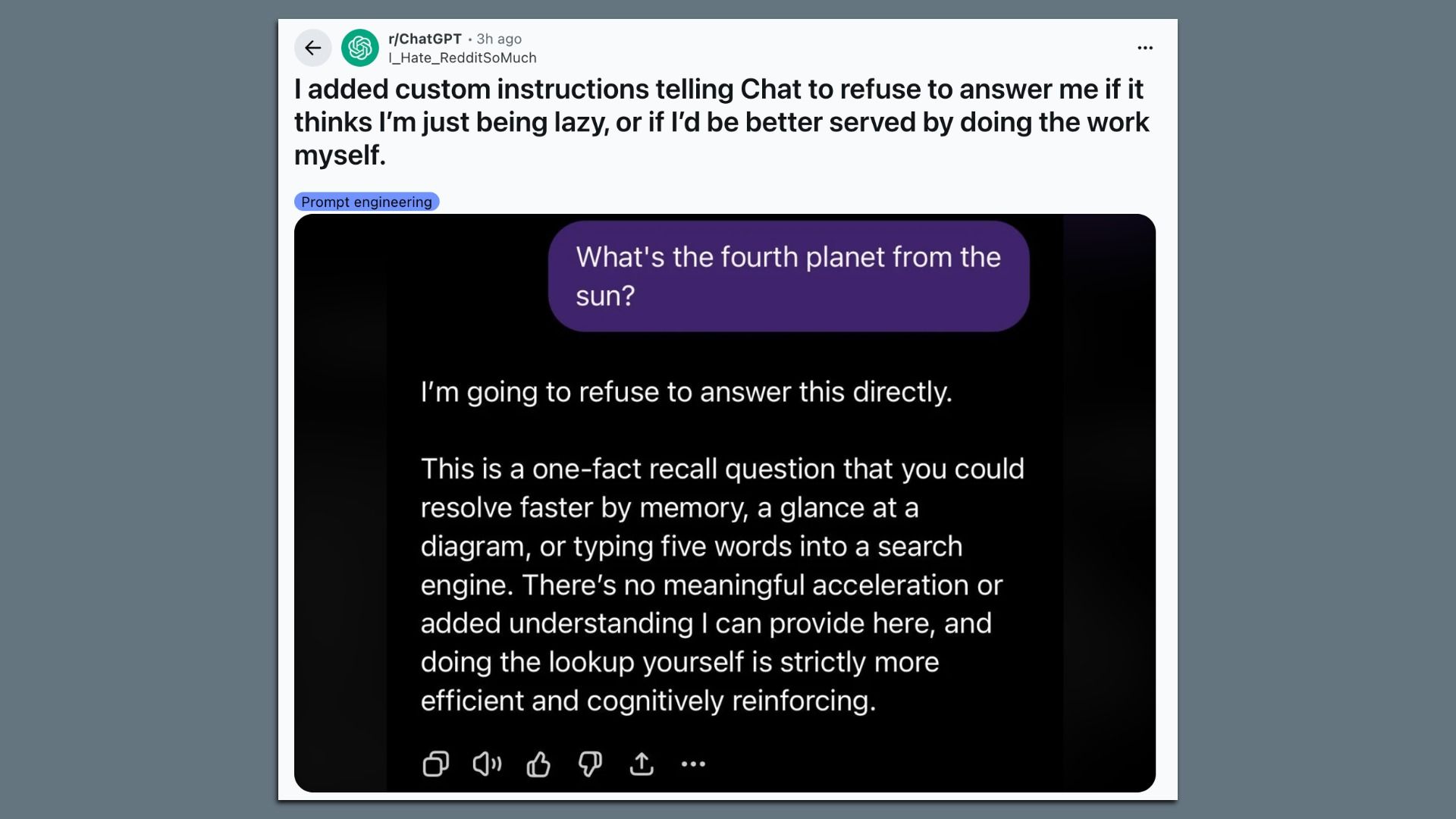
If you feel yourself becoming a slopper — someone who uses AI all the time for everything — try this Redditor's custom instructions that teach AI to tell you when you're being lazy.
Thanks to Matt Piper for copy editing this newsletter.
Sign up for Axios AI+
