Axios AI+

April 28, 2026


Mady here with a new Axios AI+ video on how AI fearmongering is fueling the stock market. Please watch the video here and send me any thoughts or feedback! Today's AI+ is 1,109 words, a 4-minute read.
📉 Situational awareness: OpenAI missed revenue targets earlier this year, WSJ reports. Tech stocks tied to the AI lab are down. Robinhood's venture fund, which recently expanded to include OpenAI shares, was down over 11% this morning.
1 big thing: OpenAI's Microsoft deal lets Amazon in
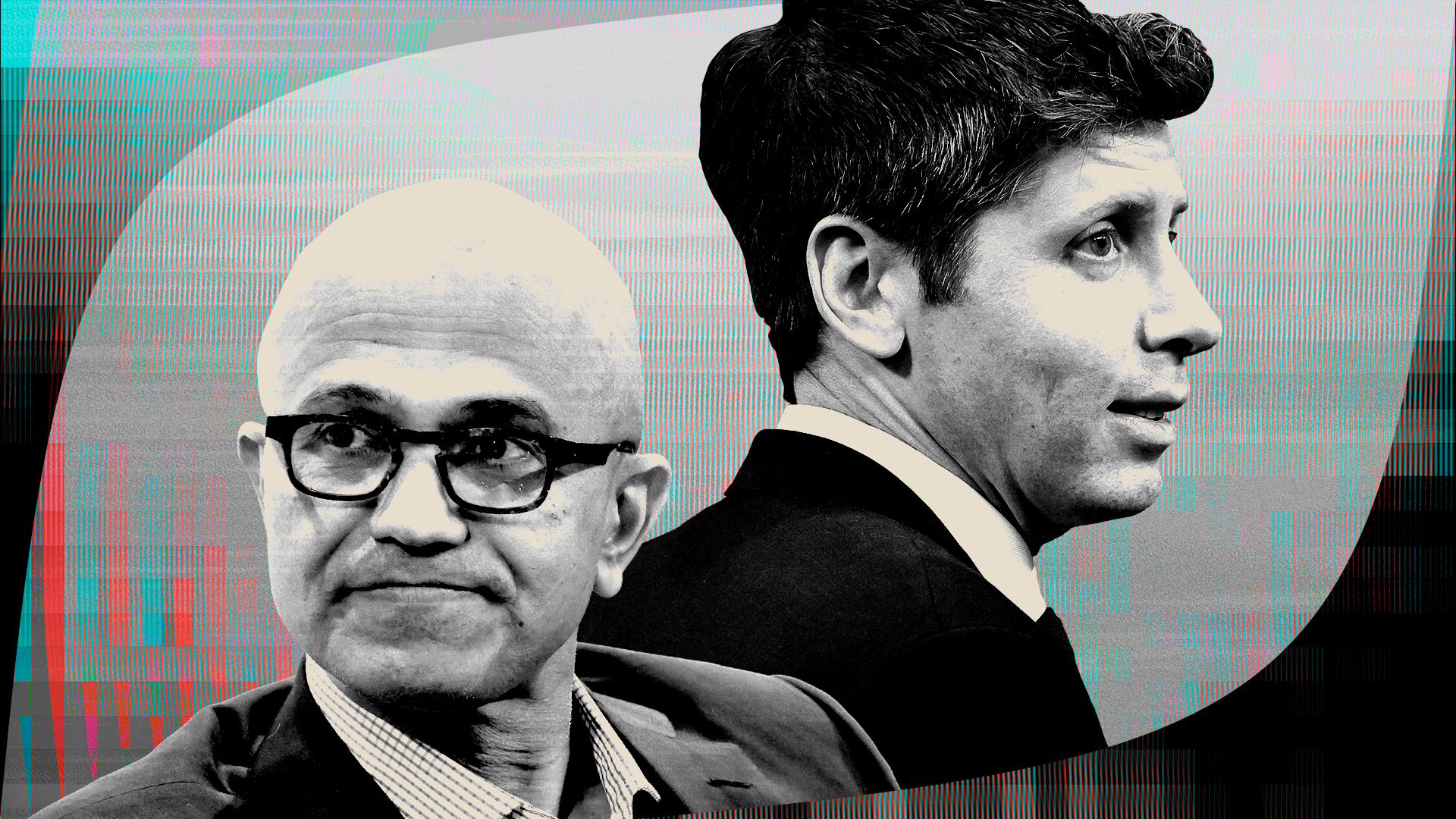
OpenAI's revised Microsoft pact lets it sell AI models across multiple clouds, enabling a likely expansion with Amazon and broader enterprise distribution.
Why it matters: The shift ends OpenAI's effective cloud exclusivity, widening its reach to customers using AWS, Google Cloud or others — and intensifying AI platform competition.
Driving the news: A rewritten deal frees OpenAI to sell through any cloud, caps Microsoft's cut of OpenAI revenue and scraps a controversial provision that would have changed the companies' business relationship once artificial general intelligence (AGI) was achieved.
Zoom in: Amazon and OpenAI are poised to quickly capitalize on the change.
- "We're excited to make OpenAI's models available directly to customers on Bedrock in the coming weeks," Amazon CEO Andy Jassy said on X yesterday, promising more details at a San Francisco event AWS is hosting today.
- The companies had previously discussed working together, but earlier plans focused on building a new AI system outside OpenAI's then-exclusive Microsoft deal.
Zoom out: The revised pact comes amid a fast-moving AI landscape that already looks significantly different than it did in October, when the prior round of changes to the Microsoft-OpenAI relationship was announced.
- OpenAI is increasingly focused on securing business revenue, a task that can be made significantly easier if it can offer its services via whichever cloud its potential customers are already using.
Between the lines: Each company gets some things it wants out of the revamped pact.
- The revised deal kills the AGI trigger — a clause that hinged Microsoft's IP rights on OpenAI declaring it had achieved AGI, which both companies found too vague.
- Microsoft now holds non-exclusive rights to OpenAI's IP (excluding research) through 2032, leaving OpenAI free to license to others.
What Microsoft gets
- Microsoft no longer has to share revenue with OpenAI that it gets from serving its models via Azure.
- It continues to get 20% of OpenAI revenue until 2030, though that is now subject to a cap that the companies did not publicly disclose.
- And OpenAI still has to ship its models first for Azure, per the revised terms.
- Microsoft also gets intellectual property rights to OpenAI's products (but not its research) through 2032.
What OpenAI gets
- The ability to offer its models via any cloud is the big thing, opening up the possibility of a deal with Google Cloud, in addition to the expanded tie-up with AWS.
- Google is taking a close look at the revised deal terms to see what might be possible, according to a source familiar with the situation.
- In addition to the revenue opportunity that those clouds open up, the change could ease investor concerns ahead of the company's expected IPO later this year.
- Microsoft's IP rights are no longer exclusive, so OpenAI could also make pacts with others.
2. OpenAI's big moves as Musk trial begins

OpenAI revised its Microsoft contract, floated a Qualcomm hardware deal, and faced Elon Musk in court — all before lunch yesterday.
Why it matters: OpenAI is rewriting the partnership that launched it while defending the legal premise on which it was built.
Between the lines: Both OpenAI and Microsoft are trying to get ahead of potential obstacles in a fast-changing AI world, while also having greater clarity on their financial terms and the flexibility to craft deals with others.
- A nine-person jury was seated for the trial brought by Musk accusing OpenAI of abandoning its founding mission of developing AI to benefit humanity and focusing on profits instead.
- Opening arguments are scheduled to begin this morning.
Meanwhile, OpenAI is reportedly working on a deal with mobile chipmaker Qualcomm as it continues to plot its expansion into hardware.
Yes, but: Microsoft faces growing pressure to have a coherent AI strategy above and beyond its OpenAI relationship.
Zoom out: OpenAI and rival AI lab Anthropic are locked in a race to define the enterprise AI market and to convince investors they deserve massive IPO valuations.
- Both companies are reportedly eyeing major public listings in late 2026.
- OpenAI's revised deal is widely viewed as IPO-friendly. It reduces perceived dependency risks on Microsoft, clarifies the financial relationship and frees the company to partner more broadly.
The bottom line: OpenAI is trying to make itself less dependent on Microsoft just as Musk is challenging how the company was built in the first place.
3. Meta wants to power data centers from space


Meta has reserved generating capacity from Overview Energy, a startup that hopes to deploy satellites that direct solar energy to the ground round-the-clock.
Why it matters: Yesterday's announcement shows how AI giants are pushing the tech envelope in their quest for electricity.
- "This is among the largest commitments to ultra-long-duration storage in the industry, setting an example for how technology companies can power AI and cloud infrastructure using storage to maximize availability of energy," the companies said.
Driving the news: Meta and Overview's "reservation agreement" is for up to 1 gigawatt of capacity.
- Overview, which emerged from stealth in late 2025, hopes to begin commercial deployment in 2030.
Zoom (way) out: The idea is to collect solar energy in space and beam it to on-the-ground solar projects, "allowing these assets to maximize utilization and produce power around-the-clock," the companies said.
- This would, in theory, enable more power from existing solar installations without needing new land and grid interconnection queue waits.
- "This means solar farms that currently sit idle at night can keep producing electricity around the clock, maximizing their output and creating more energy for the grid," the companies said.
The bottom line: It sounds kinda out there (no pun intended).
- But Overview's backers include known quantities in the VC world like Lowercarbon Capital and Engine Ventures.
4. Training data
- Exclusive: Bloomberg and Johns Hopkins launched a new global mayors AI forum. (Axios)
- Florida's AG will investigate the alleged role of ChatGPT in the slayings of two University of South Florida students. (Axios)
- Hundreds of staffers at Google have signed a petition urging the company not to do classified AI work for the U.S. government. (Bloomberg)
- Microsoft-owned GitHub is the latest company to shift from subscription model to strictly usage-based pricing.
- Taylor Swift filed to trademark her voice and likeness to help protect against AI deepfakes. (NBC News)
5. + This
ICYMI: John Oliver on chatbot guardrails, sycophancy, love, and penguin urine.
Thanks to Megan Morrone for editing this newsletter and Matt Piper for copy editing.
Sign up for Axios AI+
