Axios AI+

February 07, 2025

I'm headed to Paris for the AI Action Summit, which takes place Feb. 9-11, and I'll be reporting and writing the newsletter from there through Wednesday. Today's AI+ is 1,232 words, a 4.5-minute read.
1 big thing: "Deep research" wizard tests
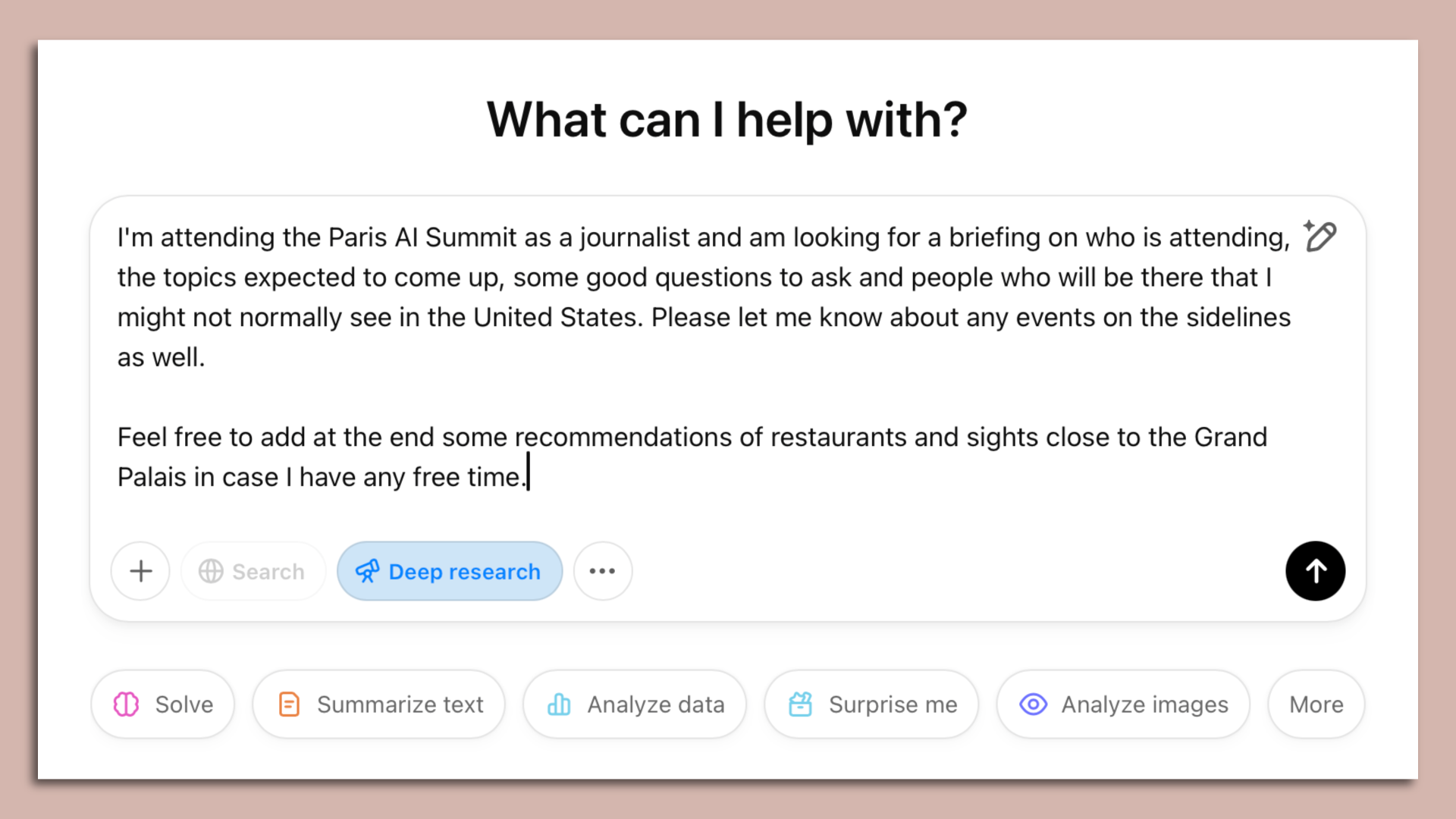
New "deep research" tools from OpenAI and Google offer utility today and hint at generative AI's broader potential, but have some important limits.
Why it matters: OpenAI CEO Sam Altman has said he thinks the company's product — which takes users' assignments and files lengthy research reports in 5 to 25 minutes — "can do a single-digit percentage of all economically valuable tasks in the world."
I tested ChatGPT's new Deep Research (as well as a similarly named product Google released for Gemini in December) over several days on a range of prompts, including my own ideas and several sent in by readers.
- In each case, I got back a well-organized research report, though the value varied depending on the task. Overall, Gemini and ChatGPT hit similar points, though ChatGPT's deep research often had more detail than Google's version.
- In both cases, I found the reports to be useful, but they were better at summarizing conventional wisdom than identifying novel approaches to the queries I raised.
Zoom in: Here are a few of the prompts I tried and the results.
1. The first task I gave my AI research agents was to prepare a report on the AI Action Summit.
- ChatGPT's Deep Research asked a few clarifying questions and returned this report on prominent attendees, expected topics of discussion, side events and suggested questions for various attendees. It also gave me the sightseeing and dining options I asked for, should I have any free time.
- A Gemini search, conducted a day later, included the then-fresh announcement that Vice President JD Vance would be representing the U.S. at the event. It was generally less detailed than the ChatGPT version, but did highlight one of the event's unique aspects — high-level participation from both the U.S. and China.
2. Next I asked for help planning my son's upcoming bar mitzvah.
- Both Google and ChatGPT offered specific potential location spots, food trucks and suggestions on renting video games and other entertainment.
- The results included both options we had considered and a few we had not. ChatGPT's report reminded me to plan ahead since the bar mitzvah is in December, and also warned we might face bad weather.
3. Reader Chris G. from Kansas asked me to use the tools to help assess who might replace Lorne Michaels as head of "Saturday Night Live."
- ChatGPT Deep Research accurately chronicled current speculation, including the possibility of SNL alumna Tina Fey coming back to run the show. It also floated other contenders and dark horse candidates, including Seth Myers, Michael Che and Colin Jost.
- Google offered similar recommendations, along with interesting sections on "The Current State of SNL and Its Challenges" and "Lorne Michaels's Impact and Qualities of a Successful Successor."
4. One of my editors has been looking for an apartment in San Francisco, so I offered to assign my research assistants to look for both specific recommendations as well as potential strategies for finding housing in this tough market.
- ChatGPT Deep Research suggested a few listings from Zillow and Redfin and then suggested my editor do some word-of-mouth networking while also "pounding the pavement" to look for "for rent" signs.
- "Many small landlords in SF still advertise vacancies by putting up signs on the building and never list online, to avoid a flood of applicants," the report said, sharing an insight it cited to Reddit.
- Similarly, Google offered a few specific listings from Zillow that met my editor's criteria as well as suggestions such as networking with real estate agents. It also retold a first-person anecdote about how someone's pet-owner friend scored an apartment — making it sound like it was the AI that had the friend in question.
- "Finding an apartment in San Francisco requires patience, persistence, and a willingness to think outside the box," Gemini's report concluded, stating the obvious.
5. Another reader asked me to have the chatbots look into the energy usage of generative AI, taking into account scenarios ranging from rapid decarbonization to a continued heavy reliance on fossil fuels.
- ChatGPT was blunt about the impact that generative AI is having on energy consumption, citing in its report various studies showing that "the energy demand of artificial intelligence is already significant and rising."
- Data centers, it said, consume 2% of electricity, or roughly the same amount as the entire country of France (although not all of that is for AI). Another study found AI alone could account for 0.5% of worldwide electricity demand by 2027.
- Gemini, too, plainly stated generative AI's energy challenges. "While AI's energy demands are soaring, the decarbonization of energy sources is not keeping pace," Gemini said in its report.
Between the lines: I appreciated the way ChatGPT often asked for clarification on various points before executing its research plan, which typically took a few minutes to run.
Yes, but: Other Deep Research users have encountered hallucinations (made-up information), particularly with queries that depend on an accurate understanding of a point in time — like knowing which sports players are on each team's roster.
- Though both tools cite sources, it's worth checking them to verify essential facts.
What's next: Google is in the process of bringing its version of deep research to the Gemini Android app and says it will be available next week to all mobile users, including iOS.
- ChatGPT Pro subscribers currently have access to OpenAI's Deep Research, but the company plans to make it available more widely soon.
The bottom line: I wouldn't say Deep Research is ready to join the staff — but it's certainly a promising intern.
2. OpenAI's Stargate eyes 15 states for hubs


The companies in Stargate, the new consortium to build out AI infrastructure for OpenAI, are actively considering new data center projects in more than a dozen states, OpenAI announced yesterday.
Why it matters: President Trump has thrown his administration's weight behind the $100 billion to $500 billion project involving OpenAI, SoftBank, Oracle and the UAE's MGX.
Driving the news: Stargate's first site is underway in Abilene, Texas.
- Other states in the running include Arizona, California, Florida, Louisiana, Maryland, Nevada, New York, Ohio, Oregon, Pennsylvania, Utah, Virginia, Washington, Wisconsin and West Virginia.
- Stargate has begun soliciting proposals for land, power, engineers and architects, and company officials are traveling across the country visiting sites.
- Each campus will be in the roughly 1 gigawatt or greater range, and they will all be connected.
Asked how the companies would address any harms to the environment or local communities, Keith Heyde, a member of Stargate's infrastructure team, said water efficiency is "part of our core design ethos."
- "This is critical, not only in places where there's ongoing drought conditions, but also critical in others where we just want to be conscious of general impacts to the water and the communities in which these campuses are situated," Heyde said in a call with reporters.
- OpenAI chief global affairs officer Chris Lehane said this should be a win for local communities "in terms of the jobs, economic development and revenue."
If you need smart, quick intel on federal tech policy for your job, get Axios Pro Policy.
3. Training data
- Amazon said it will spend $100 billion on capital expenses this year, much of it on AI, which CEO Andy Jassy called a "once in a lifetime" business opportunity. (CNBC)
- Apple plans to debut a new entry-level iPhone SE as soon as next week. (Bloomberg)
4. + This
Oh, I commissioned one more deep research project, just for you.
Thanks to Scott Rosenberg and Megan Morrone for editing this newsletter and Matt Piper for copy editing it.
Sign up for Axios AI+
