Axios AI+

September 16, 2025

Hi from D.C. Today's AI+ is 1,212 words, a 4.5-minute read.
Happening tomorrow: Tune in here starting at 2pm ET Wednesday to Axios' AI+ DC Summit to hear convos with Sen. Ted Cruz (R-Texas), Anthropic CEO and co-founder Dario Amodei, Scale AI CEO Jason Droege, AMD chair and CEO Lisa Su and more. Just added: Sen. Mark Kelly (D-Ariz.).
1 big thing: AI's new 3D wave

After years of competing to build the best model for understanding all the world's writing, AI makers are now racing to build models that better understand the physical world.
Why it matters: Robots are one main use, but giving AI an understanding of real-world physics is also key to powering everything from video games to architecture.
Driving the news: Autodesk is announcing a pair of foundation models today, both of which use understanding of designs and the physical world to generate realistic computer-aided-design (CAD) objects.
- OpenAI is said to be ramping up investment in building models with real-world understanding as it also seeks to reboot its robotics effort, per Wired.
- A host of startups, including Fei-Fei Li's World Labs, have made building real-world models their focus.
Zoom in: Autodesk is set to debut its two new models at a conference later today in Nashville, but shared details and demos first with Axios.
- One model creates editable CAD drawings for various 3D objects based on a sketch, prompt or text description.
- The other works at the architectural level, allowing the sketch of a building to be easily reshaped, with the AI model helping automatically adjust the interior with a realistic floor plan.
"What you'll notice is that the building fills in with all the rooms and windows and absolutely everything inside it," Autodesk senior VP Mike Haley told Axios — showing how the blueprints shifted as he raised and lowered one wing of a building's plan.
- Even a building's key structural elements can be automatically adjusted, he said.
Zoom out: A wave of startups are raising big bucks to chase goals similar to Autodesk's.
- Investors are betting that foundation models grounded in real-world physics could be as transformative as large language models were for text.
- Dyna Robotics announced yesterday it has raised $120 million to support further development of its robotics-oriented foundation model, which is designed to learn in real-world production settings like restaurants and laundromats.
- FieldAI raised more than $300 million last month to help build models that allow robots to safely navigate unpredictable real-world settings.
- Meanwhile, Roblox and other companies are using a similar approach to allow people to use still images or text to create intricate video game virtual worlds that operate according to real physics.
Between the lines: Large language models can do a lot even with only their extensive book knowledge of the physical world's laws. But they often struggle to capture the nuances of how materials interact with one another or the impact of gravity.
- "Those models fall off a cliff very, very quickly," Haley said, noting that even many models that can produce images or video don't have a three-dimensional understanding of what they produce.
- "And they actually set an expectation with the user that they can do those things, because they're certainly not going to tell you when they can't do it, right? Then they produce garbage at the end of the day," Haley said.
What's next: In a new research demo, also being shown today, Autodesk is demonstrating how a user can work with a physics-aware language model, speaking commands and drawing, to edit objects just as easily as creating them. That's often a challenge with today's models.
2. OpenAI is building a ChatGPT for teens

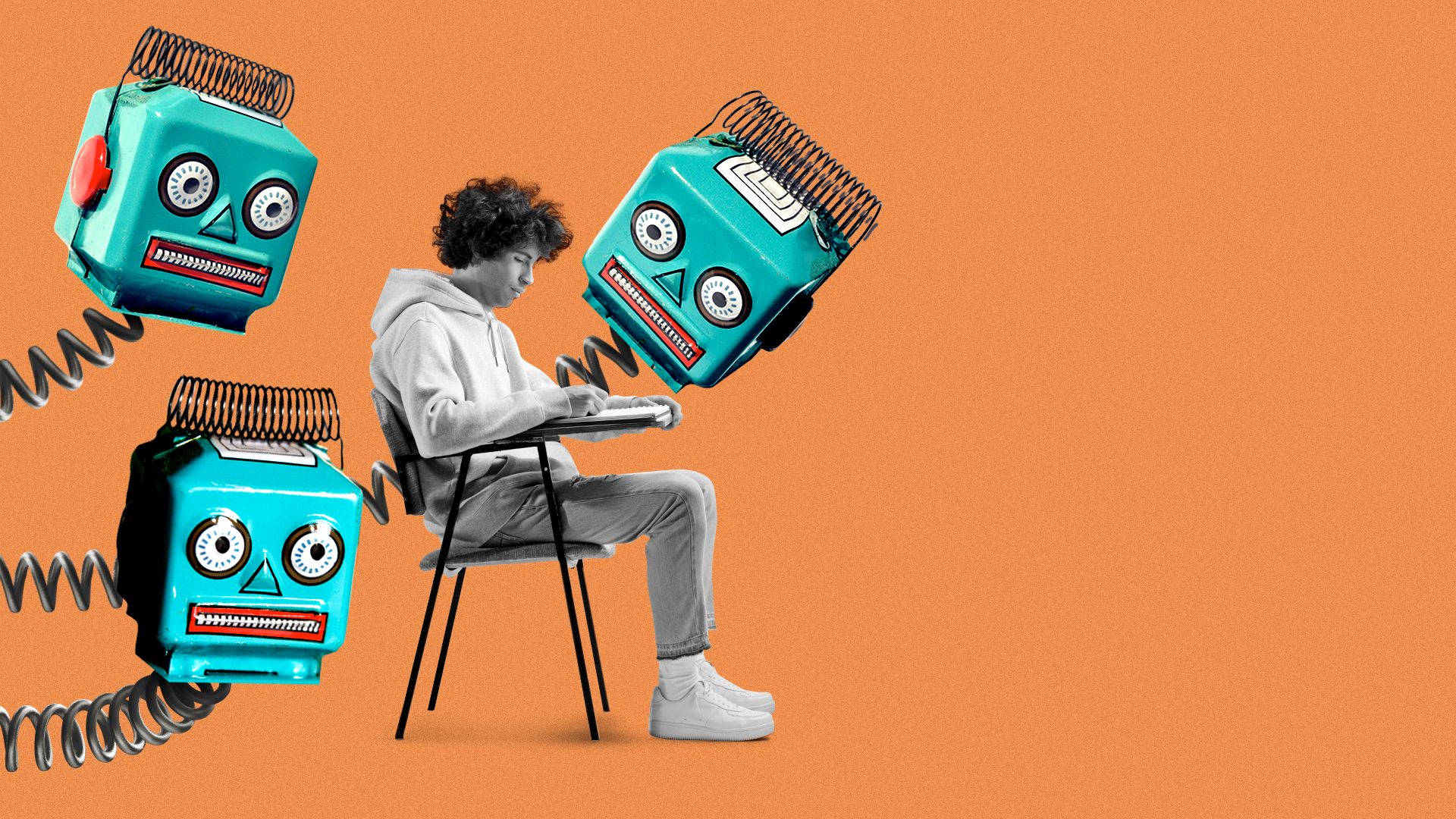
OpenAI is developing a "different ChatGPT experience" for teens and plans to use age-prediction technology to help bar kids under 18 from the standard version, the company announced today.
Why it matters: New research and a handful of lawsuits are raising alarms about ChatGPT's risks to teens' mental health.
- OpenAI says that if its tools can't confidently predict a person's age, ChatGPT will default to its under-18 version.
The big picture: In a separate blog post today, OpenAI CEO Sam Altman writes, "We prioritize safety ahead of privacy and freedom for teens; this is a new and powerful technology, and we believe minors need significant protection."
- The company's latest announcement is part of a big push it promised earlier this month to set new guardrails for teens and people in emotional distress, which it expects to roll out by the year's end.
Zoom in: The new teen experience puts much of the responsibility in the hands of parents and caregivers.
- Parents can link their accounts to those of their teens via an invitation to their child.
- Once linked, parents can restrict how ChatGPT responds to teens with built-in, age-appropriate rules.
- OpenAI will allow parents to set blackout hours when a teen cannot use ChatGPT, a new feature first announced today.
- OpenAI has long said all ChatGPT users must be at least 13 years old.
Driving the news: OpenAI's announcement comes just hours ahead of a hearing in Washington, D.C., examining potential harms from AI chatbots.
Yes, but: Tech companies, usually in response to lawsuits, have for years been creating new experiences designed specifically for teens and kids — think YouTube Kids.
- Savvy young people frequently find workarounds to get to the apps and websites they want to access.
3. Google bets on trust with AI shopping helpers


AI agent-driven e-commerce could get a boost from a new Google-backed software standard unveiled today that aims to make chatbot-enabled purchases smoother and more trustworthy.
Why it matters: Industry analysts expect consumers to rapidly embrace buying stuff with the help of AI — but only if they can count on a chatbot doing exactly what they tell it to do.
Driving the news: Google's new agent payments protocol, or AP2, extends existing standards — like the agent to agent (A2A) and model context (MCP) protocols — to e-commerce.
- Google is assuming both consumers and merchants will use "multiple agents built by multiple vendors," Rao Surapaneni, VP of Google Cloud's business applications platform, told Axios.
- All these agents will need to communicate in a reliable and trusted way.
Between the lines: The new payments protocol is designed to be able to "prove that a user gave an agent the specific authority to make a particular purchase," "be sure that an agent's request accurately reflects the user's true intent," and "determine accountability if fraudulent or incorrect transaction occurs," according to a new Google blog post.
Zoom out: The U.S. payments system that has evolved around e-commerce is complex and dependent on a wide variety of powerful players, including Visa, Apple Pay, Amazon, Stripe, Square (now Block), Zelle and other bank-backed systems.
Zoom in: Google says AP2 already has buy-in from more than 60 partners, including Mastercard, American Express, PayPal, Coinbase, Etsy, Okta and Alibaba.
4. Training data
- Apple released its fall software updates for the iPhone, iPad, Apple Watch and Mac ahead of new iPhones hitting stores Friday. (Axios)
- Meta briefly posted a video of an expanded smart glasses lineup, including the new models it is set to announce at Meta Connect later this week. (UploadVR)
- OpenAI is rolling out GPT-5-Codex — a faster coding model — across ChatGPT tiers, with API access coming soon. (TechCrunch)
5. + This
AI meets Animal Crossing? I'm here for it.
Thanks to Scott Rosenberg and Megan Morrone for editing this newsletter and Matt Piper for copy editing.
Sign up for Axios AI+
