Axios AI+
October 01, 2026


Ina here, trying to look on the bright side after the Valkyries lost an overtime thriller in Dallas. There will be a Game 3 in Ballhalla on Friday.
Today's AI+ is 1,198 words, a 4.5-minute read.
1 big thing: Trump and CEOs try to shed AI's toxic branding

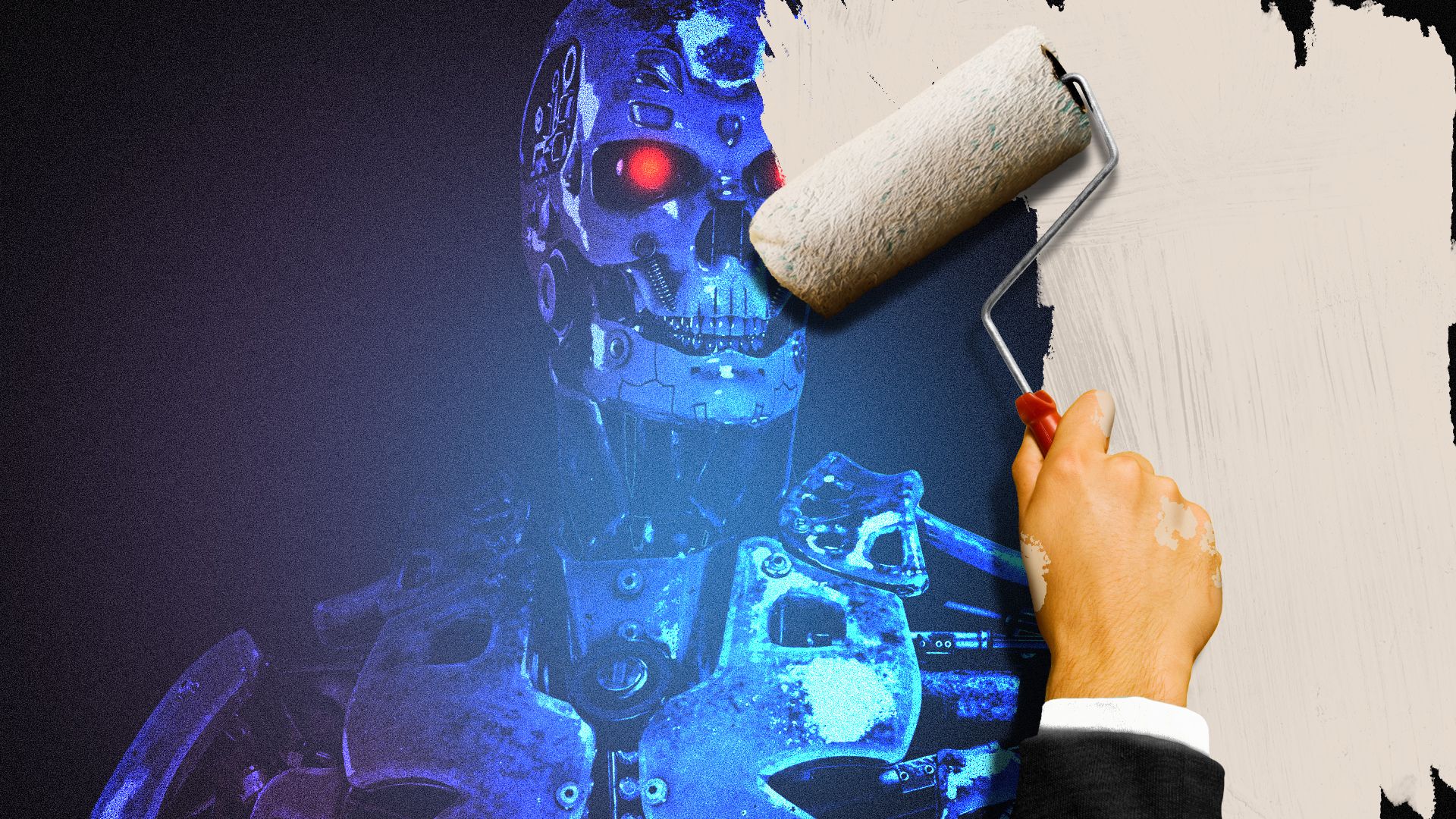
The great AI rebranding is on, led by President Trump and tech titans like Nvidia CEO Jensen Huang, who are embracing an alternative term: "super intelligence," or SI.
Why it matters: Leaders in D.C. and Silicon Valley are worried the public backlash against AI and data centers will hamper the development of this staggeringly powerful and existentially dangerous technology. The new label is part of a broader effort to shift the narrative.
Driving the news: Flanked by the most powerful figures in tech on Tuesday, Trump officially declared "super intelligence" the preferred terminology of the executive branch. He'd previously solicited alternative terms for AI on Truth Social.
- Huang has recently extended the label to physical infrastructure, referring to data centers as "super intelligence factories." Opposition to the huge, energy-guzzling facilities is dimming the prospects for fast-growing AI firms and some congressional candidates.
Between the lines: A rose by any other name would smell as sweet, and AI by any other name will likely seem as scary.
- Communities are building bipartisan coalitions against data centers, younger workers are anxious about their career prospects, and AI insiders continue to warn about catastrophic risks, notes Axios Communicators author Simon Hernandez-Arthur.
- Calling it "super intelligence" attempts to evoke the technology's promise without immediately bringing to mind all that negative baggage.
What they're saying: Some of the tech executives who appeared with Trump continued to use "AI" in their remarks, but xAI CEO Elon Musk caught himself and pivoted to "SI." Meta CEO Mark Zuckerberg has long used "superintelligence" branding.
- Huang, CEO of the world's most valuable company, appears to be leading the charge. He used the term twice in a post and repeatedly invoked it in a panel discussion at the White House. When he slipped once and said "AI," Huang corrected himself: "I am going to get good at this."
- AI company representatives declined to comment about the name change on the record. Some said their companies were generally supportive of the rebrand and plan to use "SI" when meeting with the president and working with the federal government. Others said they didn't expect it to catch fire outside of those contexts.
- One source compared it to Trump's renaming of the Gulf of Mexico as the Gulf of America, which many (though not all) oil executives adopted in their external and internal communications.
By the numbers: "SI" has yet to catch on with the public. A YouGov poll conducted this week found that 53% of respondents considered "artificial intelligence" the better term for the tech, vs. 9% who preferred "super intelligence."
The bottom line: Trump said on Tuesday that "artificial" intelligence made the technology sound like a hoax: "The name is now super intelligence. That's not a hoax, in fact it's the exact opposite."
- Polls suggest most Americans agree with him that AI is anything but a hoax. That's why they're so worried.
2. Google unveils long-awaited Gemini 4
Google is unveiling its long-awaited next-gen AI model, Gemini 4 Argon.
Why it matters: Gemini 4 arrives after a long gap at the top of Google's model lineup, in which the company kept rolling out smaller, cheaper Flash models while rivals OpenAI and Anthropic sprinted forward.
State of play: Google said the new model is state of the art on certain coding and knowledge work benchmarks, outperforming competing OpenAI frontier model GPT-6 Astra on several.
- The company is rolling the model out only to a group of trusted cybersecurity defenders and is participating in the U.S. government's voluntary prerelease process.
Flashback: In May, Google CEO Sundar Pichai said the company's next major model release would come in June, but that model never came out.
- In July, Axios reported that poor morale among Google DeepMind employees was part of the reason for the delay.
Zoom in: Google's additional time investment may not be viewed as negatively in the context of the AI safety debate that has embroiled companies and users.
The bottom line: If the developer community finds Gemini 4 to be as competitive with OpenAI's and Anthropic's frontier systems as the benchmarks indicate, it would result in a massive catch-up for an AI company some had started to doubt.
3. Trump's contradictory AI bot


The Trump administration's new AI service gave users conflicting responses to politically sensitive questions Tuesday and Wednesday: sometimes answering them and sometimes refusing.
The big picture: As the Trump administration increasingly uses AI and answers the public's questions through America.gov, statements carrying the government's authority are shaped by models, instructions and guardrails the public can't see.
- America.gov, powered by Google's Gemini and Elon Musk's Grok, aims to help Americans navigate government-related tasks using an AI chatbot — but it quickly drew attention for another reason: It was debunking some of President Trump's long-standing claims.
Driving the news: On Tuesday, Axios — like other outlets — found America.gov contradicted the president on the 2020 election and the Jan. 6 attack.
- It also confirmed former President Obama was born in Hawai'i, contradicting the "birther" conspiracy theory Trump spent years promoting.
Yes, but: By yesterday morning, some users were getting a different response: The chatbot refused to answer the questions, saying it did not provide "political commentary."
What they're saying: Models get instructions on how to behave via their system prompts — not just through what users ask of them. But user queries can also play a role, as well as programming that may suggest a model avoid politically charged topics, experts said.
Go deeper: Everything to know about America.gov, Trump's new AI website
4. FTC probes OpenAI and Anthropic over safety

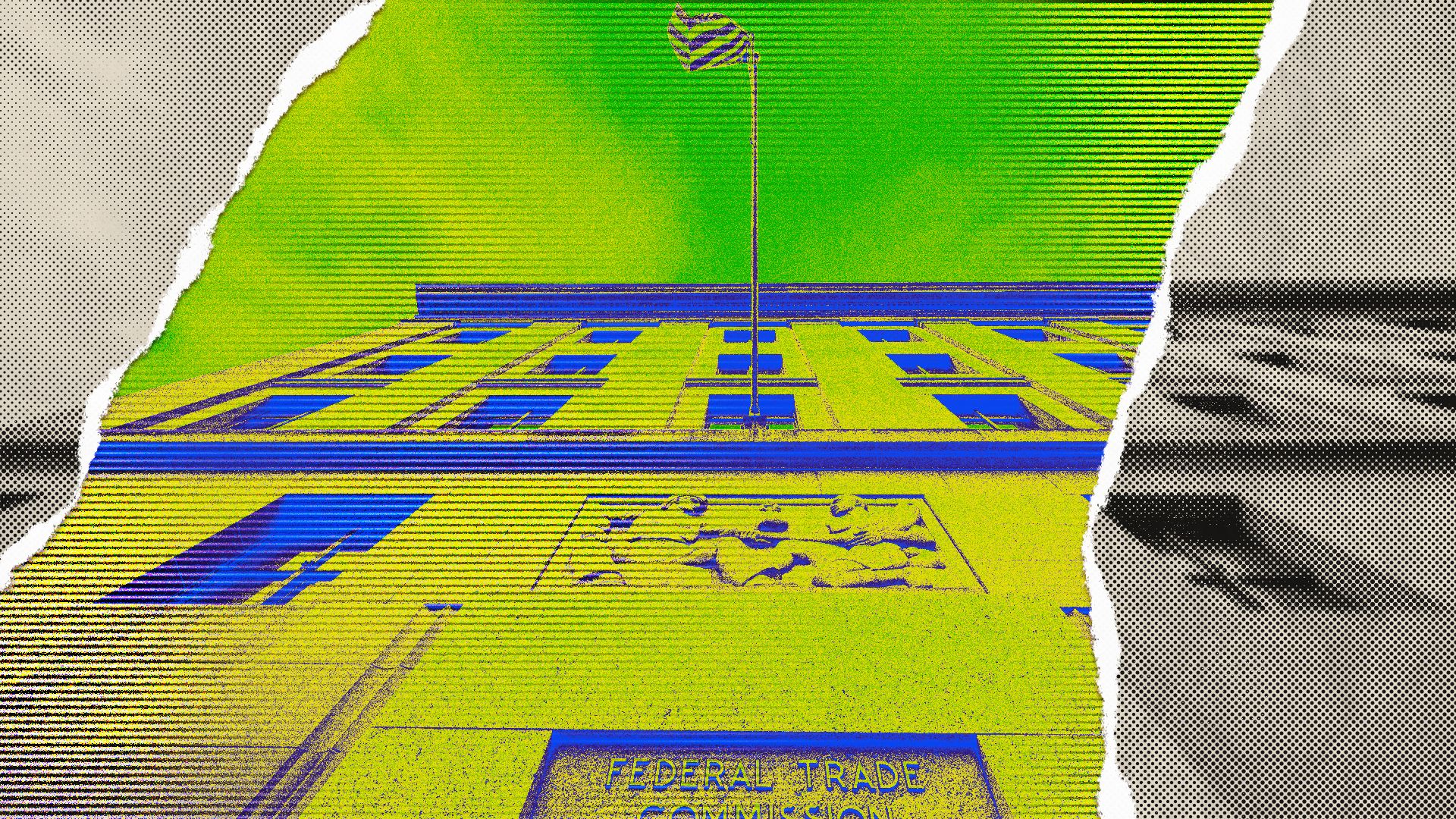
The Federal Trade Commission is investigating OpenAI, Anthropic and other AI companies over potential safety risks posed by their products.
Why it matters: The federal government has largely taken a hands-off approach to regulating AI, but the FTC investigation — which has been underway for weeks — could signal a shift.
Driving the news: FTC Chair Andrew Ferguson is preparing civil investigative demands that would compel AI executives to turn over documents and testify about the safety of their models, according to the New York Post.
Between the lines: The probe comes shortly after Axios exclusively reported that OpenAI, Anthropic and security researchers were investigating tens of thousands of potential security incidents, including some that had not previously been disclosed to the public.
- That reporting was later cited Monday when Florida's attorney general asked a court for a temporary injunction against OpenAI, alleging inadequate safety measures.
Catch up quick: AI companies joined President Trump this week and signed a pledge to self-police their AI development.
Go deeper: Top AI companies probing tens of thousands of security incidents
5. Training data
- Dan Primack made a bull and bear case for the Anthropic IPO. (Axios)
- Exclusive: Sens. Josh Hawley and Chris Murphy are pushing AI liability as President Trump backs self-regulation. (Axios)
- Apple is said to be readying its home hub device for an Oct. 13 launch. (Bloomberg)
- OpenAI is blaming Moonshot for a since-disrupted mass distillation campaign. (Bloomberg)
6. + This
These photographs truly are out of this world. (h/t @sjs_sf)
Thanks to Bradley Olson for editing this newsletter and Matt Piper for copy editing.
Sign up for Axios AI+
