Axios AI+

March 19, 2024

Hi, it's Ryan. Don't forget to tune in to Axios' What's Next summit today at 2pm ET, where Ina, Sara Fischer, Ashley Gold and more will interview top CEOs, ESPN chairman James Pitaro and Cabinet secretaries Alejandro Mayorkas and Pete Buttigieg. Today's AI+ is 1,186-words, a 4.5-minute read.
1 big thing: Apple-Google AI deal would summon the antitrust regulators
Illustration: Brendan Lynch/Axios
Apple's reported plan to use Google's generative AI on the iPhone could raise an antitrust storm — Google is already under scrutiny for paying Apple billions to be its default search provider, Ina reports.
Why it matters: Generative AI could reset competition in the search market, and Apple holds the key to the most lucrative collection of mobile users.
What they're saying: Antitrust expert Charles Rule, a former Justice Department official, says the reported partnership appears to be problematic.
- "There's a real risk that it shuts out all of the competitive promise that generative AI has as a competitor to traditional search," Rule tells Axios.
Catch up quick: Bloomberg reported yesterday that Apple is in talks with Google about a deal that would see Gemini built into the iPhone. Apple has also had talks with ChatGPT maker OpenAI, Bloomberg reported.
- Apple declined to comment, and Google had no comment.
Reality check: Any generative AI deal between Google and Apple could massively expand on the core search deal between the two firms.
- Or Apple could use Google's technology to power a discrete app or experience: less likely to raise antitrust concerns.
Between the lines: A federal judge is already weighing whether Google has abused a monopoly in the search business through its deals with service providers and device makers, a case in which the Apple-Google search deal played a prominent role. A ruling is expected some time this year.
- Meanwhile, the Federal Trade Commission is taking a look at other big business partnerships in the AI space — including Microsoft's significant stake and commercial relationship with OpenAI, as well as investments in Anthropic by Google and Amazon.
Yes, but: Any AI deal Apple does could face scrutiny.
- Antitrust experts tell Axios there are already too few companies controlling the future of tech, and they should be made to compete rather than being allowed to partner with one another.
The big picture: Outside groups aren't waiting for a deal to be announced to weigh in.
- "Apple is openly colluding with Google in an effort to block out competition and protect monopoly power for itself and closest 'rival,'" said Sacha Haworth, executive director of the Tech Oversight Project, a group encouraging stronger antitrust regulation of large technology companies.
Zoom out: A Google deal could leave Apple vulnerable if, in relying on an outside firm, it misses the opportunity to lead on what many see as the next major wave of tech.
- While it has yet to commercialize generative AI in a significant manner, Apple has been investing heavily in the space, through both acquisitions and its own research, including a paper published last week. CEO Tim Cook has promised the company would have more to say later this year.
Our thought bubble: Should it choose — or be forced — to go it alone, Apple could have an opening to develop AI models that better respect both privacy and intellectual property.
2. Nvidia's 200-billion transistor AI chip
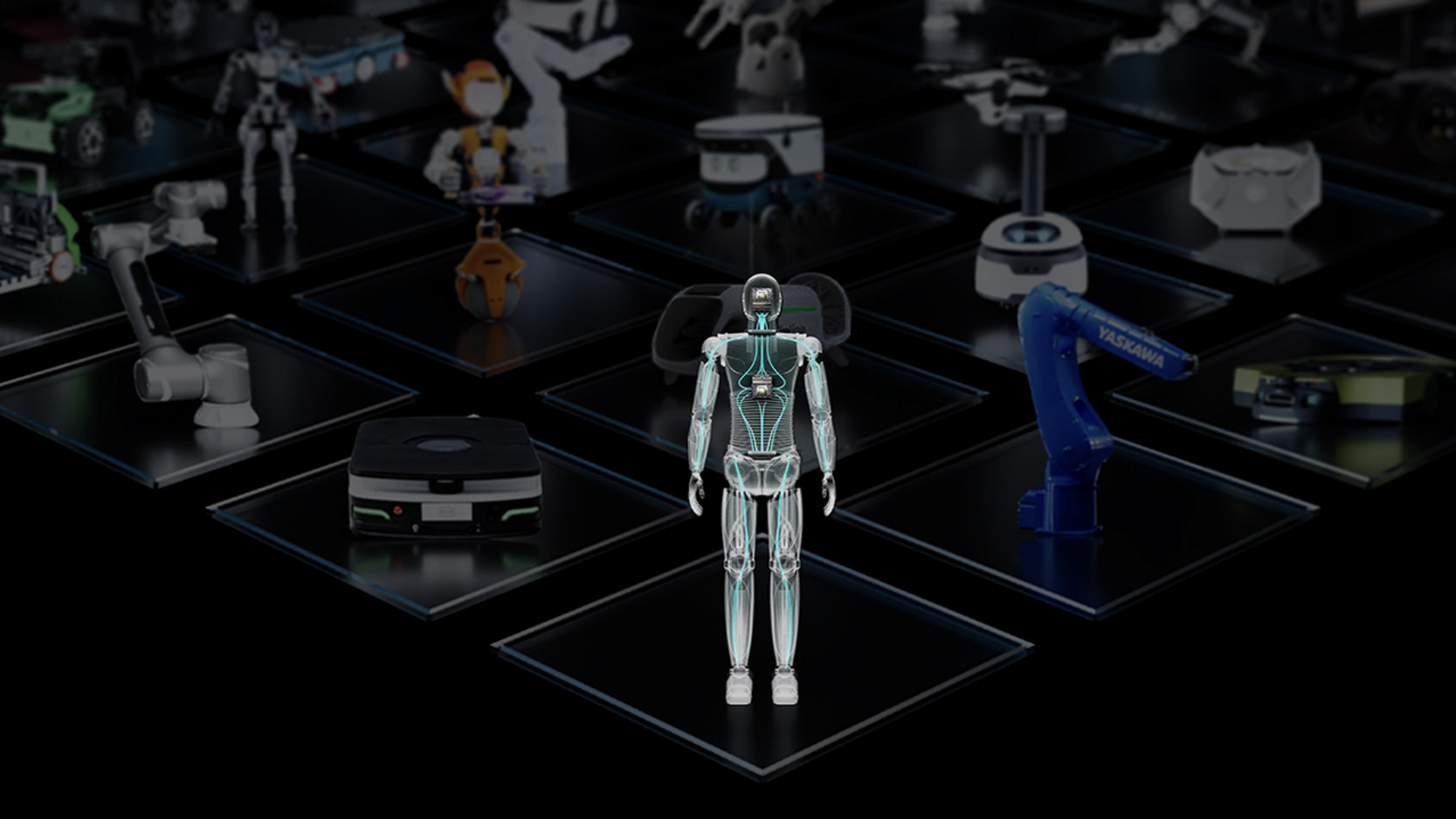
At GTC, Nvidia announced Project GR00T, a multimodal foundation model for humanoid robots. Image: Nvidia
Aiming to keep riding an AI-driven wave of demand, Nvidia is using its GTC developer conference this week to tout a more powerful family of chips along with a host of industry partnerships, Ina reports.
Why it matters: Nvidia has been the biggest winner of the generative AI boom among chipmakers, but rivals want in on the action.
Driving the news: Nvidia unveiled its new Blackwell family of processors, due out later this year — they'll contain more than 200 billion transistors.
- "We need bigger GPUs," Nvidia CEO Jensen Huang said, per CNBC. Nvidia said Blackwell processors can power much larger language models than are deployed today — up to 27 trillion parameters, many times the size of today's most advanced models, like GPT-4.
- Nvidia also used the event to highlight its expansion into new areas, including robots.
- Other tech firms were eager to tout their ties to Nvidia: companies including Google, Microsoft, Oracle, SAP and Hewlett Packard Enterprise announced new or expanded partnerships.
The big picture: Nvidia is facing pressure from established rivals, including AMD, as well as smaller upstart chipmakers focused specifically on handling artificial intelligence.
- Even as they continue to purchase Nvidia chips, tech giants including Microsoft, Google and Amazon are also developing their own processors.
What's next: Among the many sessions at GTC this week is a panel Wednesday bringing together the original authors of "Attention is All You Need," a seminal Google paper that introduced the transformer technology underlying most modern generative AI systems.
Go deeper: Meet the pickaxe vendors of the AI gold rush
3. Court weighs limiting government-social media contact
Illustration: Shoshana Gordon/Axios
Supreme Court justices appeared widely skeptical during oral arguments yesterday that government officials overstepped in communicating with social media companies about COVID-19 and election misinformation content, Axios Pro's Ashley Gold writes.
Why it matters: If the justices limit the ways the government can talk to social media platforms about content, it would upend the lines of communication between the public and private sectors about election security, public health and other issues.
The big picture: Efforts by Louisiana and Missouri to limit how much the federal government can encourage social media companies to take down certain content reached the court this week after a series of lower court decisions.
- Murthy v. Missouri stems from the two states suing the Biden administration in 2022, arguing it had violated the First Amendment while communicating with social media platforms about COVID-19 information and 2020 election misinformation.
- Judges are focusing on whether White House and other federal officials violated the First Amendment by "coercing" companies into social media content moderation.
What they're saying: Justices Elena Kagan and Brett Kavanaugh said officials trying to influence coverage was nothing new, and standard practice in all administrations.
- Arguing on behalf of the government, DOJ attorney Brian Fletcher said it has valuable information for social media companies, and that officials have tried to be persuasive, not coercive.
In this case, Republican officials are complaining about the practice of "jawboning," which is when the government encourages platforms to carry or not carry speech it wants — but both parties have engaged in the practice.
What's next: The court is expected to issue an opinion by the end of June.
A version of this story was published first on Axios Pro. Unlock more news like this by talking to our sales team.
4. Training data
- Former Autonomy CEO Michael Lynch is on on trial for allegedly defrauding Hewlett-Packard during the $11.7 billion sale of the company. (Axios)
- The Council of Europe, a post-war human rights body that also counts the U.S. as a member, has agreed on the first international treaty on AI, but it's full of holes and national security exemptions. (Council of Europe, Politico Europe)
- AWS and Fujitsu may soon join Intel in facing several lawsuits bankrolled by investor Dan Loeb via R2 Semiconductor, a small chip designer owned by his activist hedge fund Third Point. (New York Times)
- Trading places: Anthropic has hired Steve Mnich (formerly Salesforce) as head of product communications, Sam McAllister (formerly Stripe) will promote its Claude chatbot and Jennifer Martinez (formerly Robinhood) will work on policy communications, per the company.
5. + This
Bots have been silenced for too long on social networks — so now there's OnlyBots.
Thanks to Scott Rosenberg and Megan Morrone for editing this newsletter and to Caitlin Wolper for copy editing it.
Sign up for Axios AI+

Scoops on the AI revolution and transformative tech, from Ina Fried, Madison Mills, Ashley Gold and Maria Curi.