Axios AI+
October 13, 2026



Mady here after a much-needed long weekend. Hope you all got some rest!
- + Ina, reminding you that today is Ada Lovelace Day, honoring the contributions women have made to the STEM field.
Today's AI+ is 1,242 words, a 4.5-minute read.
1 big thing: In AI's cutthroat era, buyers turn rivals
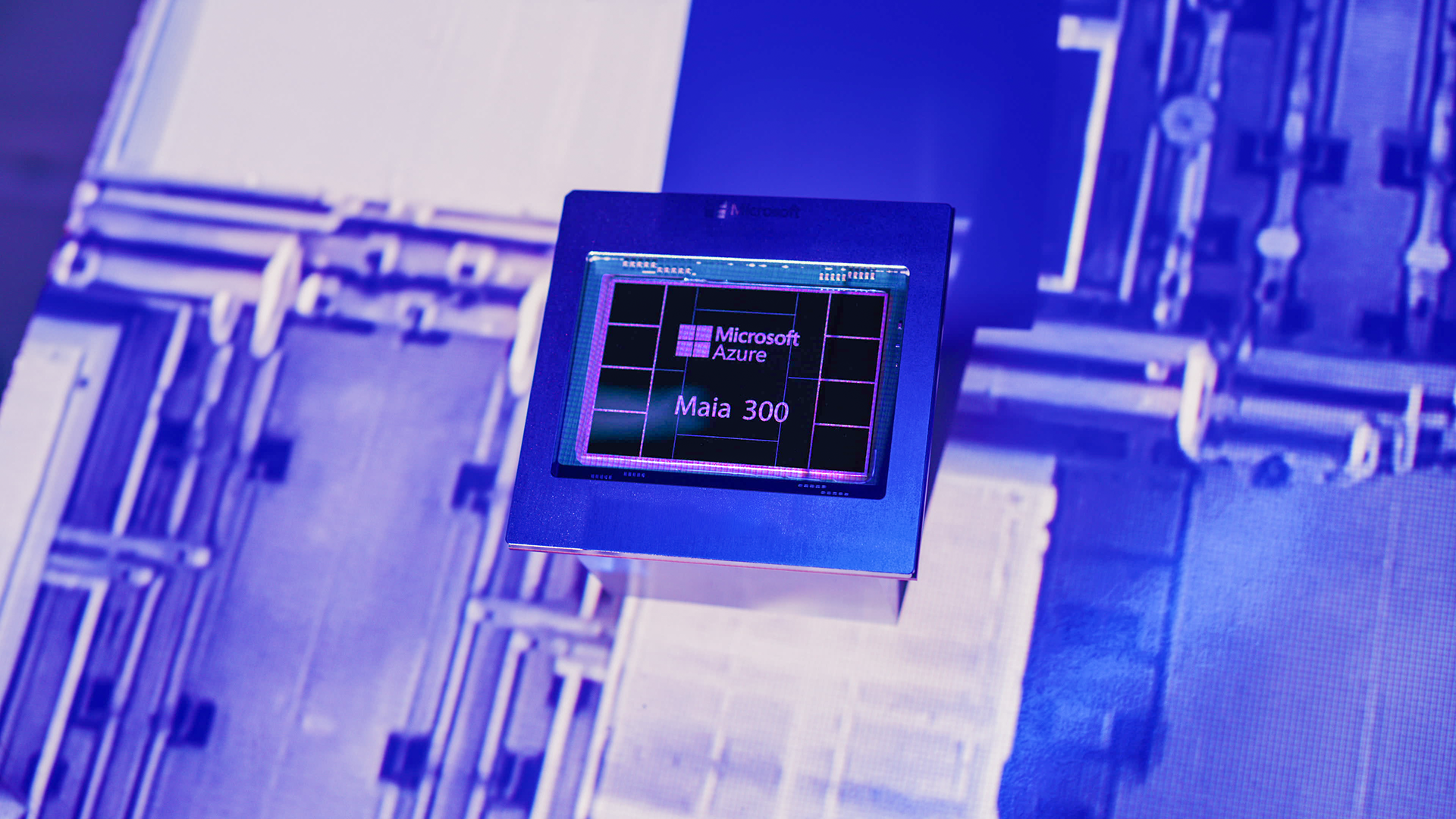
The trillion-dollar AI race is moving from software to silicon, as Microsoft's massive bet on its proprietary Maia chips proves Big Tech wants to wean itself off Nvidia's dominance.
Why it matters: Microsoft's plan to power its AI products with custom silicon shows how every major Nvidia customer is now a competitor, seeking lower costs, improved performance and more control.
- The shift is particularly significant for inference — the computing needed to generate AI responses — as more sophisticated AI models and agents drive demand for computing power.
Driving the news: Microsoft unveiled Maia 300, its latest custom AI accelerator, saying it will begin deploying the chip in 2027 and it will become the primary inference system for its own products and services.
- The company says Maia 300 will deliver 40% more AI tokens per megawatt than leading GPU-based systems.
- It's also designed to minimize unnecessary data movement between chips and memory, a growing bottleneck as AI models become more complex.
The big picture: Microsoft's plan is part of a much broader shift, with nearly all major AI players seeking Nvidia alternatives.
- Google has been developing TPUs for years, with its latest generation including separate versions optimized for training AI models and running inference.
- OpenAI is developing its Jalapeño chip with Broadcom, initially focusing on inference workloads. The company said in August that its first chip was outperforming Nvidia on certain workloads.
- Amazon has its own Trainium family of AI chips, which are being used by customers including Anthropic. OpenAI has also committed to using them.
- Anthropic confirmed in August that it is exploring its own chip designs, even as it continues to rely on chips from Nvidia and other suppliers.
- Meta also has an internal chip development program.
Between the lines: Nvidia isn't necessarily losing business just because its customers are developing competing chips.
- Nvidia's revenue more than doubled to $96 billion in the second quarter, a reminder that overall demand for AI computing leaves room for Nvidia chips and new offerings from Microsoft and others.
- Still, Nvidia has begun to leverage its balance sheet to bankroll the AI buildout, so any competition that even slightly reduces its strength is noteworthy because it could weaken its centrality to continued growth.
What they're saying: Building competitive AI hardware requires designing entire systems, optimizing everything from memory and networking to software and power consumption, Rani Borkar, Microsoft's president of Azure Hardware Systems and Infrastructure, told Axios.
- "We prioritize Maia for inference," Borkar said, describing it as the largest and fastest-growing opportunity for AI computing and an area where Microsoft can distinguish itself on cost and efficiency.
Yes, but: Microsoft's plans to make Maia its primary inference platform apply specifically to Microsoft's own services, not necessarily to third-party Azure customers, including OpenAI.
- Borkar also cautioned that the shift won't happen overnight. Maia 300 deployments will begin in 2027, but reaching multi-gigawatt scale will take time, extending beyond next year.
Reality check: As Axios previously reported, companies developing their own chips remain dependent on the same limited manufacturing capacity, advanced packaging and high-bandwidth memory that Nvidia relies on.
The bottom line: Nvidia remains central to the AI boom, but its biggest customers increasingly want to control more of the technology powering their own services — and capture more of the economic benefits for themselves.
2. Exclusive: Anthropic breaches spark AI mandate


Trump administration officials say they are now mandating that AI companies notify and correct security incidents following "fraudulent" use of government systems by Anthropic's AI.
Why it matters: The administration's approach to AI regulation had been voluntary at least in name — until now.
- "This notification and remediation process is not optional," White House Super Intelligence Force leaders said in a statement shared exclusively with Axios. "It is a critical national security obligation."
Driving the news: Anthropic contacted the government to share details of incidents discovered late last month regarding the "unauthorized and fraudulent use of government and other systems," which have since ceased, the government says.
- Anthropic contacted the State Department on Thursday to report that one of its testing models had submitted 19 nonimmigrant visa applications in August and one application in May through the publicly available form on the department's website, a State Department official said.
- None of the applications were processed and at no time were any of the department's systems compromised or hacked, according to the official.
- Separately, police officials in Philadelphia say they received a false homicide tip that was submitted by an Anthropic model.
State of play: The White House requirements apply to all AI companies.
- "SI companies must immediately disclose incidents involving their models and follow with swift, decisive action to remedy any and all harm," the SI Force statement said.
The bottom line: The Trump administration's approach to AI regulation has rested on self-regulation and voluntary frameworks, but as AI incidents stack up, Washington is feeling the pressure to act.
3. Meta unveils new "frontier" AI models
Meta yesterday launched a new family of AI models that it says can compete at the technological frontier, marking a major milestone in the company's effort to catch up with rivals OpenAI, Anthropic and Google.
Why it matters: Meta has spent heavily to assemble a top AI research team and the computing infrastructure needed to compete. These models are an important test of those investments.
Driving the news: Meta unveiled Muse Wonder and Muse Wonder Full, models it says deliver state-of-the-art performance on a range of tasks involving personal and professional agents, including coding and specialized professional work in areas including law, finance and health.
- Muse Wonder is available through the Meta Model API and Muse Code, while the more capable Muse Wonder Full is available to Muse Code subscribers.
- Muse Wonder will also power future experiences in Meta's Muse assistant, initially for paid subscribers.
What they're saying: "These are true frontier models, competitive with the best models in the world, and are particularly state of the art on personal and professional agentic work," Meta Superintelligence Labs head Alexandr Wang tells Axios.
Zoom in: Meta is emphasizing two capabilities: "Active Memory" and "Active Focus."
- Active Memory allows the AI to retain important information about a user across conversations and retrieve it when relevant to a new task.
- Active Focus is designed to keep an AI agent working toward a goal, including trying different approaches and adapting to new information when it encounters obstacles.
What to watch: Whether Meta's claimed performance advantages hold up in independent testing — and how quickly the new technology reaches the billions of people using its apps.
4. Training data

- Anthropic warned yesterday that small models may soon be capable of self-replicating without the need for a data center.
- Lawmakers want data centers to shoulder new costs while speeding up permitting for the energy work needed to power the AI boom. (Axios)
- Some AI drug discovery companies are struggling to win over public investors as uncertain clinical outcomes cloud their prospects. (Axios)
5. + This
Since we missed a day, here are a pair of fun things.
- Two dinosaurs got married in San Francisco last week.
- Meanwhile, in Minnesota, hundreds of people turned out on Sunday to watch as four contestants — riding in giant, hollowed-out pumpkins — raced along the St. Croix River.
Thanks to Bradley Olson for editing this newsletter and Matt Piper for copy editing.
Sign up for Axios AI+
