Axios AI+

July 13, 2026


Mady here. Hope you enjoyed your weekends without becoming embroiled in the social media spat between Sam Altman and Elon Musk.
Today's AI+ is 1,224 words, a 4.5-minute read.
1 big thing: Finding your Goldilocks GPT-5.6 model

Last week OpenAI handed users a new app, plus a jumble of model names, reasoning levels and subscription tiers — and left them to figure out which combination fits their work and budget.
Why it matters: Evolving AI tools can now help non-coders do more work faster and at a lower cost — if those workers can determine the "just right" settings for their use case.
The big picture: OpenAI released three GPT-5.6 models last week and introduced ChatGPT Work, an agent for longer multistep tasks, inside its newly unified ChatGPT app.
- ChatGPT Work can use connected apps and files to research, analyze information and create documents, spreadsheets, presentations, reports and websites.
- The new desktop app combines Codex, chat and Work into one place. It's the new place to delegate tasks and open separate chat windows to brainstorm.
- ChatGPT Work is also available inside the ChatGPT mobile app, so you can control your tasks while you're away from your computer.
- Non-coders and people who don't want to use AI to write software don't need Codex at all.
Yes, but: If you are a developer who uses AI to build software, don't freak out. The Codex desktop app isn't going anywhere, per OpenAI engineering lead Thibault Sottiaux.
Zoom in: The three new GPT-5.6 models are Sol, Terra and Luna.
- Sol is the flagship model. It's only available to Plus, Pro, Business and Enterprise users. You can't use it on free plans or if you're logged out of your account.
- Terra is meant to strike a balance between speed and power.
- Luna is designed for speed.
Free and $8 Go users get Terra only — and only inside ChatGPT Work and Codex. In regular chats, those users are still on the older default model.
Between the lines: Eligible paid users can pair Sol, Terra or Luna with different reasoning settings.
- Reasoning means how much thinking you want ChatGPT to do for your task. The higher the reasoning effort, the longer the task will take and the more quickly you'll reach your usage limits.
- No matter what model you use, start with the best model available to you with the lowest reasoning setting. If you're not satisfied with the results, increase the reasoning setting.
By the numbers: Developer Simon Willison priced out the new models and compared them with Anthropic's models.
- Per 1 million input/output tokens Luna costs $1/$6, Terra costs $2.50/$15 and Sol costs $5/$30.
- Claude Opus series is $5/$25 and Claude Fable 5 is $10/$50.
Reality check: With the new reasoning levels, OpenAI's and Anthropic's prices no longer tell the whole story, Willison argues.
- For the past few years Willison has tested models with a benchmark of how well they can generate an image of a pelican riding a bicycle.
- He compared the models, reasoning efforts and the cost of input and output tokens in a page with illustrations of 18 different pelicans.
- Willison found that identical prompts can cost $0.0071 or $0.4855 depending on model and effort. Your settings will determine your bill.
Zoom out: To find the right model for your work, OpenAI recommends starting with a task you already know well. This will make it easier to judge where ChatGPT Work succeeds, goes astray or needs more help from you.
What we're watching: Whether OpenAI can turn today's maze of choices into a "set it and forget it" experience that brings agentic work to the masses.
2. Apple sues OpenAI over trade secrets
Apple is suing OpenAI for trade secret theft, alleging the AI giant deliberately and systematically solicited and stole confidential information from the iPhone maker's current and former employees.
Why it matters: Apple has lost significant talent to OpenAI as the frontier lab prepares to unveil its first hardware device this year.
What they're saying: "Recently, significant evidence has emerged suggesting individuals employed by OpenAI wrongfully took Apple's secret and confidential information regarding our unreleased technologies, processes, and products," Apple said in a statement.
- "We have no interest in other companies' trade secrets. We remain focused on building innovative technology that empowers people everywhere," an OpenAI spokesperson told Axios.
Between the lines: The lawsuit alleges that Chang Liu, a former senior electrical engineer at Apple, kept a work-issued Apple laptop and discovered a bug that allowed him to access Apple's cloud file storage after leaving and while employed by OpenAI.
- Liu celebrated the exploit, according to the filing. "LOL, I found out I can access the [network storage], so funny," he said in a message to a former colleague who was still employed by Apple.
- The lawsuit claims that while Liu was developing hardware for OpenAI, he accessed and downloaded dozens of confidential files from Apple's network, many labeled as confidential.
Driving the news: Tang Tan — also mentioned in the complaint — is an Apple veteran who worked on iPhone and Apple Watch and now serves as OpenAI's chief hardware officer.
- Tan co-founded io Products as the dedicated hardware vehicle for OpenAI.
- The lawsuit accuses Tan of using Apple's internal codenames to elicit even more information from potential OpenAI job candidates who currently work at Apple.
- Tan told them to bring "actual parts" (batteries, logic boards, SIPs) for "show and tell." He allegedly circulated a "Need to Know" Apple offboarding doc that he either retained or obtained to teach new OpenAI hires to dodge Apple's exit security checks, according to the filing.
The intrigue: Jony Ive, Apple's former chief design officer who began collaborating with OpenAI in 2023, was not officially named in the suit.
- Ive co-founded io Products with Tan and others. In May 2025, OpenAI announced its acquisition of io.
- Ive now leads OpenAI's device work.
Zoom out: Apple also accuses OpenAI of approaching Apple's trusted partners with confidential Apple information as the AI firm developed its hardware device.
- The filing alleges that OpenAI had one partner show off a trade secret metal-finishing technique, "misleading the partner to believe they had Apple's permission to do so."
By the numbers: Apple says over 400 former employees are now employed by OpenAI.
The big picture: Apple currently has a partnership to integrate ChatGPT into Apple's products.
- OpenAI is also rumored to be launching a new hardware device soon. At Davos in January, OpenAI's chief global affairs officer Chris Lehane told Axios the device would come in the first half of 2026.
Catch up quick: OpenAI has been preparing legal action against Apple over the companies' partnership, Bloomberg reported earlier this year.
- The AI firm reportedly considered sending Apple a notice claiming breach of contract, according to the New York Times.
The bottom line: Apple seeks to stop defendants from possessing, using or disclosing Apple trade secrets, the preservation and return of Apple materials and damages for loss caused by trade secret misappropriation and breach of contract.
3. Training data
- Meta has discontinued a Muse image feature that allowed people to use photos from public Instagram accounts to create their own AI images. (Variety)
- Anthropic extended access to Claude Fable 5 for all paid plans through July 19.
4. + This
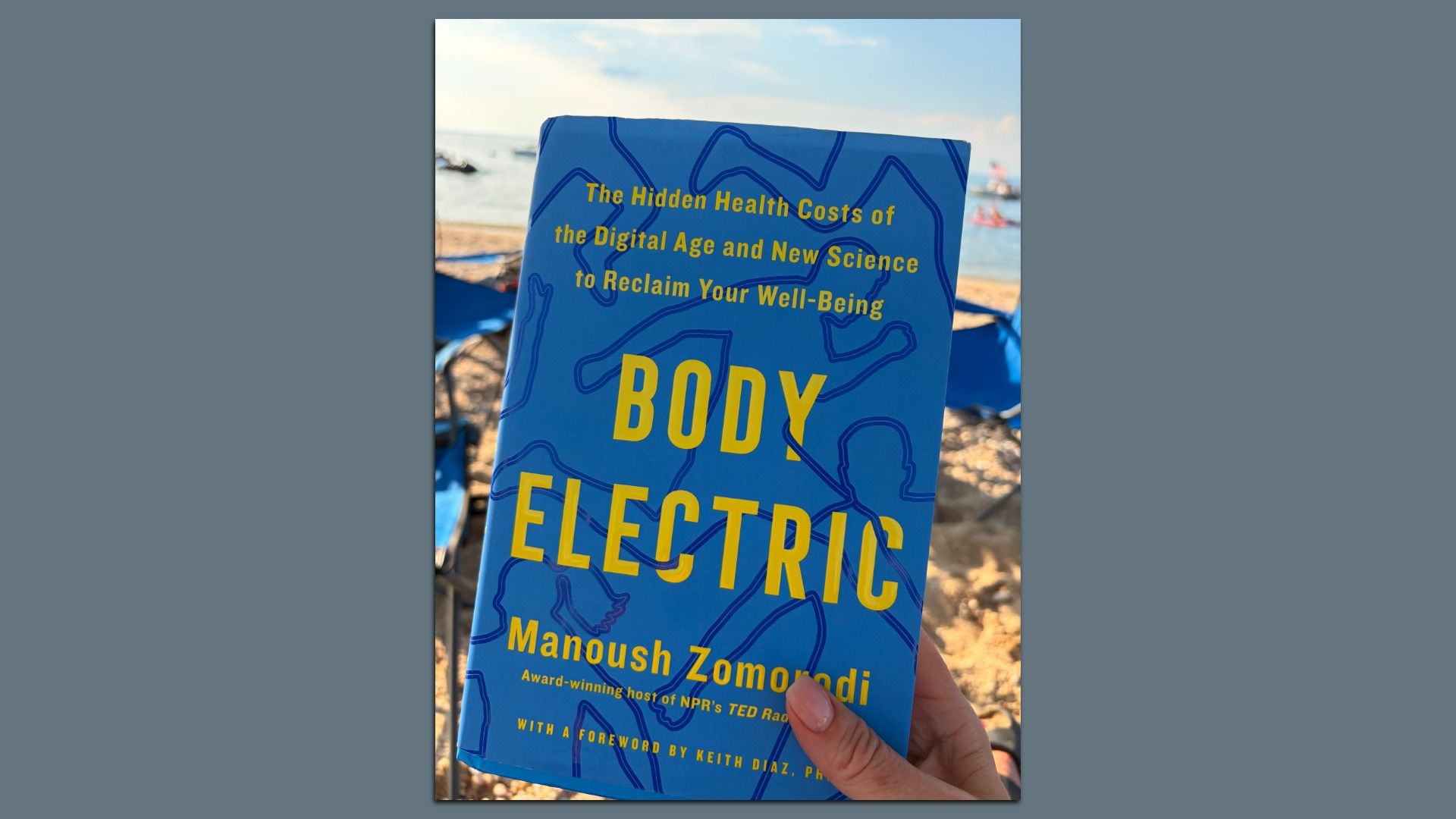
Editor Megan here with a book recommendation. Yes, I sat on the beach reading Manoush Zomorodi's new book about how we sit too much.
Thanks to Megan Morrone for editing this newsletter and Matt Piper for copy editing.
Sign up for Axios AI+
