Axios AI+
May 18, 2026


1 big thing: An AI hate wave is here
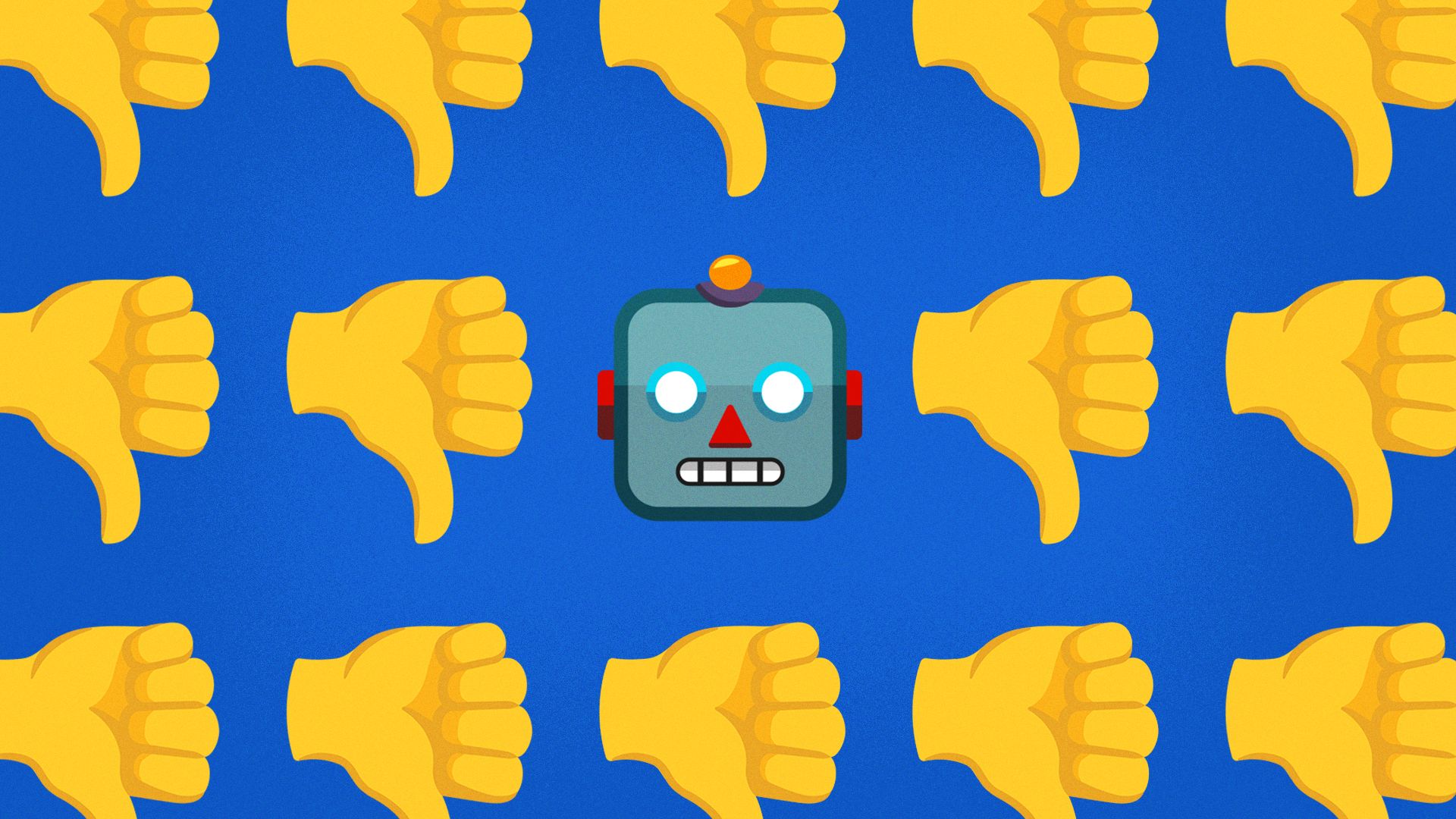
If AI were a candidate for political office, it would be losing in a landslide.
Why it matters: The AI hype cycle would have you believe the technology is inevitable. But AI backlash is growing, as people worry it will steal their jobs, jack up electricity rates and further enrich the wealthy, all while hurting the environment.
State of play: A commencement address went viral this month after Florida real estate executive Gloria Caulfield said "artificial intelligence is the next Industrial Revolution," sparking a chorus of boos from the crowd.
- Yesterday, former Google CEO Eric Schmidt garnered a similar reaction at his University of Arizona graduation speech when he mentioned AI. The crowd continued to boo even as Schmidt stopped his speech to say, "If you'd let me make this point, please." They did not.
- Both speakers could have avoided the jeers had they checked the latest polls: Only 18% of young people ages 14 to 29 say they feel hopeful about AI, according to a recent Gallup survey.
- The disdain spans generations and political parties. An Economist/YouGov poll released this week showed more than 70% of Americans think AI is advancing too quickly, with 68% of Republicans and 77% of Democrats saying it's moving too fast.
Between the lines: AI executives aren't doing much to quell the backlash, which is already showing signs of slowing the industry. Some of them appear unfazed — or unaware.
- In previous conversations with Axios, AI executives at multiple frontier AI labs were surprised by the negative opinions. They see AI as just as inevitable as the rise of the internet.
- Asked about backlash to AI, Superhuman Mail CEO Rahul Vohra — whose company makes an AI-powered email assistant — seemed unfamiliar with the premise of the question. After hearing about poor polling around AI, he responded: "We don't really see that."


Threat level: Negative AI sentiment could become a financial liability for AI labs if it continues to curb access to their most valuable resource: compute power.
- A record number of data centers, which provide the compute AI companies use to answer user queries, were canceled in the first quarter of 2026 amid resistance from communities, per Heatmap Pro data.
- "Public pushback is emerging as a binding constraint, particularly around data center buildout," Morgan Stanley analysts wrote in a note about market risks associated with the midterms.
- These data center setbacks are "sapping confidence" among investors, according to a note investment bank Jefferies sent to clients.
Reality check: AI has been around for years and is bound to be a central part of American life, whatever form it ultimately takes.
- "Some version of AI is inevitable ... but we have choice," said Arun Bahl, the CEO of Aloe, an AI company that builds models designed to be trustworthy. "Is it the dystopian plot? Or can we have tools that humans trust?"
- Globally, opinion is more positive, with the share of respondents expecting AI to do more good than harm rising to 59% in 2025 from 55% in 2024, according to Stanford data.
2. Musk lawyers wrap up case against OpenAI
3. AI hasn't overtaken human writers online



The flood of AI-generated writing unleashed by ChatGPT appears to have leveled off — a sign that AI content hasn't overtaken the web after all.
The big picture: The share of online news articles, blog posts and listicles that are primarily AI-generated has held near 50% for more than a year, according to a new analysis from digital marketing agency Graphite.
- The plateau indicates that the feared takeover of human online writing by AI hasn't materialized — at least not yet.
Why it matters: Researchers who've studied the spread of AI-written articles warn that once models start training on that content, the internet could become a massive feedback loop of low-quality, machine-generated content.
- "These models are smart because of all the information we put on the web that was created without these models," Dan Klein, a UC Berkeley professor and AI model CTO, tells Axios. "If we stop creating knowledge that is independent of these models, what's going to fuel that?"
4. Training data
5. + This
Axios AI+
