Axios AI+ Government

June 05, 2026


Happy Friday ... it's been a very busy week in AI policy, from President Trump's new executive order to the House's latest bid to craft federal regulations. Let's jump in!
Today's newsletter is 1,588 words, a 6-minute read.
1 big thing: The official quietly leading Trump's science and tech push
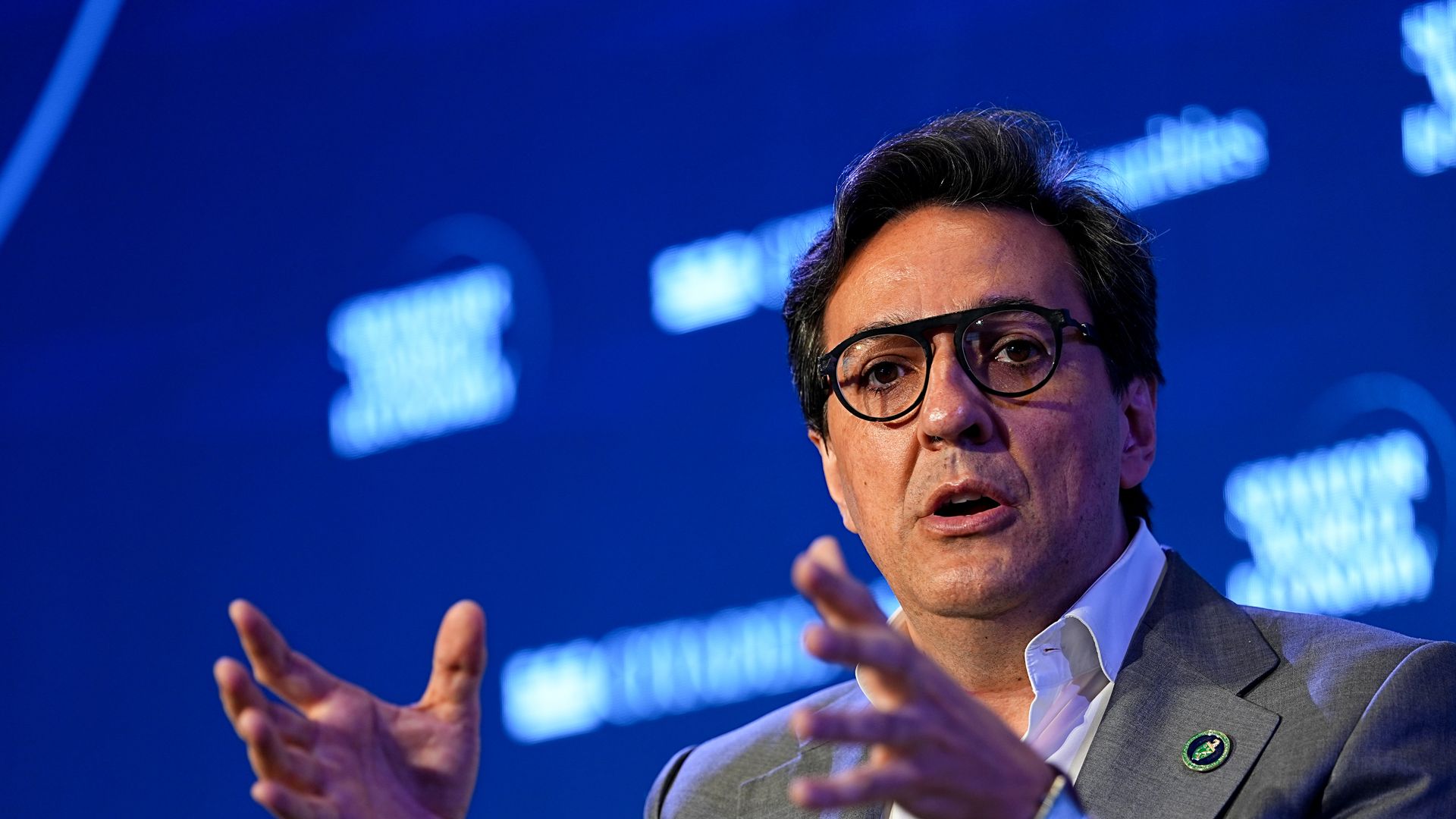
Energy Department undersecretary Darío Gil is taking a long-term view of science and technology.
Why it matters: While President Trump's second term has been marked by high-drama fights over AI policy, Gil's been working behind the scenes to strengthen U.S. competitiveness in science and tech.
The big picture: A familiar pattern is unfolding in AI policy.
- An AI lab comes out with a frighteningly powerful model, sending officials scrambling, and then states advance AI laws — which spark congressional efforts to get a federal standard in place.
- Gil is trying to spearhead a different approach where the federal government plays a larger role in shaping emerging technologies before crises emerge or competitors like China gain an advantage.
- "The posture that the U.S. government should have towards AI is much more proactive," Gil, who spent decades leading IBM's research team before joining the administration, told Maria.
Zoom in: Gil has been at the forefront of the Genesis Mission, an effort to boost science and technology research and development and to encourage government information sharing with industry, academia and other scientific institutions.
- The program reached a major milestone this week, when the Energy Department and Japan struck a $1 billion information sharing partnership, expanding Genesis internationally.
- Gil said the program has received a record number of submissions from universities and scientific institutions looking to participate, with over 5,000 unique proposals coming in.
- "It is the record in the history of the Department of Energy, like two and a half times the next largest solicitation," Gil said.
For his efforts to stand the test of time and future political headwinds, two key things need to happen, Gil said.
- One, Congress has to appropriate more money to science R&D. And two, lawmakers need to pass a bipartisan law codifying the Genesis Mission.
- "I'm having very active discussions again in this philosophy in a bipartisan manner, talking to everybody who's interested ... both in the House and the Senate."
Friction point: Gil's ambitions will collide with a major challenge: funding.
- Critics say the administration's research goals are difficult to reconcile with cuts to federal science agencies.
- The Center for Strategic and International Studies' Navin Girishankar said the goal of strengthening U.S. science leadership is hard to square "without a complete turnaround or a significant shift in the four-decade-long reduction in public spend on R&D."
Zoom out: Gil highlighted fusion energy and quantum computing as two of the scientific breakthroughs that excite him the most.
- Gil said fusion is one of the most "inspirational" problems to solve that would be "civilizational" in terms of its impact: "It's essentially building a little star on Earth."
- Gil also said he wants to see a fault-tolerant quantum computer that would operate correctly in the presence of errors in the next few years.
What we're watching: The department expects to announce its first Genesis awardees this summer, Gil said, with hundreds of teams potentially participating in the program's first cohort.
2. What's inside the House draft AI bill

A bipartisan group of House lawmakers yesterday unveiled a proposal to regulate AI that would override some state laws.
Why it matters: The draft's release is a major step in what will be a difficult path forward for a bipartisan AI bill that can pass the House and the Senate.
- The White House has been skeptical of any approach that imposes strict requirements on companies.
Driving the news: Reps. Jay Obernolte (R-Calif.) and Lori Trahan (D-Mass.) yesterday rolled out a discussion draft of the Great American Artificial Intelligence Act.
- The draft comes days after President Trump signed an executive order on AI safety and cybersecurity.
- Co-sponsors include Reps. Scott Franklin (R-Fla.), Suhas Subramanyam (D-Va.), Erin Houchin (R-Ind.) and Scott Peters (D-Calif.).
What's inside: The 269-page framework would:
- Preempt state laws on the development of AI models for three years.
- Formally establish the Center for AI Standards and Innovation, tasked with making voluntary standards and guidelines, and appropriate $100 million per year from 2027 to 2029.
- Require "large frontier developers" to write and implement plans addressing risks prior to releasing new models, as well as to report critical safety incidents to CAISI.
The draft legislation would also protect AI whistleblowers and increase fines for AI-enabled fraud, and try to boost funding for AI literacy, education and research.
- It would create a mechanism for the government to study AI's impact on the workforce and add some workforce protections around AI.
- The draft touches on content moderation, cybersecurity, research security and international AI standards.
What we're watching: The lawmakers call the draft "the start of a serious national conversation" to get feedback from experts and the public ahead of the bill's formal introduction.
3. Exclusive: Dems' "responsible" defense AI bill

Democratic lawmakers will roll out a bill setting guidelines for the military's use of advanced AI next week, per an announcement first shared with Ashley.
Why it matters: The bill is one in a series of responses from members of Congress concerned about how AI can be used in defense or make deadly decisions without human oversight.
Driving the news: Sens. Chris Coons (D-Del.) and Jack Reed (D-R.I.) will introduce the Responsible Artificial Intelligence in Defense Act on Monday.
What's inside: The bill would establish a framework governing how the Pentagon acquires, tests and uses AI-enabled autonomous weapon systems.
- It would direct the Pentagon to have human oversight and a manual override capability "until AI systems achieve a reliability threshold," per a memo about the bill shared first with Ashley, along with prohibiting the use of military AI "for mass surveillance of persons inside the United States."
- It would direct the Pentagon to require "humans in the loop" during operation of AI-enabled systems and require privacy assessments.
- It would also prohibit AI from "making the decision to launch a nuclear weapon" from "lethal autonomous force," or from tracking people in the U.S.
What they're saying: "Artificial intelligence is a rapidly evolving technology, and its incorporation into military operations — particularly lethal autonomous systems — is genuinely new territory," the memo reads.
- "A rigorous framework for human oversight is not a brake on adoption; it is the foundation that makes sustainable, confident adoption possible."
Between the lines: These lawmakers were prompted to write this bill after the Pentagon and Anthropic started publicly fighting over the use of Anthropic's AI in classified settings, eventually resulting in the Pentagon designating Anthropic as a supply chain risk, which it is challenging in court.
The big picture: It's not the first bill to come out of the Pentagon-Anthropic spat.
- Both Sens. Elissa Slotkin (D-Mich.) and Kirsten Gillibrand (D-N.Y.) have introduced similar bills.
4. Anthropic's warning

AI development is moving so rapidly that soon it will be able to advance itself without human involvement, per a new blog post from Anthropic.
Why it matters: "Recursive self-improvement," a process in which AI systems build, test and improve themselves, is a phenomenon which may come sooner than expected, Anthropic says its research shows.
Driving the news: Anthropic warns that AI is no longer just changing how people work, it's also beginning to change how AI itself gets built.
- New data from the company suggests that frontier models have accelerated coding, debugging and research.
- That is likely to create a feedback loop in which AI systems create even more sophisticated successors.
What they're saying: "We've always found that the best thing to do is to socialize the concept and basically give people a sense of what's coming," Anthropic's Jack Clark said in an interview with Ashley.
- "The big story here is what we see are indications that, contrary to some popular opinion, AI progress is going to speed up in coming years rather than stay the same, or diminish."
5. The Output: Bio threats, quantum and more

Here's our guide to catch you up on the AI policy news you may have missed this week:
🤖 Government equity push: NOTUS reported yesterday that the Trump administration has held "preliminary discussions" with AI companies, including OpenAI, about potentially giving the federal government equity stakes by voluntarily ceding shares.
🧬 Bio threats warning: OpenAI's Sam Altman, Anthropic's Dario Amodei and Google DeepMind's Demis Hassabis signed on to a letter urging Congress to protect against AI-assisted bioweapons.
- "We call on legislators to make screening of orders for synthetic nucleic acids — and the equipment needed to make them — mandatory," the letter states.
❌ Data centers ban: Residents in the city of Monterey Park, California, became the first in the country to vote to permanently ban data centers, per the Los Angeles Times.
- 86% voted this week in support of the ban, which can only be overturned by a future ballot measure.
🔦 Quantum spotlight: IBM CEO Arvind Krishna said at Axios' AI+NY Summit that the country isn't prepared for post-quantum cryptography, which will happen soon and could result in "embarrassing data" going public, our colleague Avery Lotz reports.
- "If you think it's more than five years out, you're making a mistake," Krishna told Maria.
- Zoom in: The Commerce Department announced federal investments in quantum computing companies under the CHIPS Act last month, with the largest share going to IBM for its Anderon quantum chip foundry.
💼 People moves: Helen Toner, who made waves in AI world as one of the leaders of the failed effort to oust OpenAI's Altman, has officially been named permanent executive director of Georgetown's Center for Security and Emerging Technology (CSET).
Thanks to Mackenzie Weinger and David Nather for editing and Matt Piper for copy editing.
Sign up for Axios AI+ Government
