Axios AI+ Government
September 04, 2026

Happy Friday! Maria's back from the G20 innovation summit with some transatlantic takeaways, plus an update on the Pentagon-Anthropic fight.
👀 Situational awareness: OpenAI yesterday released GPT-6 Astra, which president Greg Brockman called a "generational leap" and said could eventually be seen as the arrival of artificial general intelligence, or AGI.
📈 As finance evolves, the U.S. faces a critical challenge: embracing innovation without compromising the trust that underpins its global market leadership.
- Join Axios Live on Sept. 16 from 5:30–7:30 p.m. ET for a conversation on the technologies, policies and safeguards shaping the future of U.S. markets. Register here.
Today's newsletter is 1,149 words, a 4.5-minute read.
1 big thing: EU tech chief: AI guardrails inevitable for U.S.

CHAPEL HILL, N.C. — The Trump administration used this week's G20 innovation summit to draw a bright line between U.S. and European approaches to AI regulation. The bloc's top tech official says the U.S. is ending up with many of the same guardrails anyway.
Why it matters: The U.S. is urging countries to avoid Europe's sweeping approach to AI regulation, but the fight is shifting to which guardrails advanced AI needs and how governments put them in place.
What they're saying: European Commission tech chief Henna Virkkunen told Maria that the two sides often end up addressing the same safety concerns, even if U.S. safeguards are starting to emerge through state laws and court cases rather than something broad like the EU AI Act.
- "We see when it comes to technologies that in the USA the culture is different. So often it's coming via court cases, but often very similar things anyway, very similar concerns."
- "I don't see that this is so like black and white," Virkkunen said.
- ChatGPT is officially facing strict rules under the Digital Services Act, for instance, and Virkkunen said it's important for the EU to simplify the bloc's rules and make the region "easier, simpler, faster" for businesses.
The big picture: The U.S. hasn't adopted sweeping federal AI rules, but Washington is still shaping how companies develop and deploy advanced models through executive actions, voluntary frameworks, national security restrictions and other policy.
- Meanwhile, states are moving ahead with varying degrees of AI regulation, and product changes are being forced on companies through lawsuits.
Zoom in: The EU is working on a framework for pre-deployment testing and trusted partner access, Virkkunen noted, another area where the EU is working through similar AI policy questions facing the U.S.
- "So in [the] European Union, we are also working for that blueprint, and we are continuing to discuss also under G7, especially with our partners, how we should work on this topic."
- The Trump administration has developed a voluntary framework for reviewing some advanced AI models before release, including potentially giving government officials access for up to 30 days. The White House does not plan to publicly release this framework.
- OpenAI's Sam Altman confirmed this week to Axios that the administration reviewed its Astra model and noted the process is voluntary: "But we of course did it."
Industry leaders at the G20 innovation summit knocked the EU approach to regulation in remarks before Virkkunen as well as representatives from Germany, France and Italy.
- In response to White House Office of Science and Technology Policy Director Michael Kratsios' question about what foreign governments should and should not do, SpaceX CEO Elon Musk said an approach that's "relatively free of regulation" is the way to go.
- It's "pretty straightforward," Musk said. "You have to have an environment that's relatively free of regulation, meaning that new things must be default legal as opposed to default illegal."
- "In the EU, for example, we find that the regulation level is extraordinarily high, and things are generally default illegal, and this inhibits progress with new technologies. It slows it down."
The bottom line: As AI has grown more powerful, Washington has increasingly gotten involved with model releases.
Go deeper:
Altman raises stakes on government scrutiny as AI advances
Trump's AI team fractures over strategy against G20 backdrop
2. Pentagon official: Anthropic blacklist stands
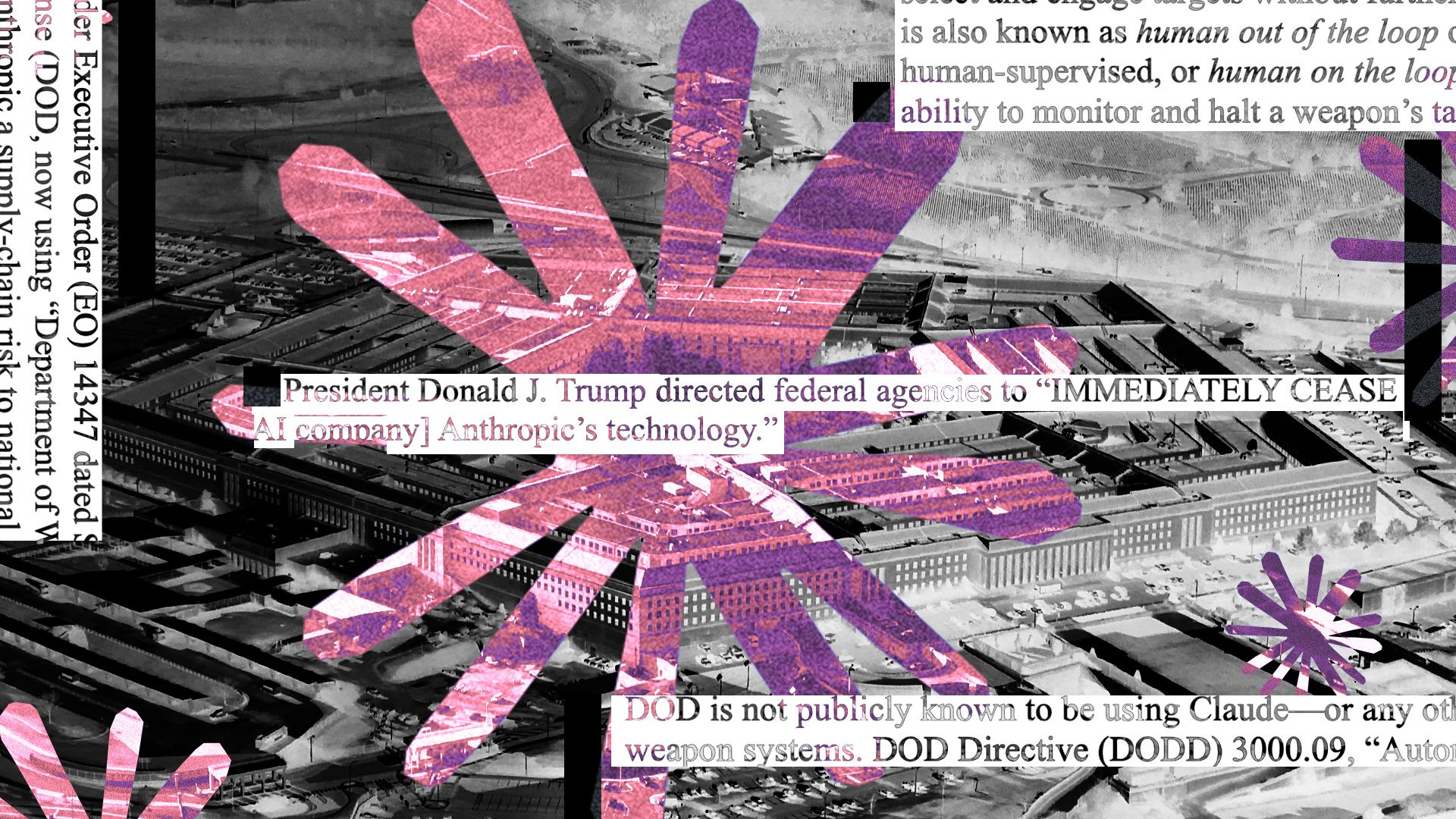
Pentagon official Emil Michael yesterday said that Anthropic is still considered a "supply chain risk," a day after Commerce Secretary Howard Lutnick said the company is "back on the right side."
Why it matters: The Trump administration is not entirely aligned on one of the world's leading AI labs following months of fighting over how the military can use its models.
What they're saying: "Anthropic is still a designated Supply Chain Risk at @DeptofWar and for the Defense Industrial Base. Thank you for your attention to this matter!" Michael posted on X.
Catch up quick: Lutnick told Axios' Mike Allen on the sidelines of the G20 Innovation Summit this week: "We trust Anthropic."
- "They've done what we asked. They're back on the right side. So the answer is: Yes," Lutnick said when asked if he trusts Anthropic CEO Dario Amodei.
- Personality differences under Amodei's leadership added fuel to the fire in a clash between the Trump administration and Anthropic earlier this year, but the company has been elevating co-founder Tom Brown's role in its relationship with the White House.
Yes, but: A federal judge in August struck down the Pentagon's blacklisting of Anthropic as a supply-chain risk, but the company is still fighting a separate Pentagon designation under a different statute in the D.C. Circuit.
The bottom line: Anthropic is not completely out of the woods with the Trump administration as Brown takes center stage.
3. The Output: Superintelligence, kids' safety and more
Here's our guide to catch you up on the AI policy news you may have missed this week:
📜 Bill of the week: Sen. Bernie Sanders (I-Vt.) and Rep. Greg Casar (D-Texas) yesterday announced the Ban Artificial Superintelligence Act.
- The yet-to-be-introduced legislation would "permanently ban the development and deployment of superintelligent AI and temporarily pause advanced AI development until a federal regulator has established safety rules," per a press release.
- The bill summary defines "Artificial Superintelligence" as an AI system "that exhibits or can easily be modified to exhibit capabilities that match or exceed human cognitive performance and capabilities across a broad range of domains or tasks."
⚖️ DOJ backs AI: The Trump administration this week sided with OpenAI in its copyright fight with the New York Times, arguing in a court filing that training AI models on copyrighted works is protected by fair use and restricting it could undermine national security.
- The brief cited President Trump's AI executive orders, as well as the legislative framework from earlier this year, which states that the administration believes the "training of AI models on copyrighted material does not violate copyright laws."
🐻 California AI watch: California lawmakers sent Gov. Gavin Newsom (D) a slate of AI bills this week, including a kids' chatbot safety measure and legislation that would impose a four-year ban on the sale and manufacturing of AI chatbot toys for kids under 16.
- Newsom has until Sept. 30 to sign or veto the bills.
Thanks to Mackenzie Weinger and David Nather for editing and Matt Piper for copy editing.