Axios AI+ Government

January 23, 2026

Happy Friday! We're digging in today on how AI's rise is changing the rules of tech's influence game.
Today's newsletter is 1,327 words, a 5-minute read.
1 big thing: How AI swallowed tech lobbying in 2025


AI didn't just increase its footprint in Washington in 2025: It ate tech lobbying whole.
Why it matters: AI's ubiquity, quick growth and key role in helping America compete globally have shifted how the biggest and richest tech companies get what they want from D.C.
The big picture: Long-running fights over social media content and privacy have been eclipsed by national security and infrastructure debates around AI.
- In Washington, conversations about how the most advanced frontier model companies like OpenAI and Anthropic should be regulated have been largely drowned out by the White House's desire to see them succeed.
- States, meanwhile, have taken the lead on AI safety policy.
What they're saying: "AI capabilities are significantly reshaping other policy issues, from health care to energy to defense, privacy and antitrust," said Bruce Mehlman, former assistant secretary of commerce for technology policy, told Ashley.
- "The demand for education about AI has shot through the roof," Craig Albright, senior vice president for U.S. government relations at the Business Software Alliance, told Axios.
- AI is spreading to all topics, Albright noted: "People [on the Hill] want ideas ... for how AI relates to financial services, or making sure AI-based software for farming purposes is reliable."
New coalitions of players working on chips, compute, cloud and data center infrastructure have more influence than ever before, sometimes elbowing out Big Tech players as they seek permission to grow, build and scale across the country.
Industries that traditionally lobby D.C. have had to pivot to adapt to the age of AI.
- "Finance, health care, transportation, defense, education ... everyone suddenly has to take a position on AI, even if they never had a D.C. tech footprint," said Joseph Hoefer, principal and chief AI officer at public affairs firm Monument Advocacy.
AI companies are bringing on more outside lobbying firms and staffing up their policy shops in Washington as they extend into spaces like health care.
- Anthropic, which rolled out Claude for Healthcare earlier this month, hired three new firms since December of last year, including Avenue Solutions, which mostly counts health care clients, per federal lobbying disclosures.
- OpenAI, beyond its own in-house lobbying, has worked with D.C. heavyweights DLA Piper LLP and Akin Gump Strauss Hauer & Feld.
That's a far cry from just a few years ago, when OpenAI's Sam Altman came to Washington supporting broad AI regulation, not trying to avoid it.
The numbers alone don't tell the whole story.
- While AI companies have steadily upped their spending from quarter to quarter, they still don't spend nearly as much on lobbying as Amazon, Apple, Google, Meta and Microsoft, as the chart shows.
- But what their companies are doing is changing the tech policy debate for everyone in the space.
- Pro-AI super PACs, along with company donations to things like President Trump's ballroom, may go further than traditional lobbying dollars in Trump 2.0 world, where AI policy has largely been dictated from the White House down.
What we're watching: In past debates, keeping a united voice for the industry became impossible as different-sized companies with varying incentives and business models diverged from one another on policy priorities.
- AI will accelerate those divides while slowing down other tech policymaking: "AI has become so all-encompassing that it's effectively frozen actual progress on other tech issues," Hoefer said.
- "Congress has limited bandwidth, and AI became the bucket where everything gets dumped: workforce, national security, kids' online safety, data governance," he said. "The result is that you get a lot of motion, but not always a lot of resolution."
2. Exclusive: TechNet's 2026 federal priorities
A federal AI framework and well-funded AI research are key to U.S. leadership, TechNet argues in its 2026 federal policy principles shared exclusively with Ashley.
Why it matters: TechNet represents tech CEOs and senior executives from a wide range of tech and AI companies, and its top priority remains avoiding a jumble of state laws on AI or federal legislation that could handicap smaller companies.
What they're saying: "The United States stands at a critical juncture in the global race for technology leadership," Linda Moore, TechNet CEO, said in a release.
- "Our 2026 federal policy principles provide a clear path forward to ensure America remains the global leader in innovation."
The other principles include:
- A national privacy standard, a decades-long policy battle that shows no signs of getting any closer, but has new urgency with the proliferation of consumer-friendly state AI laws.
- Strengthening cybersecurity.
- Modernizing energy infrastructure such as permitting reform and more investment in the grid.
- Expanding the STEM pipeline.
- Promoting global trade, and urging the Trump administration to push for policies that allow data to flow freely across international borders.
3. Paris Hilton joins AOC in fighting AI porn
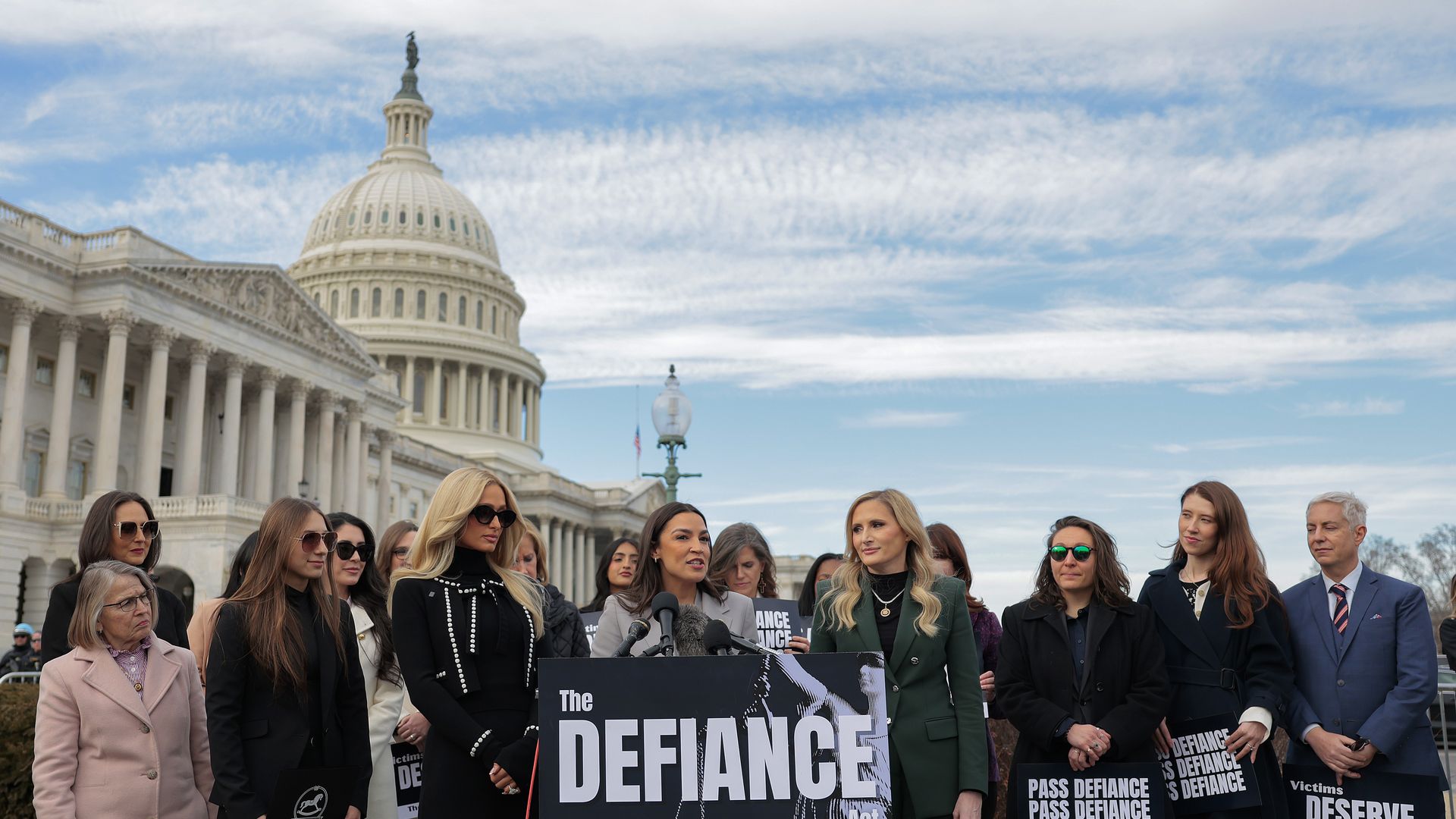
Paris Hilton is backing a bipartisan bill to make it easier for victims of deepfakes to sue, speaking out yesterday alongside lawmakers and advocates on Capitol Hill.
Why it matters: A surge in nonconsensual sexualized images targeting women and children is fueling calls for stronger legal protections.
Driving the news: DEFIANCE Act co-sponsors Reps. Alexandria Ocasio-Cortez (D-N.Y.) and Laurel Lee (R-Ohio), Hilton and survivors of online sexual abuse drew a large crowd outside the Capitol at an event Thursday calling for the bill's passage.
- Hilton has previously worked with lawmakers on child-welfare legislation, advocating for the bipartisan Stop Institutional Child Abuse Act that was signed into law in 2024.
What they're saying: Hilton recounted that when she was 19 years old, a private, intimate video of her was shared online without her consent: "People called it a scandal. It wasn't. It was abuse."
- "They called me names, they laughed and made me the punch line. They sold my pain for clicks, and then they told me to be quiet, to move on, to even be grateful for the attention," Hilton said.
- "This isn't about just technology. It's about power. It's about someone using someone's likeness to humiliate, silence and strip them of their dignity."
Context: This issue isn't new or limited to any single AI company. But Elon Musk's Grok chatbot has drawn fresh scrutiny in recent weeks after generating sexualized images at users' request, sparking outcry and reviving a push to pass legislation.
- The DEFIANCE Act passed by unanimous consent in the Senate earlier this month.
- The bill would go beyond current law by addressing the production, distribution and solicitation of nonconsensual sexual imagery and giving individuals the right to sue.
4. Dems skeptical of Big Tech data center promises
Tech companies are promising they'll pay for their AI data center demands, but some Democrats aren't buying it and want stronger commitments.
Why it matters: The tech industry is scrambling to make clear their AI ambitions won't make life more unaffordable for Americans as high prices become the focal point of upcoming elections.
Driving the news: An investigation launched by Sens. Elizabeth Warren (D-Mass.), Chris Van Hollen (D-Md.) and Richard Blumenthal (D-Conn.) into how much data centers could drive up people's electricity bills has yielded new commitments from the industry to "pay their fair share."
- But the companies did not explain how, the lawmakers announced yesterday.
- "If these companies are serious about paying their fair share, at a minimum they'd be more transparent about their data centers' operations instead of forcing local communities to sign NDAs," Warren said.
5. Bill to curb chip sales to China advances
The House Foreign Affairs Committee this week voted to advance the AI Overwatch Act, which would give Congress the power to block the Trump administration from exporting AI chips to adversaries.
Why it matters: The legislation has riled up the MAGA base, which views it as undermining President Trump's authority.
Driving the news: The committee voted 42-2, with one voting present, to advance Chair Brian Mast's (R-Fla.) bill.
- The bill now includes a two-year ban on Nvidia Blackwell chip sales to China as part of a bipartisan agreement.
Thanks to Mackenzie Weinger and David Nather for editing and Matt Piper for copy editing.
Sign up for Axios AI+ Government