Catch up on the day's biggest business stories

Subscribe to Axios Closer for insights into the day’s business news and trends and why they matter

Please enter a valid email.

Please enter a valid email.

Subscription failed
Thank you for subscribing!

Stay on top of the latest market trends

Subscribe to Axios Markets for the latest market trends and economic insights. Sign up for free.

Please enter a valid email.

Please enter a valid email.

Subscription failed
Thank you for subscribing!

Sports news worthy of your time

Binge on the stats and stories that drive the sports world with Axios Sports. Sign up for free.

Please enter a valid email.

Please enter a valid email.

Subscription failed
Thank you for subscribing!

Tech news worthy of your time

Get our smart take on technology from the Valley and D.C. with Axios Login. Sign up for free.

Please enter a valid email.

Please enter a valid email.

Subscription failed
Thank you for subscribing!

Get the inside stories

Get an insider's guide to the new White House with Axios Sneak Peek. Sign up for free.

Please enter a valid email.

Please enter a valid email.

Subscription failed
Thank you for subscribing!

Communicate like Axios

Keep teams engaged and aligned with Axios-style communications crafted with Axios HQ.

Learn moreArrow

Catch up on coronavirus stories and special reports, curated by Mike Allen everyday

Catch up on coronavirus stories and special reports, curated by Mike Allen everyday

Please enter a valid email.

Please enter a valid email.

Subscription failed
Thank you for subscribing!

Want a daily digest of the top Denver news?

Get a daily digest of the most important stories affecting your hometown with Axios Denver

Please enter a valid email.

Please enter a valid email.

Subscription failed
Thank you for subscribing!

Want a daily digest of the top Des Moines news?

Get a daily digest of the most important stories affecting your hometown with Axios Des Moines

Please enter a valid email.

Please enter a valid email.

Subscription failed
Thank you for subscribing!

Want a daily digest of the top Twin Cities news?

Get a daily digest of the most important stories affecting your hometown with Axios Twin Cities

Please enter a valid email.

Please enter a valid email.

Subscription failed
Thank you for subscribing!

Want a daily digest of the top Tampa Bay news?

Get a daily digest of the most important stories affecting your hometown with Axios Tampa Bay

Please enter a valid email.

Please enter a valid email.

Subscription failed
Thank you for subscribing!

Want a daily digest of the top Charlotte news?

Get a daily digest of the most important stories affecting your hometown with Axios Charlotte

Please enter a valid email.

Please enter a valid email.

Subscription failed
Thank you for subscribing!

Sign up for Axios NW Arkansas

Stay up-to-date on the most important and interesting stories affecting NW Arkansas, authored by local reporters

Please enter a valid email.

Please enter a valid email.

Subscription failed
Thank you for subscribing!

Please enter a valid email.

Please enter a valid email.

Subscription failed
Thank you for subscribing!

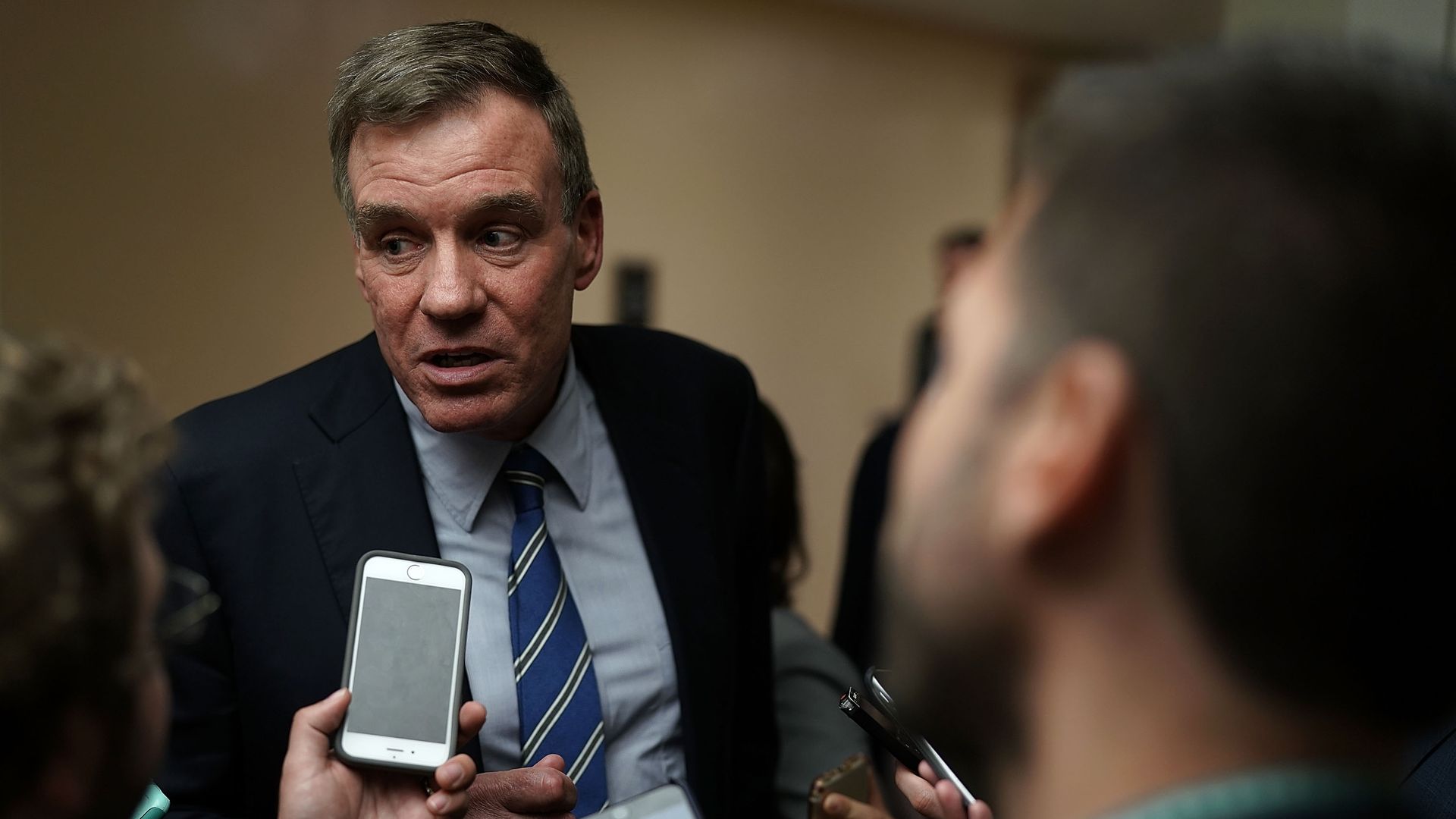
Virginia's Mark Warner is the top Democrat on the Senate Intelligence Committee. Photo: Alex Wong/Getty Images

In a policy paper obtained by Axios, Sen. Mark Warner's office laid out 20 different paths to address problems posed by Big Tech platforms — ranging from putting a price on individual users' data to funding media literacy programs.

Why it matters: The paper — prepared by Senate Intelligence Committee Vice Chairman Mark Warner’s staff and circulated in tech policy circles in recent weeks — is a window t0 the options available to U.S. policymakers concerned about disinformation and privacy. Enacting any of these plans is a long shot in the near-term, but a shift in party control of Congress come November could give them more momentum.

The policy paper divides the different proposals along three lines:

  1. Combating disinformation,
  2. Protecting user privacy,
  3. Promoting competition in the tech space.

The details: Options listed in the paper run the gamut from those that are relatively small lifts to more sweeping policy options.

  • New resources and roles for government: The paper raises the prospect of new federal funding for media literacy programs that could help consumers sort through the information on online platforms. It also describes the military and intelligence communities as not adequately prepared for foreign information operations and includes various measures for bolstering their capabilities.
  • New rules for platforms: The paper considers requiring web platforms to label bot accounts or do more to identify authentic accounts, with the threat of sanction by the Federal Trade Commission if they fail to do so.
  • But it also goes further: One idea would be to make platforms legally liable for claims like "defamation, invasion of privacy, false light, and public disclosure of private facts" if they fail to take down doctored video and audio or so-called deep fakes (or fabricated footage), if a victim secured a necessary judgement regarding the sharing of that content.
  • Another would hang an "essential facility" label on certain widely-used tech products, like Google Maps. That would require them to offer access on "fair, reasonable and non-discriminatory" terms and not engage in "self-dealing or preferential conduct."
  • New powers for consumers: Warner’s staffers raised the idea of a law mimicking Europe’s GDPR privacy rules in the United States or offering a more limited right for users to consent to the use of their data.
  • The report also suggested that, to increase visibility into competition, platforms could put a monetary value on an individual user’s data.

The paper acknowledges that these policy ideas come with plenty of questions: “In many cases there may be flaws in each proposal that may undercut the goal the proposal is trying achieve, or pose a political problem that simply can’t be overcome at this time."

What they’re saying: “The size and reach of these platforms demand that we ensure proper oversight, transparency and effective management of technologies that in large measure undergird our social lives, our economy, and our politics,” the paper says. “The hope is that the ideas enclosed here stir the pot and spark a wider discussion — among policymakers, stakeholders, and civil society groups — on the appropriate trajectory of technology policy in the coming years.”

What they’re not saying: The list doesn’t include the possibility of breaking up any of the large tech platforms — as some activists have called for — or establishing a new federal regulator for digital issues.

The big picture: Warner, who made his fortune in telecommunications before running for office, has been a prominent critic of major social media platforms from his perch as top Democrat overseeing the intelligence committee’s investigation of Russian election interference. Other members of Congress say they share some of his concerns about disinformation, privacy and competition.

Reality check: Even with vocal support, major tech policy proposals often fail to reach the velocity they need to actually be enacted. A Democratic wave in November could put more momentum behind these ideas — but for now they remain just that.

Read the whole paper:

Go deeper

22 mins ago - World

Australia to acquire nuclear submarines in historic security pact with U.S., U.K.

Photo: Brendan Smialowski/AFP via Getty Images

The U.S. and U.K. will help Australia acquire nuclear-powered submarines as part of a historic trilateral security partnership announced Wednesday afternoon by the leaders of the three countries.

Why it matters: The partnership, known as AUKUS, is a major strategic pact that will bind the U.S. and U.K. to Australia's security for generations — and a warning to China as the Biden administration continues to lay the groundwork for countering Beijing in the Indo-Pacific and beyond.

Biden expresses "great confidence" in top general after Woodward report

Photo: Win McNamee/Getty Images

President Biden on Wednesday expressed "great confidence" in Joint Chiefs Chairman Mark Milley after a new book said the general secretly assured his Chinese counterpart that President Trump had no plans to launch an attack.

The big picture: Details emerged that Milley told his Chinese counterpart that if Trump did decide to attack, Milley would give him a heads-up, Axios' Jonathan Swan reports.

Updated 4 hours ago - Politics & Policy

FBI apologizes to the U.S. gymnasts abused by Larry Nassar

Olympic gymnast Simone Biles, from left, Olympic gymnast McKayla Maroney, Olympic gymnast Aly Raisman, and Collegiate gymnast Maggie Nichols arrive for a Senate Judiciary Committee hearing. Photo: Saul Loeb/AFP/Bloomberg via Getty Images

FBI director Christopher Wray on Wednesday apologized to U.S. gymnasts abused by Olympic Team USA gymnastics doctor Larry Nassar for agency's mishandling of the investigation.

Driving the news: Wray made the comments after four gymnasts — McKayla Maroney, Simone Biles, Aly Raisman and Maggie Nichols — testified before the Senate Judiciary Committee and detailed how the FBI mishandled their reports.