How Virginia Tech is advancing wireless communications research

A message from: Virginia Tech
Every text, satellite signal, AI query and video call depends on one thing: wireless communication keeping pace with a world producing more data than ever before.
Why it's important: Existing communications infrastructure is under growing pressure to move, compress and process massive amounts of information quickly, securely and sustainably.
- That challenge is reshaping everything from AI-enabled devices and satellite systems to national security and space communications.
The solution: Virginia Tech is helping develop next-generation wireless systems designed for the AI era.
The background: The university is building on a wireless research legacy that stretches back to the early days of the space race.
- Shortly after NASA's Apollo 4 mission in 1967 helped pave the way for the moon landing, Virginia Tech researchers Warren Stutzman and Charles Bostian began to redefine what was possible for global — and interstellar — wireless communications.
- That foundation later expanded through the work of Jeff Reed, one of the central figures in transforming Virginia Tech into a nationally recognized wireless research powerhouse through Wireless@Virginia Tech.
- Their work helped lay the foundation for technologies ranging from WiFi connectivity to emergency radio network design, advancements that continue to influence modern communications systems today.
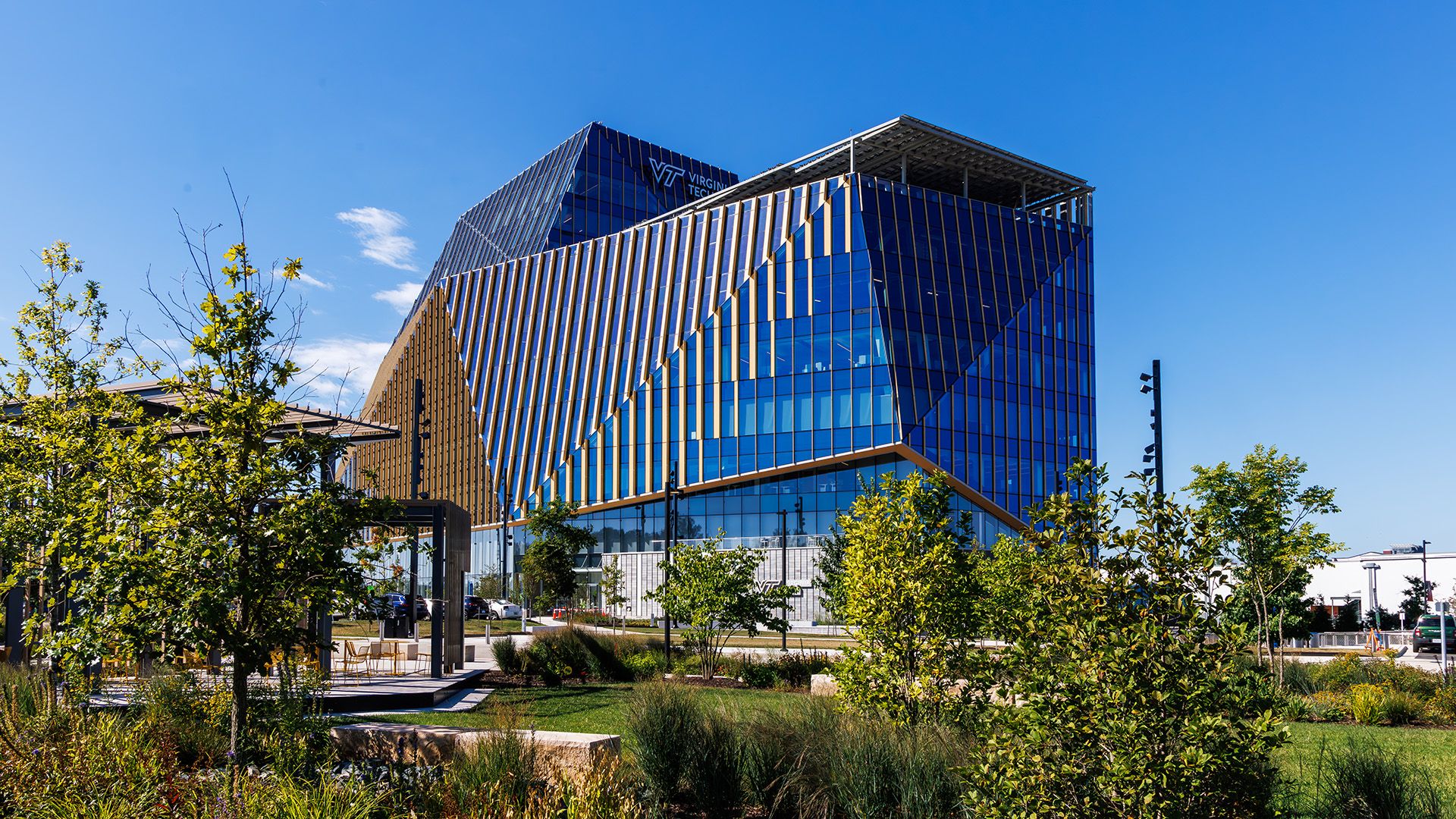
Now, the university's new Institute for Advanced Computing in Alexandria is helping shape what comes next.
What you need to know: Two key researchers at the Institute for Advanced Computing are building on Stutzman and Bostian's legacy through a "yes, and" approach to discovering the wireless methodologies of the future.
- Lingjia Liu is a founding faculty member of the university's new Institute for Advanced Computing who studies next-G wireless, sophisticated data highways and methods of standardizing modern wireless hardware and software.
- Walid Saad leads the institute's Network Intelligence, Wireless and Security group, tackling the biggest challenges on the road to safe and sustainable 6G.
The strategy: The pair is developing critical wireless communications advancements in collaboration with government agencies, national labs, private corporations and industry partners — helping the technological frontier scale the next big thing.
💽 Making data smaller
Liu is working with computer scientists at Argonne National Laboratory and Ohio State University on new flexible data compression algorithms that could enable dynamic computing on AI-enabled personal hardware and ultra-long-range satellite communications.
The impact: Liu's joint project is literally a new frontier — existing benchmarks for compression ratios were developed before the tech Liu is studying was invented — and could have impacts on consumer items like smart glasses and industry specialties like deep space communications.
The fundamental theory he developed can be extended to token-based communications, which is the foundation of the modern large language models.
- "In order to answer these questions, we need some mathematicians, like Professor Liu, to help us," Argonne computer scientist Sheng Di said. "We need to work together because we are the compression experts and Lingjia is the theory expert."
🧠 Rethinking data transmission
Saad is developing world models, a new kind of AI that learns how the physical world behaves, so wireless can harness semantic communication — sending a message's meaning and letting the receiver reconstruct the rest, akin to a teacher conveying concepts and trusting students to fill in gaps.
The impact: It could give a new wave of physical AI (robots, driverless cars) connectivity and intelligence to make sense of the world in real time. It could also ease satellite outages, cut energy use, and lower video latency before 6G's 2030 launch.
- "We've spent decades building networks that send bits faster. The next leap asks: what matters enough to send, and what can the receiver figure out on its own?" Saad said.
The takeaway: Virginia Tech's researchers are moving from innovation to impact by building the next generation of secure, resilient wireless communication.
Explore how you can be a part of the future of wireless research.