Advancing pediatric health care with AI

A message from: Virginia Tech
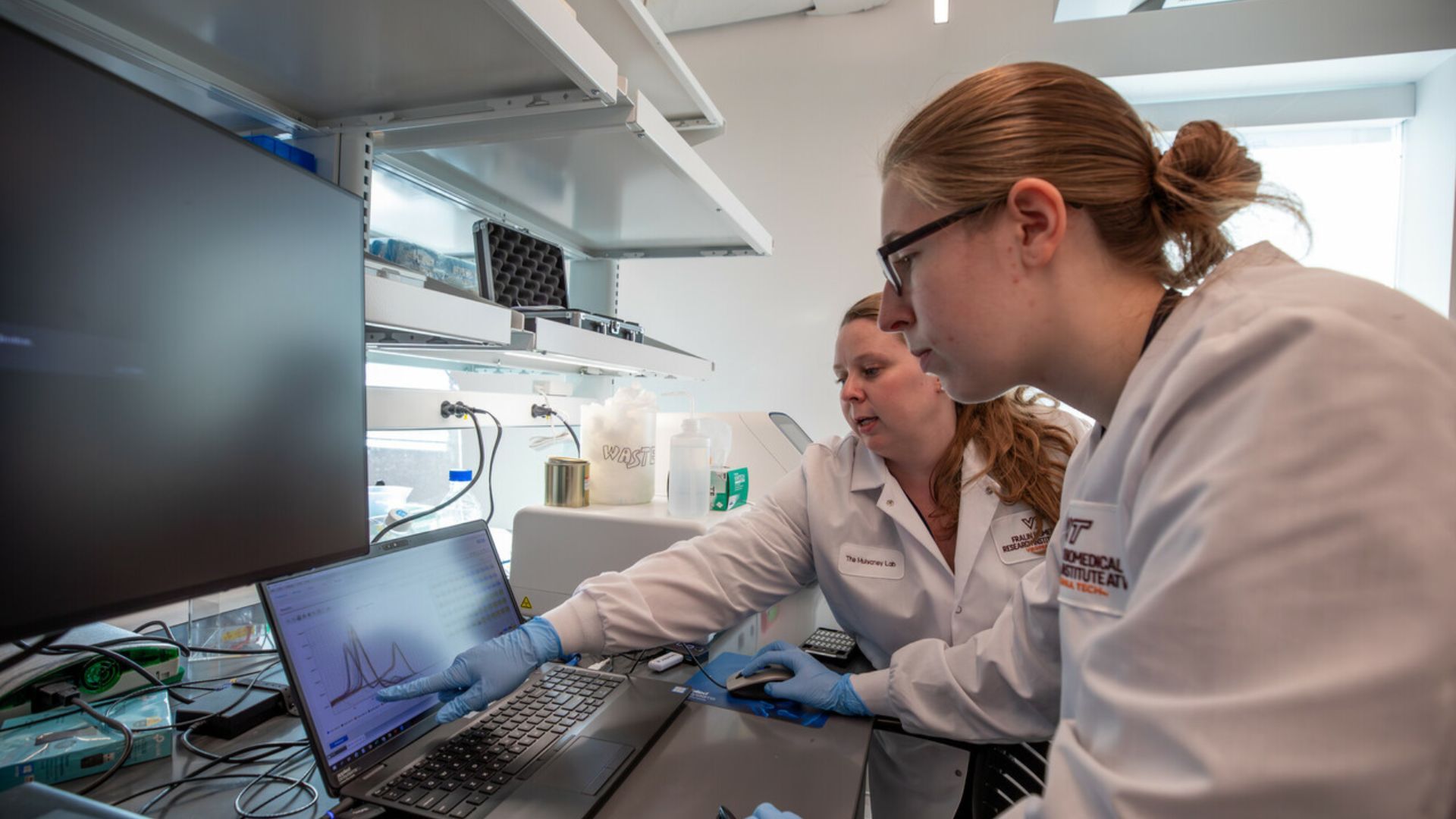
Researchers at the Fralin Biomedical Research Institute lab at Children's National Research and Innovation Campus in Washington, D.C. (Photo by Craig Newcomb/Virginia Tech).
Health care AI is moving fast, but pediatric care is still waiting for tools built specifically for kids.
The story: Virginia Tech and Children's National are launching a national Pediatric Health AI Innovation Hub in D.C. to help close that gap.
- Announced at their third annual AI for Pediatric Health Symposium in June, the hub will build and test pediatric-specific AI models and clinical workflows designed to support care teams without adding to their administrative burden.
Why it's important: Children make up more than a quarter of the U.S. population, but just 2.4% of all health care AI research focuses on them.
Most pediatric health care AI tools are also adapted from data about adult medicine — even though children have different physiology, disease patterns and developmental needs.
- "AI has a role in the delivery of pediatric healthcare and across the entire ecosystem, from basic discovery science to translation to clinical implementation," said Michael Friedlander, executive director of the Fralin Biomedical Research Institute at Virginia Tech and vice president for health sciences and technology.
The strategy: The hub unites health care practitioners, researchers, AI developers and data scientists in a shared effort to turn discoveries into treatments that reach young patients faster.
- Over the last three years, the AI health science research partnership between Children's National and Virginia Tech has evolved into a broad effort to build infrastructure, research pipelines and translational pathways that can move pediatric AI innovation from concept to clinical impact.
How it's done: Researchers from Virginia Tech are taking machine learning approaches to speed up and increase the precision of fundamental discovery, including for analyzing pediatric seizure disorders, monitoring the chemical activity in patients' brains and identifying rare diseases like some pediatric immunological disorders.
The hub also reflects a statewide goal of linking the research and innovation ecosystems in the greater Washington, D.C., area and Southwest Virginia.
- "Pediatric health presents some of the most complex challenges for artificial intelligence, from limited data to rapidly changing biology," said Naren Ramakrishnan, University Distinguished Professor and director of the university's Sanghani Center for Artificial Intelligence and Data Analytics.
The proof: Early collaboration shows how this partnership can come together in a clinical setting.
Virginia Tech and Children's National built a deep learning model to forecast emergency department crowding so hospitals can staff up before a surge hits, not after.
- Children's National emergency medicine physician Dr. Kenneth McKinley drew on Sanghani Center research to develop a pilot program that deploys a surge team when the model predicts that too many patients will otherwise leave without being seen.
- In testing against existing data, it has reliably avoided both false alarms and missed surges — and the team hopes to fold in predictive data next, creating a framework other medical centers could adopt.
"At every level, there's this little piece that Virginia Tech is contributing that ultimately will get us to what I hope will be generalized models with better performance," McKinley said.
The takeaway: Pediatric AI built the right way — for children, tested in an academic setting, deployed where care actually happens — is a model for how academia and industry can partner to bring emerging technology into clinics responsibly.