A new playbook for data center development
A message from: Virginia Tech
Virginia Tech
They may also be one of the biggest stories in America in 2026.
Here's why: Data centers have impacts well beyond the AI race, and the energy and resource problems they reveal need solutions — even if the boom turns out to be a bubble.
Researchers at Virginia Tech across disciplines and industries are working on a generational rethinking of how America produces, moves and conserves data and energy.
Before we get started: The data center debates face challenges that follow the path of electricity.
- ⚡Energy producers supply the electricity that powers the centers.
- 🪢Utility companies move that power and keep supply and demand balanced.
- 🏜️Real estate developers and private companies acquire the underlying land and build the facilities.
- 💾Chipmakers and hardware designers determine how much energy the computer requires.
- 🔬Researchers and software teams chase efficiency at every layer of the software and hardware computing stack assembled in the data center.
Virginia Tech's Kirk Cameron, who directs the university's Institute for Advanced Computing, says these billion-dollar industries often lack the infrastructure or incentive to collaborate and align their strategies.
- "What you'd really like to do is bring everybody together on the supply and the demand side to start talking," Cameron said.
But this innovation gap — and the incentive to fix it — is shifting.
- Consumer energy prices around the country are rising as data centers demand more power.
- Governments are writing legislation that forces price freezes.
- Residents are voicing their concerns about land use, water conservation, noise pollution and more.
The solution: Virginia Tech has the public-private partnerships, research resources and technical expertise needed to help frontier companies connect across industries, test their ideas together and partner with leading researchers to chart the future.
Plus, the university's depth across academic specialities — including water conservation, pollution, land use and public policy — brings critical environmental and community expertise to the table.
- That means Virginia can help industry leaders weigh the trade-offs of data center growth, from computing demand and energy use to sustainability, land impacts and long-term resource planning.
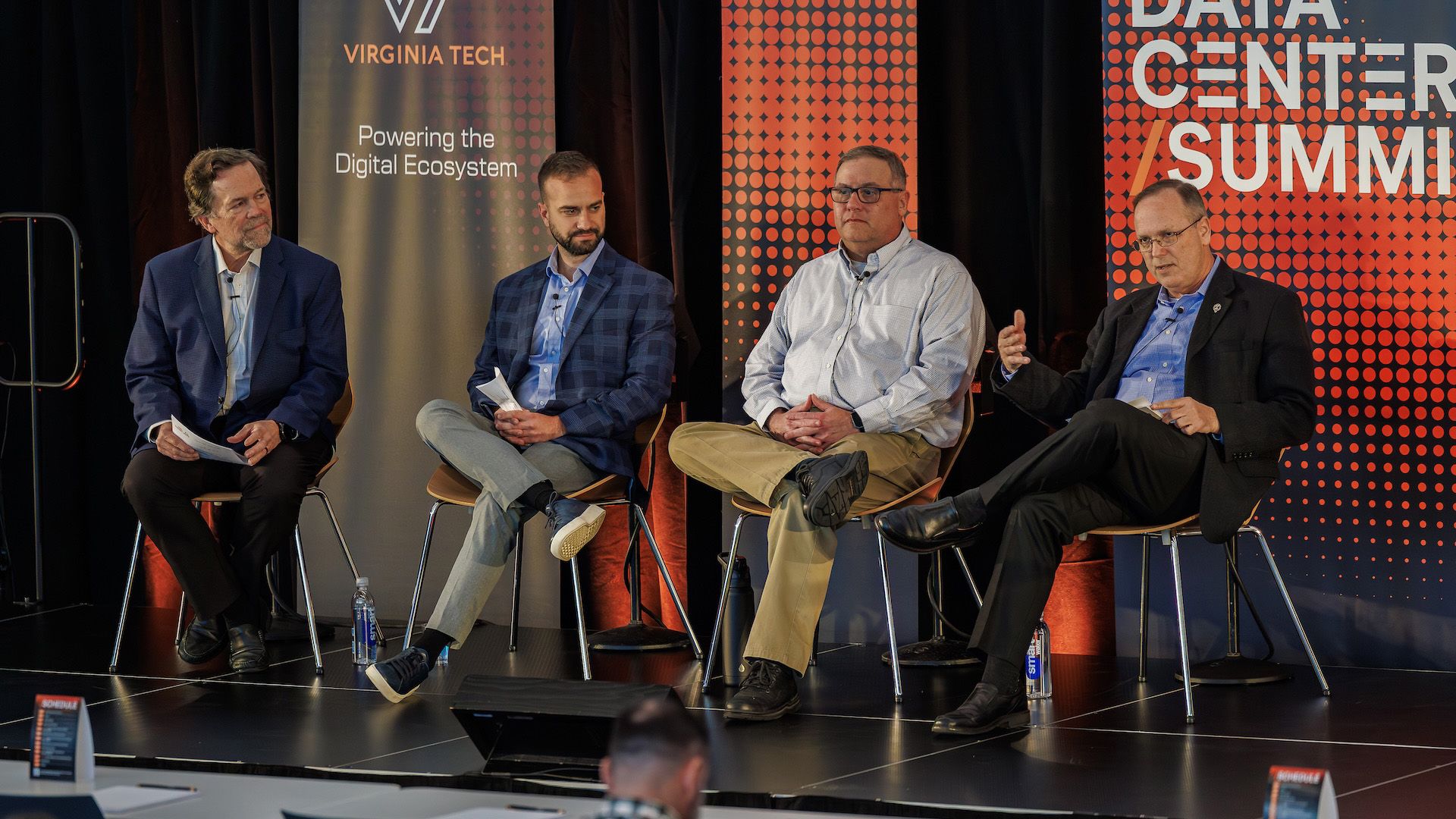
An example: This spring, Virginia Tech hosted a Data Center Summit in Alexandria, Virginia, minutes from Northern Virginia's data center corridor — widely considered the world's densest data center hub.
The summit had representation from more than 150 companies across every industry implicated, including:
- Energy giants such as Dominion Energy, Washington Gas, Bloom Energy and ABB.
- Hyperscalers like AWS, Microsoft, Google, Oracle and IBM Cloud.
- Leading developers, such as HITT Contracting, CloudHQ and Hensel Phelps.
- Frontier chipmakers, including AMD, ARM and NVIDIA.
- Defense contractors like Northrop Grumman, Boeing, HII, and Lockheed Martin.
- Public bodies, including the Department of Energy, the National Science Foundation and the National Institute of Standards and Technology.
The result: Leaders spent the day discussing the why behind the data center industry's power consumption, diving into the relationships the industry has to energy capacity and reliability, cloud safety and scale, resource resilience, and next-gen clean power — all with an interdisciplinary, solutions-oriented approach.
The summit was a rare chance to realize Cameron's vision into practice: connecting the supply- and demand-side stakeholders in one room with leading researchers to think big about long-lasting solutions.
- "People on multiple panels spoke about the need to get people together that are both using the systems and designing the infrastructure around them," said Cameron. "So I was very excited about it."
Here's what else: The benefits don't stop at data centers. The world needs more power than ever for advanced manufacturing, smart construction, electric vehicles and more.
- "The skills and the infrastructure that we put together as we address data centers are going to be extremely useful for these other sectors of the economy," said Ali Mehrizi-Sani, the director of Virginia Tech's Power and Energy Center and a professor of electrical and computer engineering.
The takeaway: No matter where you fall in the data center industry — or debate — Virginia Tech offers partnerships and research that drive the technology and solutions of the future.