How the District's fight with Congress affects your tax bill, city finances

Add Axios as your preferred source to
see more of our stories on Google.
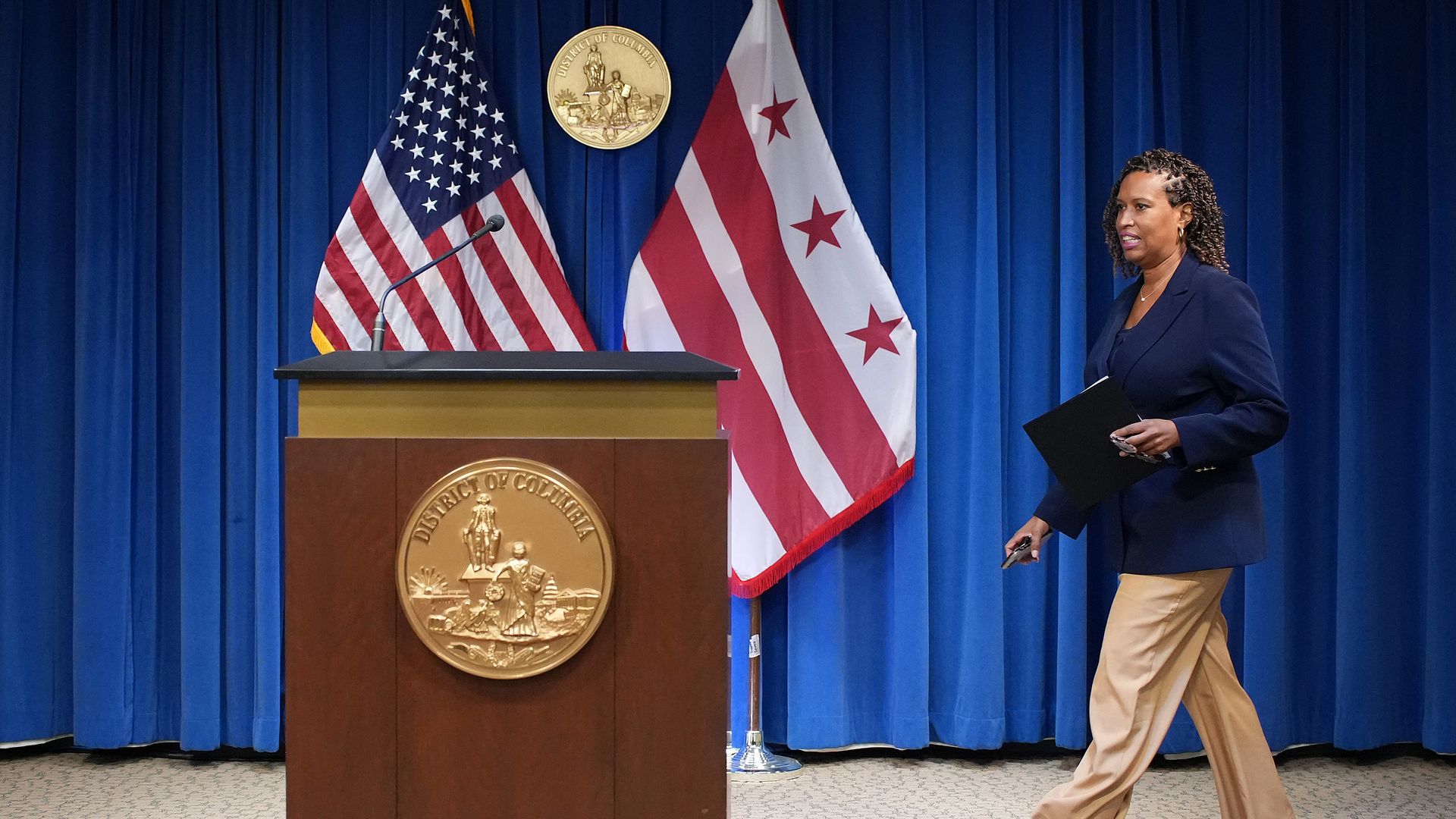
Photo: Kevin Dietsch/Getty Images
D.C.'s finance chief said on Wednesday the city can effectively ignore Congress' meddling in its tax law — but there's a caveat.
Why it matters: The decision means D.C. residents who already filed their taxes don't need to refile.
- But here's the part Mayor Muriel Bowser will hate: city hall can't map out its upcoming budget using the tax revenue from the disputed law, depriving the city of funding for programs.
Catch up quick: It's complicated, but here's why D.C.'s budget is so messed up:
- Last year, D.C. leaders passed a "decoupling" law refusing to adopt President Trump's One Big Beautiful Bill's tax cuts locally. So, for example, D.C. servers would still owe local taxes on tips, and tax rates would stay the same on D.C. returns. The D.C. Council's thinking was that the tax revenue would amount to $600 million over four years, and they'd use it to fund programs like a local child tax credit.
Republicans in Congress caught word, and swooped in to overturn that local law.
- Usually when Congress repeals a District law, that's the end of the story.
- Except this time, D.C.'s attorney general argued that Congress didn't act fast enough — telling city leaders basically to ignore it.
The latest: Siding with Attorney General Brian Schwalb's guidance, D.C. Chief Financial Officer Glen Lee declared on Wednesday that the city can continue with its tax collections.
- But Lee — an independent office with immense power over D.C.'s pursestrings — also said D.C. opens itself up to "considerable [legal] risk and uncertainty" by moving ahead with its decoupling from the One Big Beautiful Bill tax law.
- So, for now, Lee said that Bowser and the D.C. Council can't depend on tapping into those estimated $600 million in revenues for the upcoming budget.
The bottom line: D.C. leaders will now have a harder time cobbling together the budget this spring, on top of an already $1 billion projected shortfall.