Maryland, Virginia get more federal money than they send


Add Axios as your preferred source to
see more of our stories on Google.
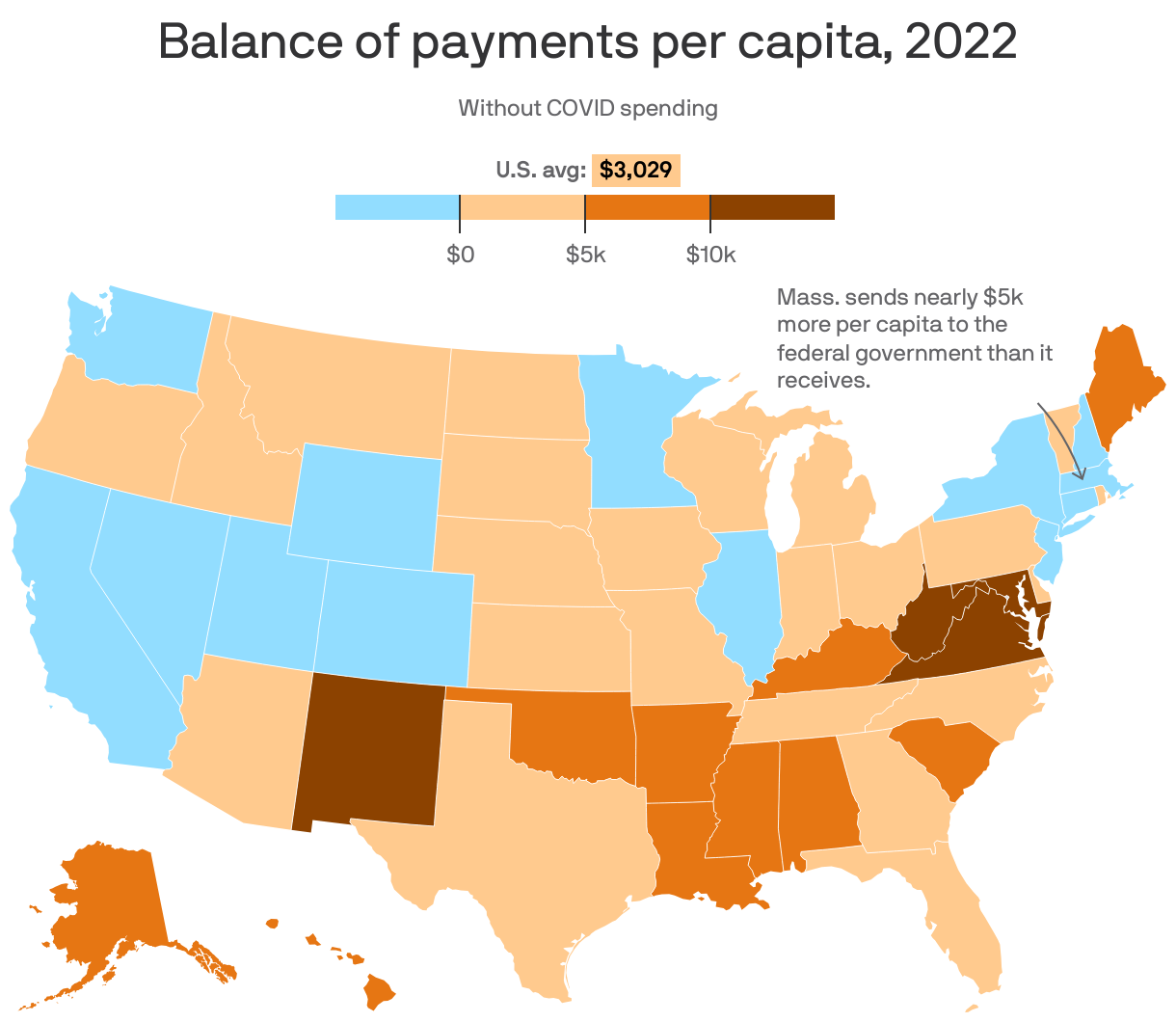
Maryland and Virginia are two of 37 U.S. states that get more money from federal government coffers than they send, a recent analysis found.
Why it matters: The Trump administration's push for states to be more financially independent brushes up against the reality that many depend on federal money for everything from disaster relief to food aid.
Driving the news: Maryland and Virginia snag two of the top three spots on the list of states that receive more federal government money than they give back.
- Maryland received more than $27,867 per capita as of 2022, according to a Rockefeller Institute of Government report released last year. Virginia received more than $26,204. Those totals do not include COVID aid.
- But Maryland and Virginia only sent the federal government $15,602 and $14,627 per capita, respectively, leaving Maryland a balance of $12,265 and Virginia $11,577.
Zoom out: New Mexico took the number one spot, with a balance of $14,781, while Massachusetts (-$4,846) had the lowest.
How it works: Each state's balance of payments reflect how much federal money is distributed there (in the form of programs like Medicaid and SNAP, for example) versus how much money residents and businesses send to the federal government (via income or employment taxes, for instance).
- A negative figure means a state sends more to the federal government than it receives, while a positive figure means it gets more than it gives.
Between the lines: "States with large defense-contracting sectors and more military bases receive more federal defense spending, while federal wages are disproportionately concentrated within states with a large federal employee presence," the report notes.
- That at least partially explains the results here in Virginia and Maryland — relatively high-income states with lots of federal workers, contractors and agency offices.
What we're watching: How President Trump's quest to trim federal spending actually plays out at the state level could shake up these figures in unpredictable ways.