Pandemic-era migration cost D.C. more than $1 billion

Add Axios as your preferred source to
see more of our stories on Google.
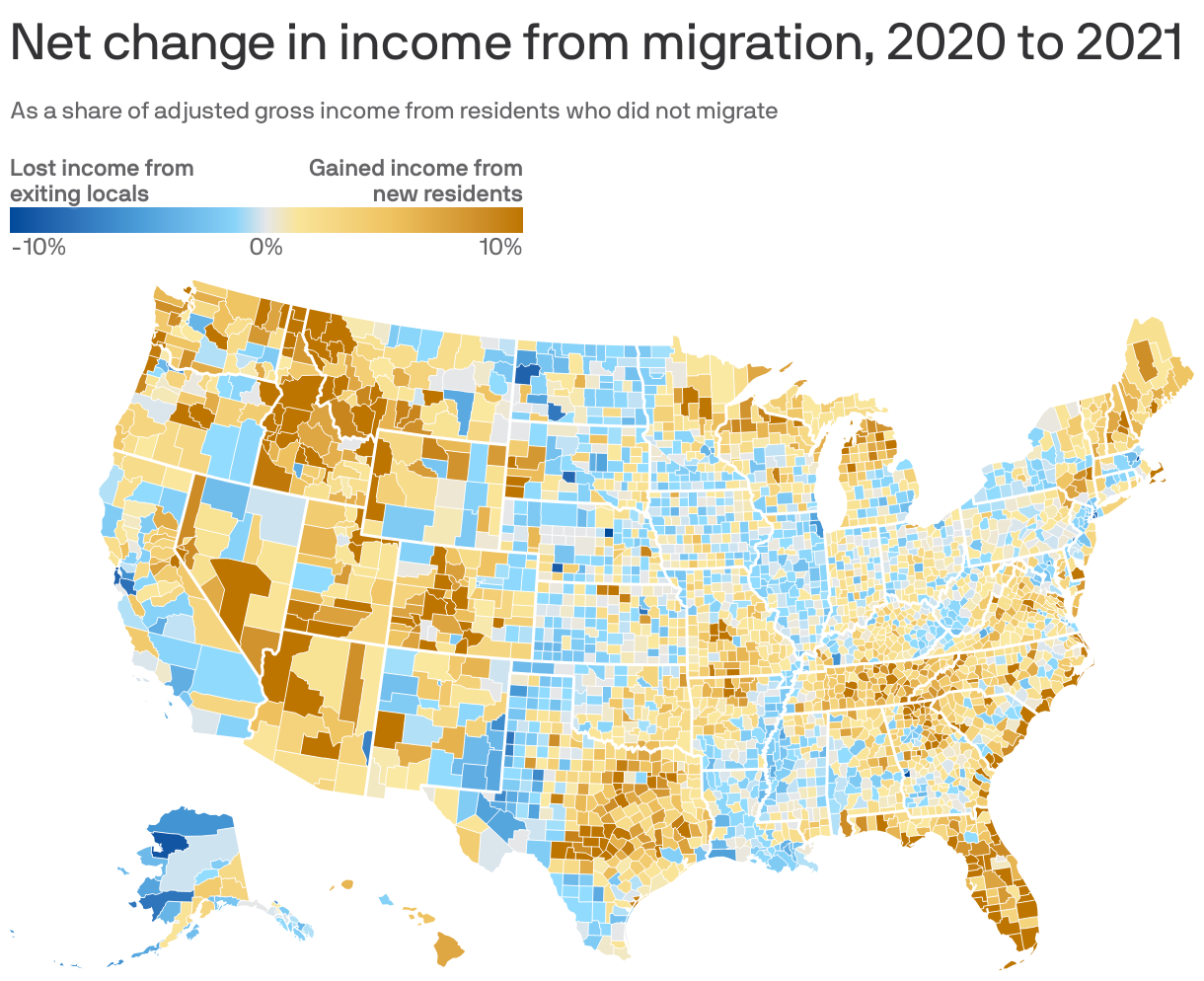
Migration during the pandemic resulted in Washington, D.C., losing $1.6 billion in taxable income between 2020 and 2021, a 7.6% drop — in line with other big cities that lost residents to cheaper locales during the same time period.
Why it matters: A new analysis of tax data by the D.C.-based Economic Innovation Group quantifies the reasons some of America's biggest cities are struggling to rebuild their economies post-pandemic, writes Axios' Neil Irwin.
Zoom in: In some cities — including Washington, D.C. — income taxes are a major source of municipal revenue
The big picture: When millions of Americans rethought their living situations during the pandemic, their moves changed the geography of where money is made in the United States.
- The data shows a surge in income arrived in many rural and exurban places and in popular vacation destinations.
- Not only did residents leave the biggest cities, but those who left disproportionately had high incomes, meaning the hit to those local economies was larger than migration numbers alone would imply.
By the numbers: The flight occurred across the Washington region. In Arlington County, out-migration caused an 8.2% drop in adjusted gross income from 2020 to 2021. That totaled $845.4 million.
- Affluent Fairfax County had a smaller proportional drop of 2.3%, but the loss amounted to $1.2 billion.
- Montgomery County saw a 1.6% drop equaling $705 million, and Prince George's County had a 2.6% drop that added up to $527 million.
Yes, but: The District has made up its losses thanks to the growing incomes of those staying put.
- "Between 2020 and 2021, non-migrant resident incomes grew by $3.1 billion, or double the income lost through outmigration," Yesim Sayin, the head of the local think tank D.C. Policy Center, wrote in a recent analysis.
What they're saying: Nationally, "the scale of urban income flight is a lot larger than I thought it would be," said Connor O'Brien, who conducted the Economic Innovation Group analysis. "It's very likely that in the last couple of years in superstar cities, high earners have become more mobile while everyone else had been stuck."
- At the same time, "rural areas caught a break for the first time in a while," he said.
- There was a particularly strong influx of income in counties near the Canadian border in Michigan, Minnesota, and Maine — places that haven't been magnets for entrepreneurship and investment, he pointed out.
What's next: The data only covers 2021, so it doesn't shed light on 2022 and what's happened so far this year.
- O'Brien said that based on other evidence the trend likely eased but does not appear to have reversed.