Minnesota's early voting total shatters midterm records

Add Axios as your preferred source to
see more of our stories on Google.
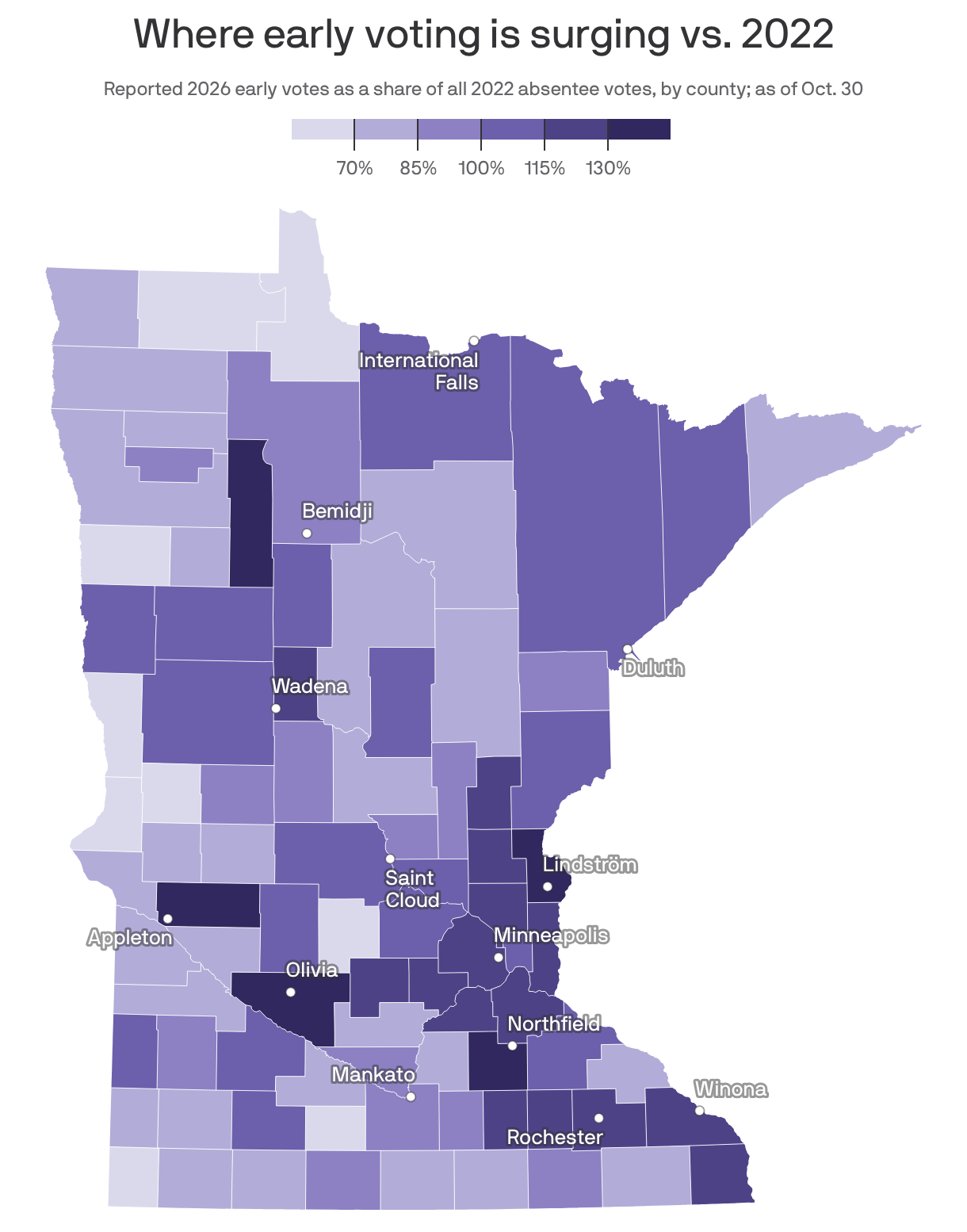
More than 728,000 Minnesotans had already cast ballots as of Friday, shattering the state record for early voting in a non-presidential election.
Why it matters: The conventional wisdom is that strong early turnout is a good sign for Democrats — but elections experts caution that it doesn't necessarily predict overall turnout or which party will benefit.
By the numbers: The greatest volume of early ballots is pouring in from DFL strongholds and Democratic-trending suburbs.
- Minneapolis blew past its previous midterm early voting record last Wednesday.
- As of Friday, Twin Cities metro area counties had exceeded their 2022 absentee totals by 65,000 votes — a 16% increase.
- The DFL-leaning counties that contain Rochester and Duluth have also already topped their 2022 absentee totals.
What they're saying: These figures "could be good news for the Democrats," Hamline University political science professor David Schultz tells Axios.
- The turnout in the metro could reflect national polls showing greater enthusiasm among Democratic-leaning voters.
Yes, but: Schultz also pumps the brakes, noting Democrats in recent elections have been more likely to vote early, but Republicans' day-of voting may cancel out any partisan advantage.
Reality check: Strong early turnout this year doesn't necessarily mean overall turnout will be higher.
- More voters may simply be shifting away from voting on Election Day, Charles Stewart, who directs MIT's Election Data and Science Lab, tells Axios' Josephine Walker.
The intrigue: The seven Minnesota counties where absentee vote numbers have grown at the fastest rate since 2022 are Swift, Clearwater, Chisago, Renville, Rice, Wadena and Winona.
- All of those are rural or exurban counties won by President Trump.
This could be a sign more Minnesota Republicans are embracing early voting, despite Trump's longstanding skepticism, Schultz says.
- It also signals that conservatives are motivated, too. "Many people are thinking this is the first shot Republicans have had in 20 years to win statewide office," Schultz notes, citing tight polls.
The big picture: Minnesota doesn't keep data on voters' party affiliation — but in 26 other states that do, registered Democrats account for 44% of the ballots cast so far, according to the University of Florida's Election Lab.
- Republicans account for 31% of the ballots cast.
What we're watching: Whether this midterm's turnout surpasses the 2018 "blue wave" — which saw the highest participation rate since 1914, according to Pew Research.
- At a minimum, Schultz says, all signs point to turnout that's "higher than recent history."