How ranked-choice voting could tip Minneapolis and St. Paul mayor races

Add Axios as your preferred source to
see more of our stories on Google.
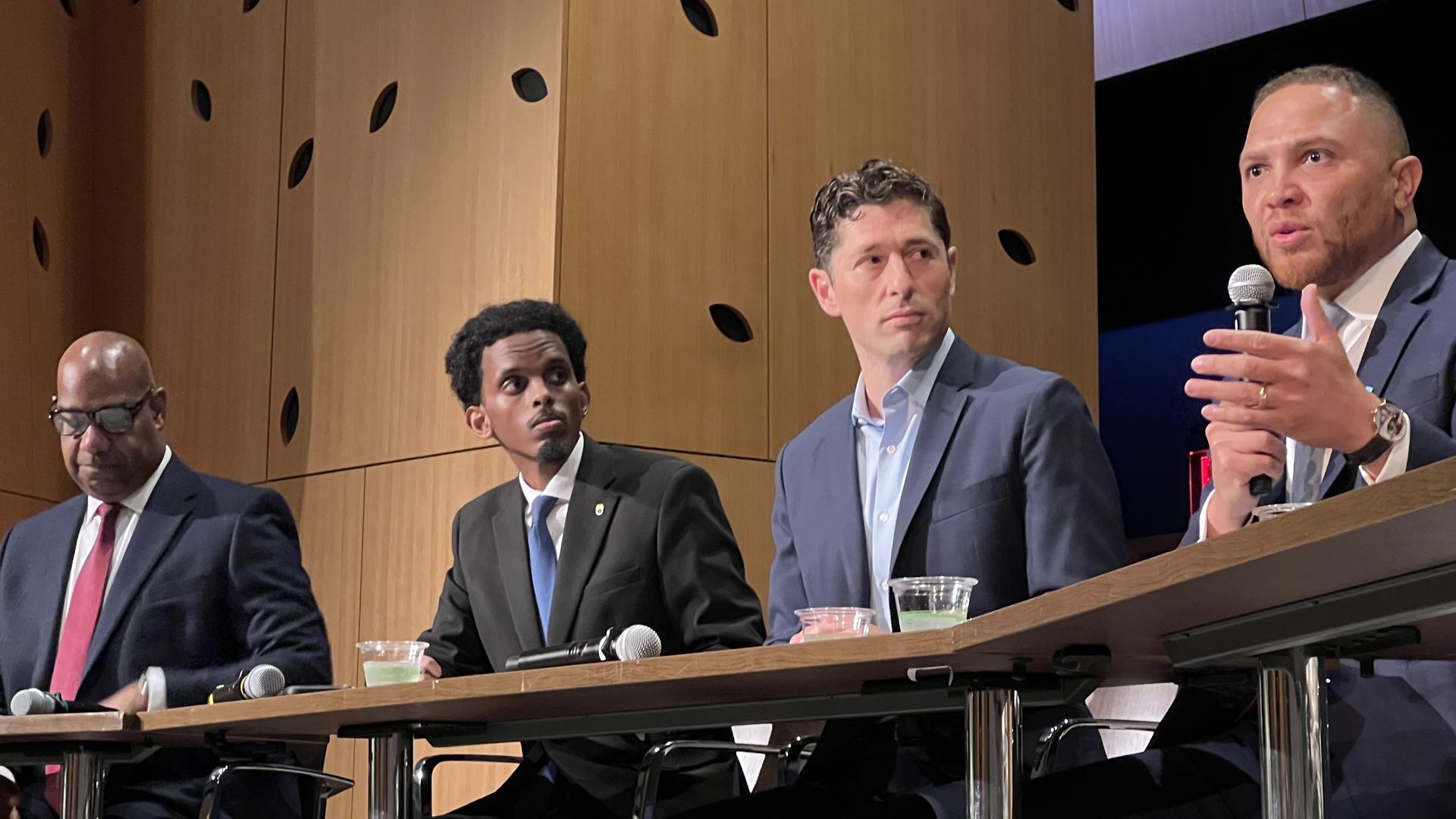
From left, DeWayne Davis, Omar Fateh, Jacob Frey and Jazz Hampton at a Minneapolis mayoral debate in September. Photo: Kyle Stokes/Axios
The next mayor of Minneapolis or St. Paul may not need to be voters' first choice — but they will need enough voters to rank them second or third.
The big picture: Tuesday is Election Day across the Twin Cities, and ranked-choice voting will decide the two highest-profile contests.
- Contenders in Minneapolis' 15-candidate mayoral field spent the campaign's final days vying for a place anywhere on voters' ballots: in a ranked-choice election, second- and third-choice votes matter.
State of play: Mayor Jacob Frey's critics have banked on an "anyone but Frey" strategy, asking voters to rank, in any order, their so-called "Slate For Change": Omar Fateh, DeWayne Davis and Jazz Hampton.
- "These are the three best options right now," Fateh said during a debate on WCCO last week.
The other side: Frey expressed confusion at the strategy, contending the slate would only benefit Fateh: "He's by far the leading challenger … Minneapolis voters are smarter than that."
The intrigue: Frey's leading opponents have appeared at joint door-knocking outings and meet-and-greets — but they also said the "Slate For Change" wasn't their strategy; it was organizers'.
- "I have never said and will never say 'Don't Rank Frey,'" Hampton said during the same debate. (The conventional wisdom is that a significant number of Hampton's first-choice voters may make Frey their second or third choice.)
- "I'm running for myself," Davis said, and not to "prop up" any other candidate.
What we're watching: Whether second-choice ballots tip St. Paul's five-candidate mayoral election.
- State Rep. Kaohly Her's late entry into the race gave incumbent Melvin Carter a high-profile challenger — but biophysicist Yan Chen has raised just as much money as Her.
😴 Bedtime alert: If no candidate in Minneapolis' mayoral or City Council races wins outright on first-choice votes, city officials plan to count second- and third-choice votes on Wednesday.
- Ramsey County officials expect to declare a winner late Tuesday night thanks to new ranked-choice tabulation software.
Also voting: Twelve suburban cities are holding municipal elections — including Bloomington, Minnetonka and St. Louis Park, which also use ranked-choice voting.
- Woodbury-area voters and several northwest exurbs are filling vacant state Senate seats that will determine whether Democrats retain their one-seat majority.
- A high-stakes election in Anoka-Hennepin schools — the state's largest district — headlines a list of two dozen school board races in the metro.
📚 Plus: St. Paul Public Schools is one of 15 metro-area districts seeking taxpayer revenue to fund or build schools.
- Statewide, more districts than usual are seeking approval for a general operating levy, which can be used to cover day-to-day expenses.
How to vote
🙋♀️ Who's eligible: U.S. citizens who have lived in Minnesota at least 20 days and will be 18 by Election Day.
- Minnesotans can register online or in-person, including when they arrive to vote.
📍 Where to vote: What's on a voter's ballot — and their Election Day polling place — is based on where they live.
- Make sure your registration is up to date and reflects your current address.
🎓 College students can use their campus address to vote as long as they consider Minnesota their home, even if they pay out-of-state tuition.
- Those who consider their family's dwelling their home can register and vote by mail there instead.
✉️ Mail-in voting: Anyone who hasn't yet returned their absentee ballot should return it to an elections office or drop box — or simply go cast a new ballot in person.
- Mail-in ballots not received by 5pm on Election Day will not count.