Minneapolis mass shooting prompts calls for assault weapons ban, early intervention

Add Axios as your preferred source to
see more of our stories on Google.
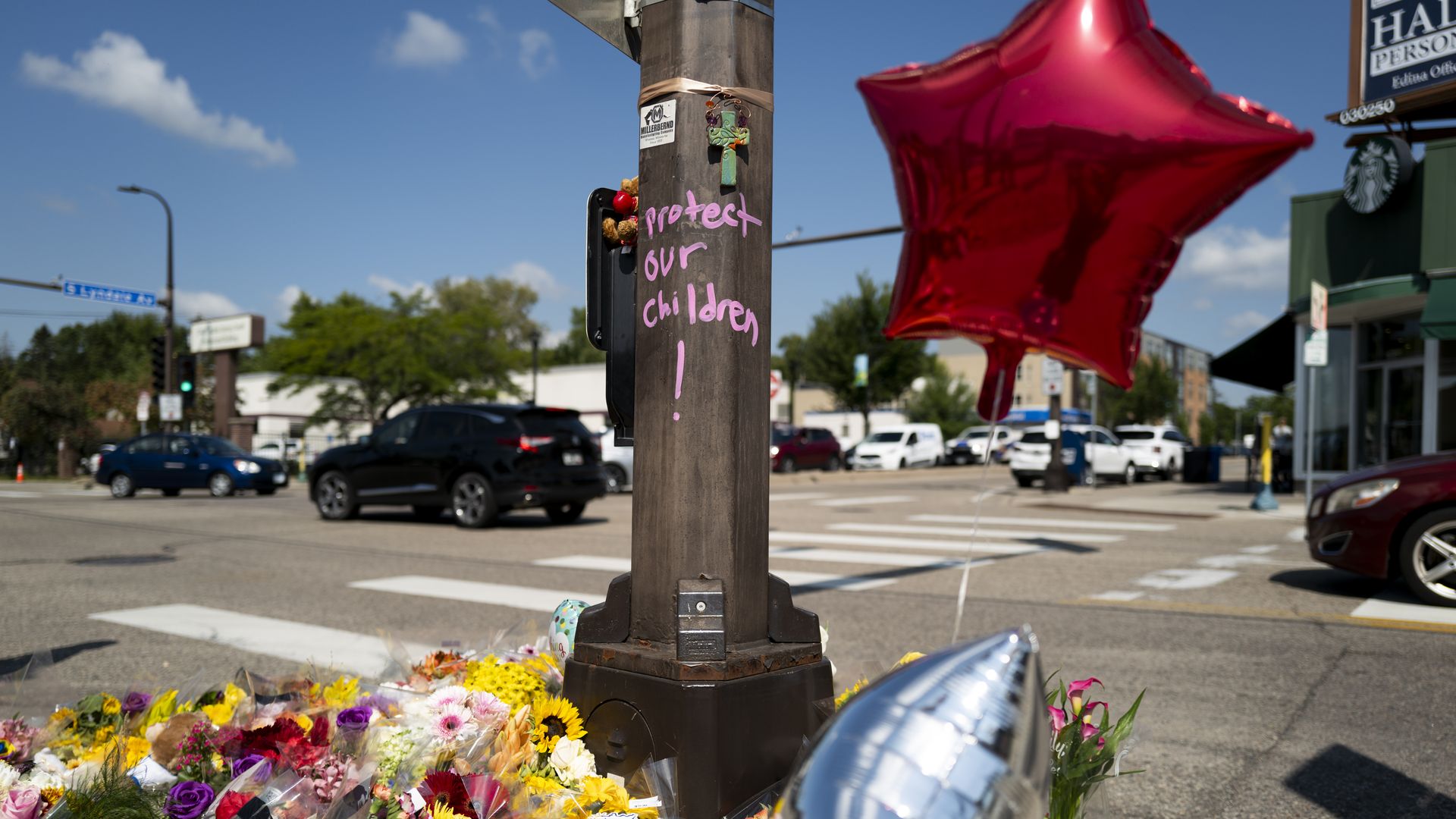
A memorial stands at an intersection near Annunciation Catholic School following Wednesday's mass shooting. Photo by Stephen Maturen/Getty Images
This week's deadly attack on Annunciation Catholic Church and School has revived a long-simmering debate and introspection over how to prevent mass shootings, especially those targeting schools.
The big picture: Shootings like the one that shocked South Minneapolis Wednesday, which left two children dead and 18 other worshippers injured, have become a sadly common fixture in American society.
- Since 2000, at least 117 people nationwide have been killed in school shootings that involved two or more deaths and at least two additional injuries, per the Violence Prevention Project Research Center at Hamline University.
Driving the news: Local, state and federal officials, prominent figures and parents are already calling for changes ranging from an assault weapons ban to armed security in schools to more mental health support and "behavioral health assessments" aimed at identifying potential shooters sooner.
- On Thursday, Gov. Tim Walz (D) announced that he had authorized the deployment of 20 state public safety officials to assist MPD in supporting Minneapolis schools and places of worship ahead of next week's start of the school year.
What we're hearing: There's no "one policy solution" that will likely solve the problem entirely, Violence Prevention Project executive director Jillian Peterson told Axios.
- But her center's research findings that most mass shooters follow a "pretty consistent pathway" and virtually always show warning signs before an attack suggest that many could be prevented.
Zoom in: Peterson's recommendations range from policies that "slow down access" to guns, especially for people in crisis, anonymous reporting systems and other efforts to alert mental health professionals and law enforcement to people exhibiting threatening behavior.
Between the lines: Avenues for reporting such concerns are crucial, she noted, because shooters often show signs of distress and "leak" their plans to a person or online community.
- They tend to fit a standard profile: white men who are typically current or former students of the targeted school and who have a fascination with school shooters.
- Most seek to make their attack a "final act" that's designed to "make their hateful message go viral."
- The 23-year-old Annunciation assailant, who died from a self-inflicted gunshot wound, appears to check almost all of those boxes, she noted.
Yes, but: For Peterson, suicide prevention — and support for mental health struggles and social isolation more broadly — has to be a part of the solution.
- That's because school shooters often exhibit anger, depression and suicidal ideation.
- "If you don't want to die, you're not going to do this," she said.
Friction point: While schools and other institutions can take steps to identify and help students or community members who are at high risk of violence, it can be easier for outside adults plotting attacks, like the Annunciation shooter, to go undetected.
- "This group of young men who are increasingly committing these acts is actually a really difficult group to reach and no one is on them," she said.
The bottom line: While focusing on victims instead of the shooter to reduce notoriety and attention may help deter copycats, earlier mental health support and intervention is crucial in preventing more bloodshed.
Zoom in: The debate over guns
A group of local, state and federal DFL lawmakers pledged Thursday to push to ban assault weapons and high-capacity magazines.
Why it matters: Hamline's researchers found that assault-style weapons were used in nearly half of all mass shootings between 2020 and 2024.
- The Annunciation shooter was carrying three firearms, including a semiautomatic rifle at the time of the attack, authorities say.
What they're saying: "The monsters who commit these horrific crimes and acts keep using the same tools," DFL state Sen. Zaynab Mohamed, whose district includes Annunciation, said at a Thursday news conference. "The same weapons of war turn up over and over at different shootings."
The other side: The Minnesota Gun Owners Caucus vowed to fight any approved ban at the Capitol and in court and said lawmakers should focus on increasing mental health support and school safety "instead of wasting time on unconstitutional distractions."
- "For politicians who want to 'do something,' increasing school security, especially for non-public schools, is a good first step," the group wrote on X, noting that the Minnesota Catholic Bishops unsuccessfully lobbied lawmakers for more school security funding in 2023.
Some elected Minnesota Republicans, meanwhile, criticized Democrats for diving into the gun issue, saying they were politicizing the tragedy.
Worth noting: Minnesota recently enacted several new gun measures, including expanded background checks and a "Red Flag" law that allows family or law enforcement to petition to remove firearms from people who are deemed a danger to themselves or others.
- Law enforcement officials said Thursday that they were not aware of any criminal charges or state-ordered mental health commitments that would have prevented the shooter from lawfully purchasing the guns used in the attack.
Reality check: Other gun measures proposed in recent years, including more restrictive storage laws, drew opposition from both Republicans and moderate Democrats at the narrowly divided Legislature.
DFL leaders said Thursday they plan to revive the bills next year, even if the political dynamics don't favor passage.
- "We have to take the vote," Senate Majority Leader Erin Murphy (DFL-St. Paul) said.