Minnesota's oldest Black newspaper turns 90

Add Axios as your preferred source to
see more of our stories on Google.
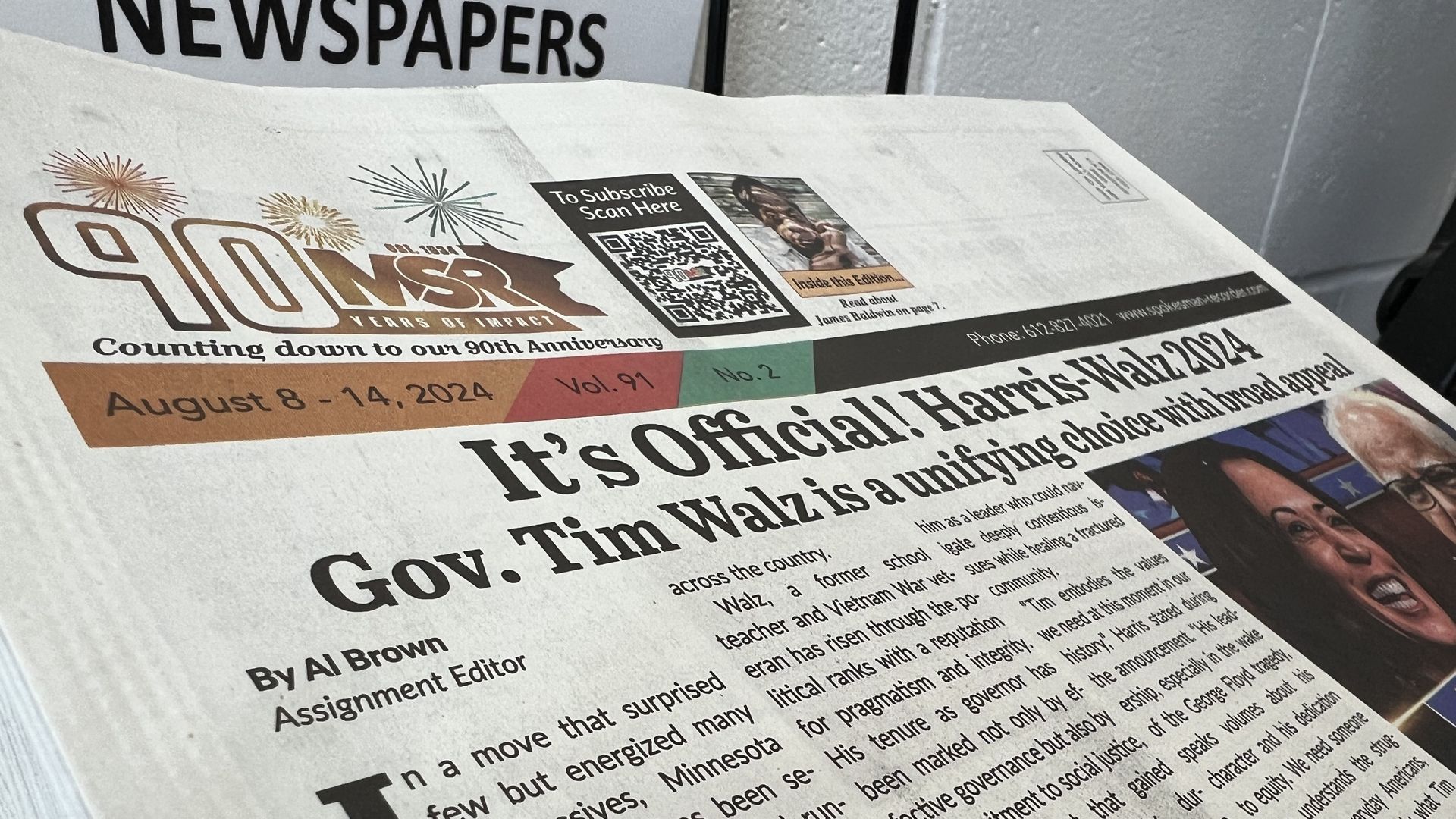
The Spokesman-Recorder's latest edition on a rack in the paper's South Minneapolis offices. Photo: Kyle Stokes/Axios
On Aug. 10, 1934, on the first front pages of two new newspapers for Black Minnesotans, publisher Cecil E. Newman made a promise to readers:
- "In the ST. PAUL RECORDER and the MINNEAPOLIS SPOKESMAN, we feel sure St. Paul and Minneapolis will have real champions of the Race."
The latest: Now merged as one news organization, the Minnesota Spokesman-Recorder celebrates its 90th birthday this weekend.
Why it matters: Still owned by Newman's family, the Spokesman-Recorder has survived decades of tumult in the news industry to become Minnesota's oldest Black newspaper and one of the state's oldest Black-owned businesses.
The big picture: The papers have tried to make good on Newman's original promise, centering Black voices as mainstream news organizations continue to struggle to authentically tap into communities of color and diversify their reporting staffs.
- "We cover Black culture. We cover the Black story. But the important point is, we cover it with balance," veteran Spokesman-Recorder journalist Al Brown told Axios.
Flashback: Newman learned the ropes of the news business on the side while working as a railroad porter in the 1920s, local historian Iric Nathanson wrote.
- After founding the newspapers, he grew them with shoe-leather salesmanship. By 1950, when the Twin Cities had just under 13,000 Black residents, Newman's papers claimed 4,100 subscribers.
"He had a lot of courage," Brown said of Newman and his paper's early editions.
- After Prohibition's repeal, Newman called out booming local breweries for failing to hire a single Black employee by 1935.
- The papers gave "a play-by-play" of Ku Klux Klan activities, from everyday threats to a 1948 story naming the longtime state auditor as a possible KKK member. (That charge was confirmed after his death.)
- Through the 1960s and '70s, the paper chronicled the Civil Rights movement — as well as the FBI's targeting of the movement's Black leaders.
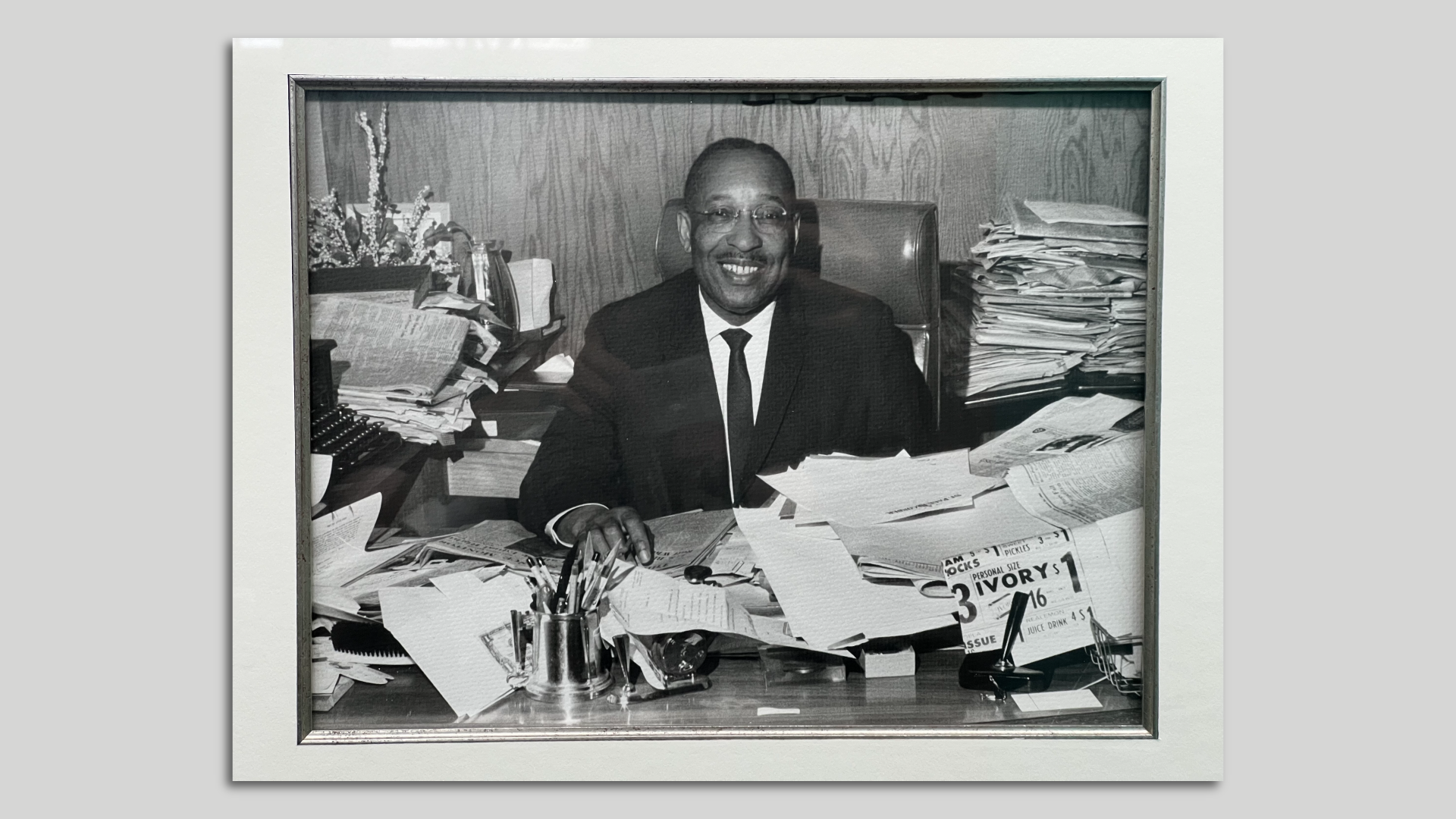
George Floyd's murder in 2020 was the continuation of a storyline the paper had covered since its inception: killings by police and Black Minnesotans' strained relations with law enforcement.
- "Minneapolis is burning," the late editor Mel Reeves wrote in the June 4, 2020, issue, "and anyone with eyes could see it coming."
Bearing witness to these stories is why longtime reporter Charles Hallman is "a news junkie … News takes history at its point and documents it," he told Axios.
Between the lines: Staffers said the Spokesman-Recorder's job is to elevate stories that mainstream outlets miss with a critical eye and without cheerleading.
- "I'll report it if what you're doing is good," Hallman told Axios, "but I'll also report it if you're not doing good."
Hallman authored investigations into allegations of unfair discipline against Black Minneapolis parks employees and questioned how relief was distributed after the 2011 North Side tornado.
- A celebrated sportswriter, Hallman is also proud of the reporting that convinced the University of Minnesota to retire women's basketball star Linda Roberts' number in 2006 — an honor he felt was delayed because she's Black.
What's next: In 2007, control of the paper passed to Tracey Williams-Dillard, the granddaughter of Cecil Newman and wife Launa, the paper's second publisher.
- Today, the newspaper is "in a growth mode," Williams-Dillard told Axios, leaning into efforts to grow digital operations while maintaining its print product.
How the paper covered history
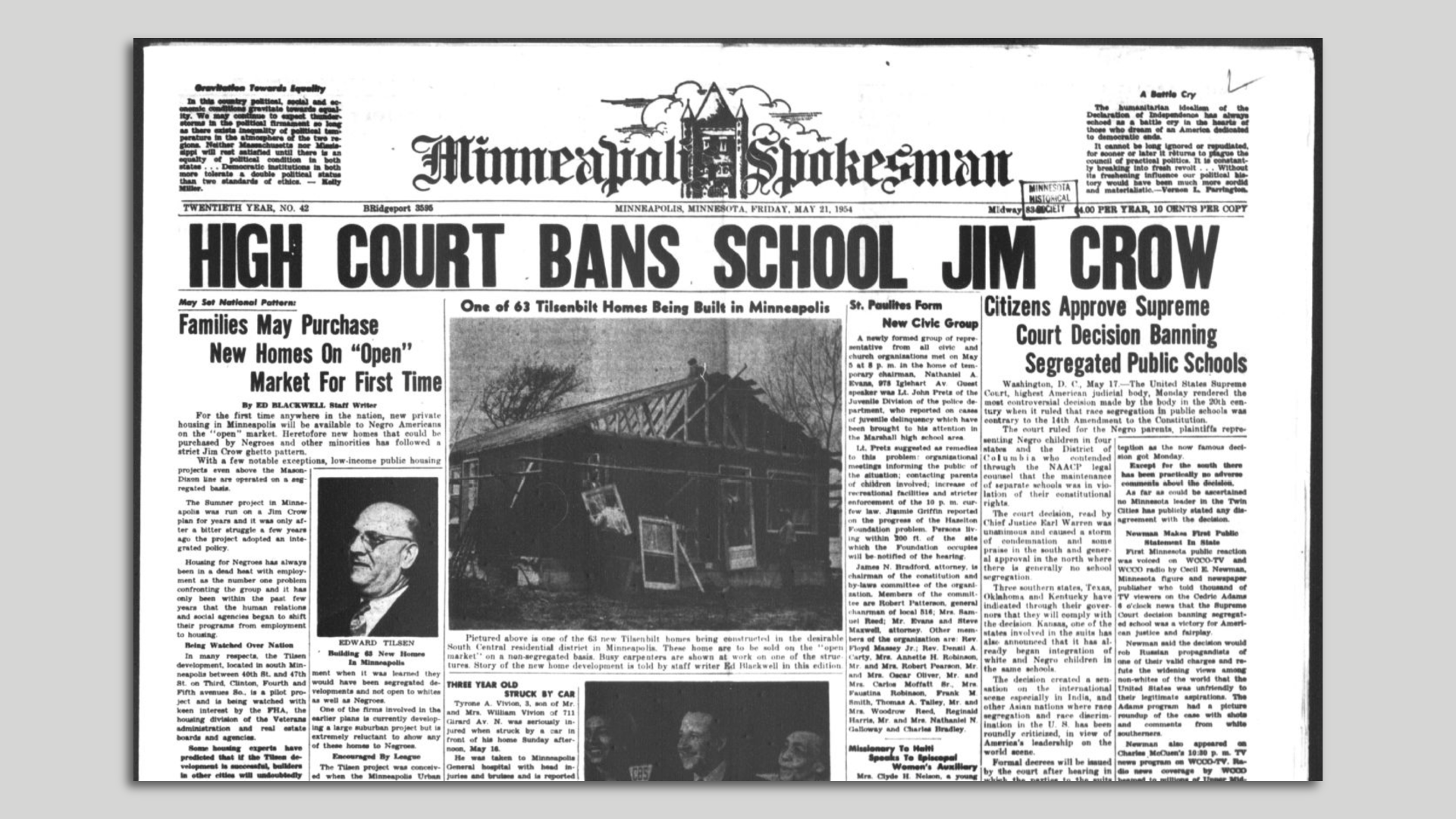
Click to view the editions in the Minnesota Historical Society's archives:
Pearl Harbor, 1945: The Spokesman's front page featured letters rebutting Japanese claims that Black Minnesotans wouldn't support the U.S. in the world war it was about to enter.
- One of those letters from a U of M grad student: "The Negro, now as ever in a crisis, will join hands with all other true Americans and 'rally around Old Glory' to … save the democracy which their ancestors have unselfishly fought for before."
- The same front page also reported Minneapolis Army recruiters turned away five Black Minnesotans who tried to enlist.
Brown v. Board of Education, 1954: Newman wrote that the court ruling banning legalized school segregation "would rob Russian propagandists of one of their valid charges and refute the widening views among the non-whites of the world that the United States was unfriendly to their legitimate aspirations."
Plymouth Avenue violence, 1967: After the looting and firebombing of a historically Black and Jewish neighborhood, the paper quoted Syl Davis — storied founder of The Way Community Center — calling for a "Marshall Plan" for North Minneapolis.
Minneapolis' first Black and woman mayor, 1993: "After 34 mayors," the Spokesman reported of Sharon Sayles Belton's victory that "the city of Minneapolis elected … a Black female who, like her ancestors, survived and persevered through adversity and hard times."
Sept. 11 attacks, 2001: A Spokesman-Recorder editorial warned against ostracizing Muslims, drawing parallels to the internment of Japanese Americans during World War II. "If we allow that to happen, our attackers will have done much more than destroy the World Trade Center and Pentagon."
Philando Castile's killing, 2016: Hallman reported on protests against "what appears to be another senseless death of a Black individual at the hands of police."
- The St. Anthony Police Department fired officer Jeronimo Yanez, who shot Castile. A jury acquitted him of manslaughter in 2017.