"True" unemployment for Twin Cities is around 19%: Report


Add Axios as your preferred source to
see more of our stories on Google.
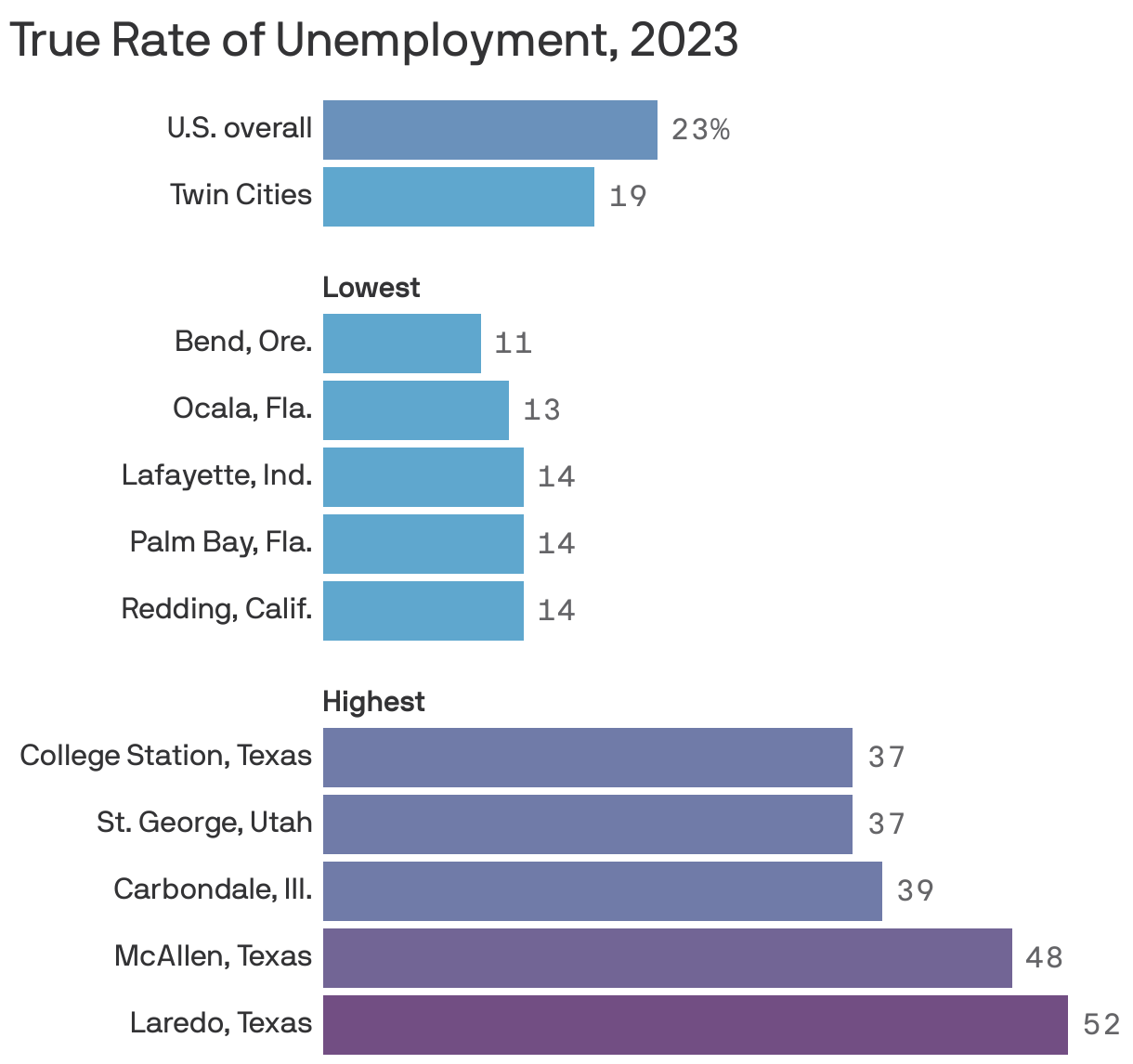
One in five Twin Cities residents struggled last year to land a job paying a living wage, a new think-tank report estimates.
Why it matters: Unemployment in the metro has steadily recovered since the pandemic, but a more nuanced look at our workforce data shows a larger share of individuals who can't find a good job.
The big picture: The Ludwig Institute for Shared Economic Prosperity's True Rate of Unemployment measures the proportion of workers seeking, but unable to find, a full-time job paying not just any wage, but a living wage.
By the numbers: The institute's latest analysis, released in early May, put the 2023 "true" unemployment rate in the Twin Cities at 19%.
- That's much higher than the official rate for last year, which fluctuated from 1.9% to 3.2%, per the U.S. Bureau of Labor Statistics (BLS).
Yes, but: The metro's "true" jobless rate is better than the national average of 23% and good enough to rank our region among the best in the country for livable jobs.
What they're saying: The Twin Cities' performance "confirms what we already know: that Minnesota has a strong economy [with] lots and lots of opportunities available for people in living-wage jobs," Cameron Macht, a labor market information manager with the state Department of Employment and Economic Development (DEED), told Axios.
- "In fact, we could use more people to come in and fill more of these jobs, if possible," he said of the state's tight labor market.
Driving the data: Minnesota is home to a diverse economy with plenty of opportunities in sectors that experienced post-pandemic growth, such as health care, manufacturing and construction, he said.
- A high concentration of corporate headquarters and companies that fall into the "professional and technical services" category — both typically high-paying sectors — also helps.
Between the lines: The "true" unemployment rate tends to track — but also be much higher than — the headline BLS jobless rate.
- That's because the BLS rate excludes people who might be earning only a few dollars a week; Ludwig Institute, by contrast, counts as unemployed anybody earning less than $25,000 per year.
- BLS, unlike LISEP, also excludes anyone who has stopped looking for work.
Keep reading: Where the living-wage jobs are (and aren't)