Commuting is still quicker for most workers in the Twin Cities


Add Axios as your preferred source to
see more of our stories on Google.
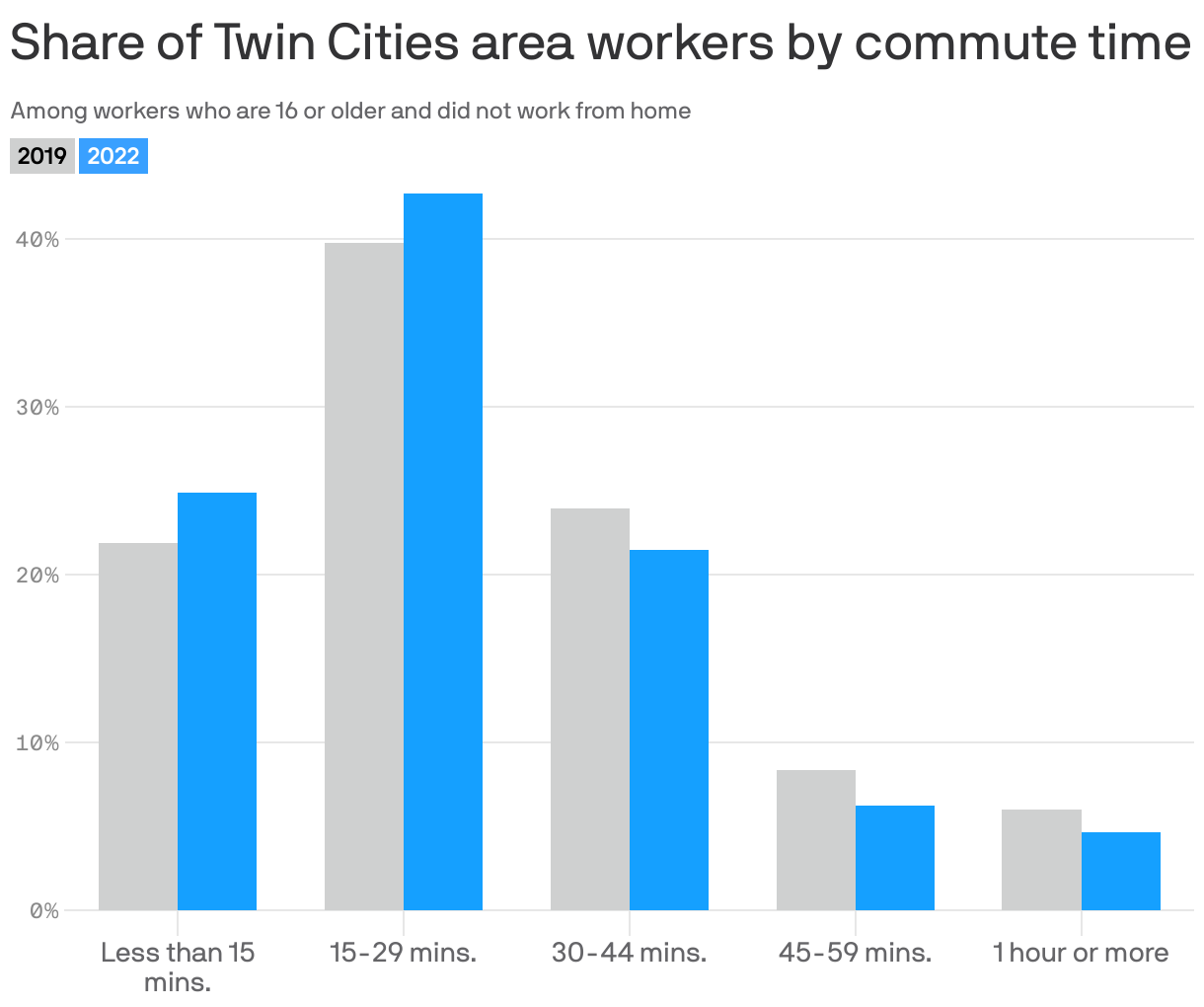
Nearly 68% of workers in the Twin Cities had commute times under 30 minutes last year, according to new U.S. Census Bureau data.
- That's an improvement from 2019 when only 61.7% of people got to work in less than half an hour.
Why it matters: Quicker commutes are tied to better mental health, greater job satisfaction, and a host of other personal benefits.
- And in the aggregate, the less time Americans spend in cars, the better for the environment. (Of course, many people commute via public transit.)
Of note: These findings don't include employees who work from home, and thus have a commute time of zero.
Between the lines: Traffic volume in the Twin Cities has been increasing since the depths of the pandemic in 2020-2021, but still isn't all the way back to 2019 levels, thanks to the rise of remote work.
- In 2019, 24.4% of the metro freeway system was congested; in 2022 that number was only 13.7%, according to a MnDOT report.
- Another state report found that just a 4% drop in vehicle miles traveled during peak times can cause a 35% decrease in congestion. In other words, just a small number of remote workers staying home during rush hour has a big impact.
Yes, but: The census data is from 2022 and didn't capture most of the traffic-snarling snowstorms of last winter, which was the third-snowiest on record.
What we're watching: Congestion could get worse next spring, when federal Infrastructure Investment and Jobs Act money begins flowing into Minnesota for road construction projects.