How the Twin Cities is diversifying

Add Axios as your preferred source to
see more of our stories on Google.
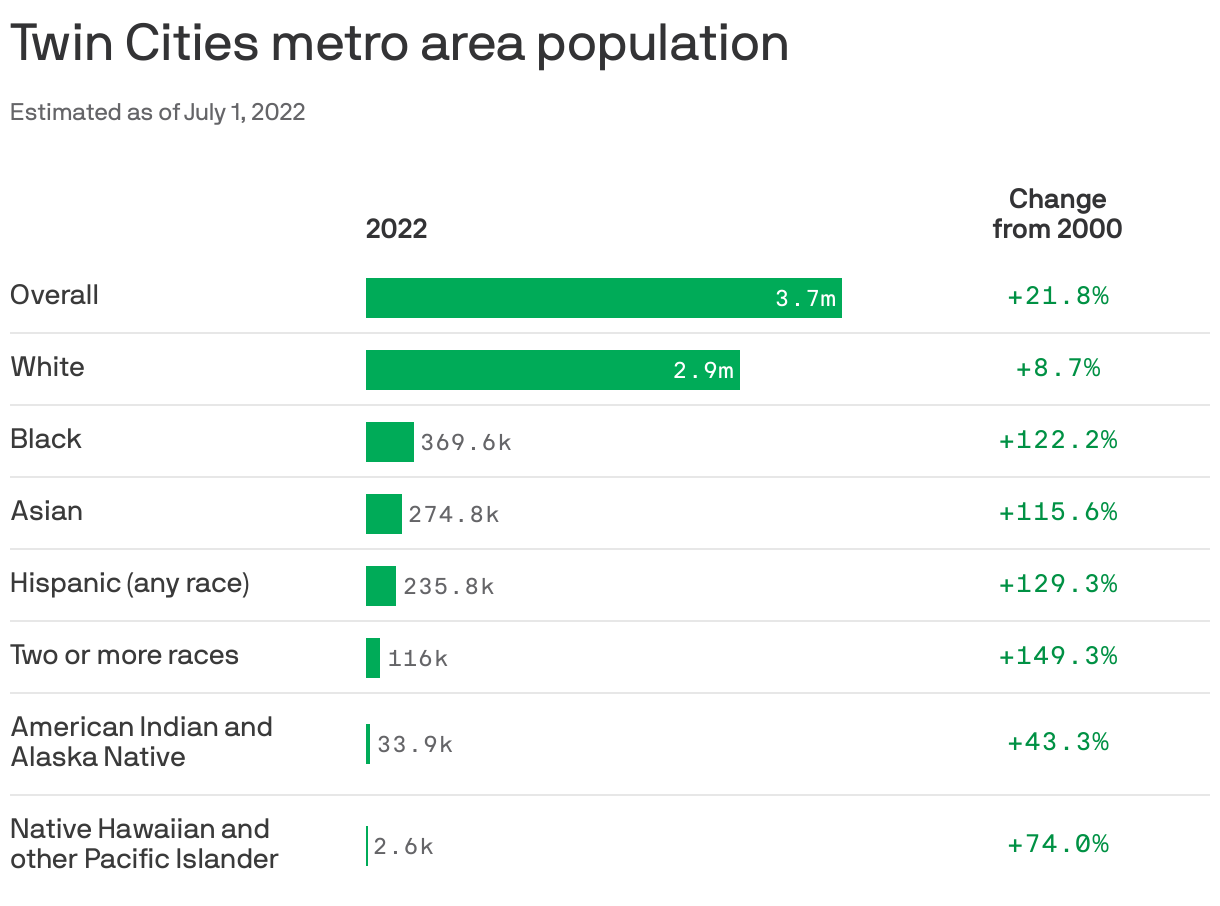
The Twin Cities has grown much more diverse in the 21st century as the metro area's Black, Asian, and Hispanic populations more than doubled between 2000 and 2022, according to new U.S. Census data analyzed by Axios' Kavya Beheraj and Alex Fitzpatrick.
Why it matters: Such demographic data is a vital snapshot of how the Twin Cities' racial and ethnic makeup is changing over time, which can help to inform policies and programs across the city.
Driving the news: Demographic trends are driven by a combination of factors, including varied birth, mortality, and immigration rates (both internal and external) among different socioeconomic groups.
- In the Twin Cities, international migration has been a big driver of the growth of the area's Black and Asian populations.
The big picture: Nationwide, the country's Pacific Islander, Asian, and Hispanic populations saw the biggest percentage increases between 2000 and 2022.
- The number of Native Hawaiian/Pacific Islanders grew about 120%, to nearly 879,000, while the Asian population grew about 105%, to 21 million.
- The Hispanic population grew about 80%, to nearly 64 million.
- The Black population grew 31%, to 45.4 million.
Of note: The U.S. is still predominantly white, with a growth of 19% between 2000 and 2022 to nearly 252 million.