Meet San Diego's volunteers who wrangle snakes for free

Add Axios as your preferred source to
see more of our stories on Google.
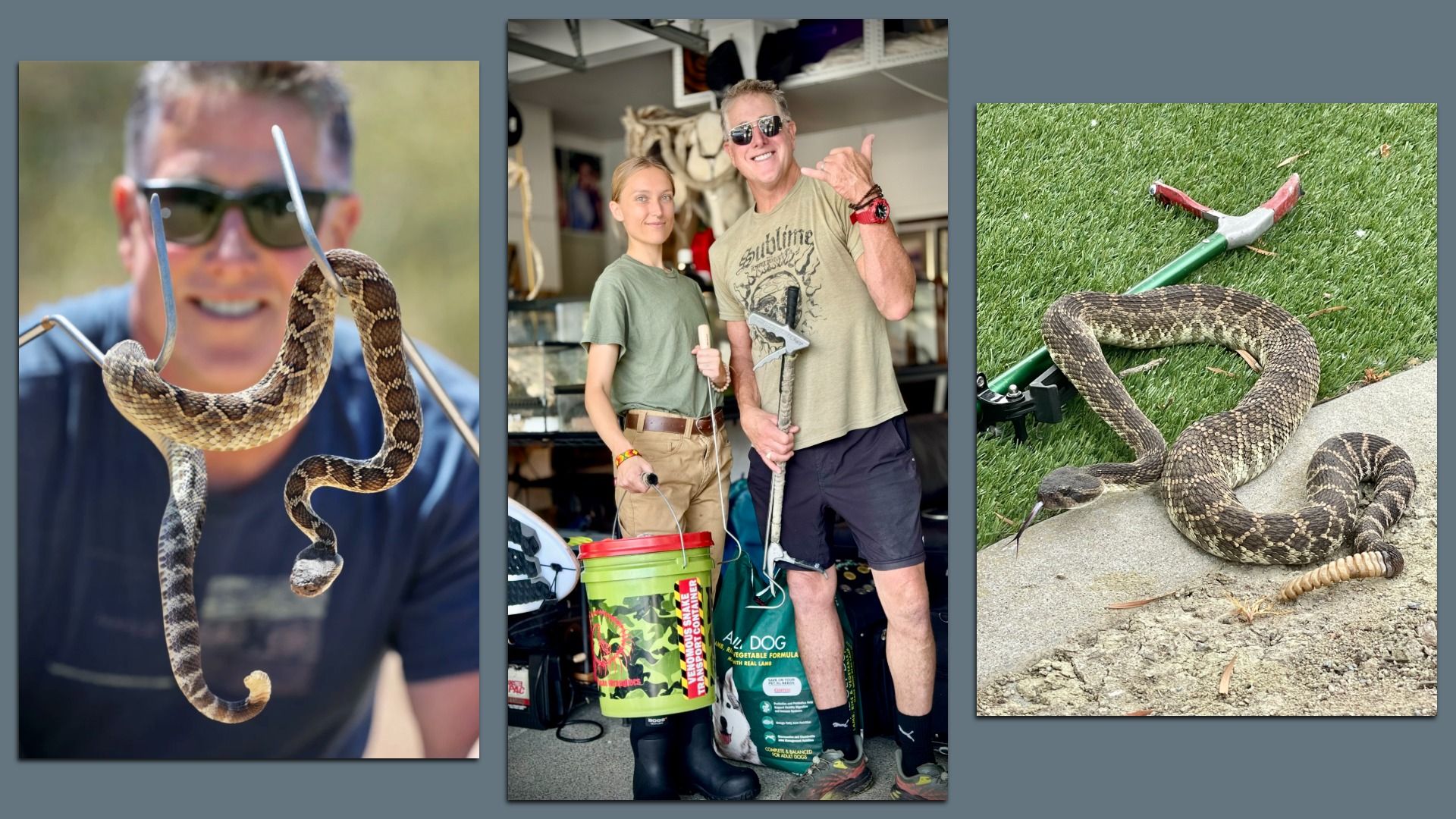
Ireland, Lauer and the snakes. Photos: Courtesy of Bruce Ireland
Snake wrangling is such a busy job around here that Bruce Ireland could only talk on his way to pick up a snake.
The big picture: Ireland runs The Snake Wranglers, a group of volunteers who come to your house and catch that intrusive snake free of charge.
- He sometimes gets more than 20 calls a day and his exploits have nabbed him more than 1 million followers across social media (though he said he kept getting banned from TikTok for doing dangerous acts).
"I joke with my wife that this is my midlife crisis, instead of a Ferrari and dating a golf cart girl," Ireland, 61, said. "The adrenaline rush is real when it's a giant rattlesnake that does not want to be caught. I get the blood rushing, and you know that's pretty fun for me."
One call came in during our interview.
- "There is a snake inside the home, the mom called, there are kids there, she's petrified, so I am driving there now," Ireland told Axios.
- Turns out it was a non-venomous coachwhip snake, but the caller was so scared that Ireland went anyway.
Flashback: Ireland has always been obsessed with snakes, and would bring home venomous copperheads and water moccasins as a kid.
- "They were the underdogs, and no one really liked them," he said.
- He learned to catch and care for snakes on his own, and then 10 years ago started The Snake Wranglers to help others.
Between the lines: If you call 911 about a rattlesnake, they'll send a fire truck and kill the snake, Ireland said.
- "So I started doing this as a knee-jerk reaction, and it grew way faster than I ever thought," he said.
Now he has a team of more than 50 trained volunteers who respond to thousands of calls a year.
How it works: Ireland takes the calls himself.
- He finds out where the person is and if they have eyes on the snake.
- "If they say 'oh, it went into the bushes, or this was yesterday, or no, but I saw it an hour ago,' the call ends, we can't," he said.
- If they can see the snake, he asks them to send a picture and then works with his team to find out who's closest.
- His volunteer shows up with tongs and a bucket to capture the snake.
That volunteer then takes the snake on a hike.
- "You have to release that animal within a certain distance from the capture site," Ireland said. "Any farther than that, and it's a death sentence to that snake. We might as well have killed it in the first place."
Follow the money: It's free because Ireland doesn't want money to stop someone from asking for help.
- He does take donations and thinks about starting an official nonprofit, but also doesn't want to be bogged down by paperwork "and all that crap."
His team doesn't get paid either, and does the work for the love of snakes.
- They heed Ireland's warnings that they could get bitten and could die.
- They have to buy the tools themselves—boots, tongs and a bucket—and go through training with live snakes.
Threat level: Volunteer Anna Lauer told Axios she joined because she loves misfit underdogs, or undersnakes, in this case.
- "We're doing this because we don't want things unnecessarily killed because they're misunderstood," she said.
- Ireland has never had a venomous bite but has had "some really close calls."
- "You can follow protocol, be safe, use the tools, and it does not ensure a biteless life," he said.
State of play: The call for help with the coachwhip snake turned out fine for all involved.
- "The kids weren't as young as I thought; she made them sound like they were little; these were teenagers," Ireland told Axios on his way home from the job. "But they were all petrified. They wouldn't even go in the kitchen to show me. All she said was, 'It's under the stove.'"
- Turns out it was a baby, about the size of a pencil, Ireland said.
- "I was like, 'Oh gosh, you guys are scared of this?' But I have to be respectful."
He picked up the snake, carried it a quarter mile away and left it in a field.