San Diego poker pro makes a living playing the odds

Add Axios as your preferred source to
see more of our stories on Google.
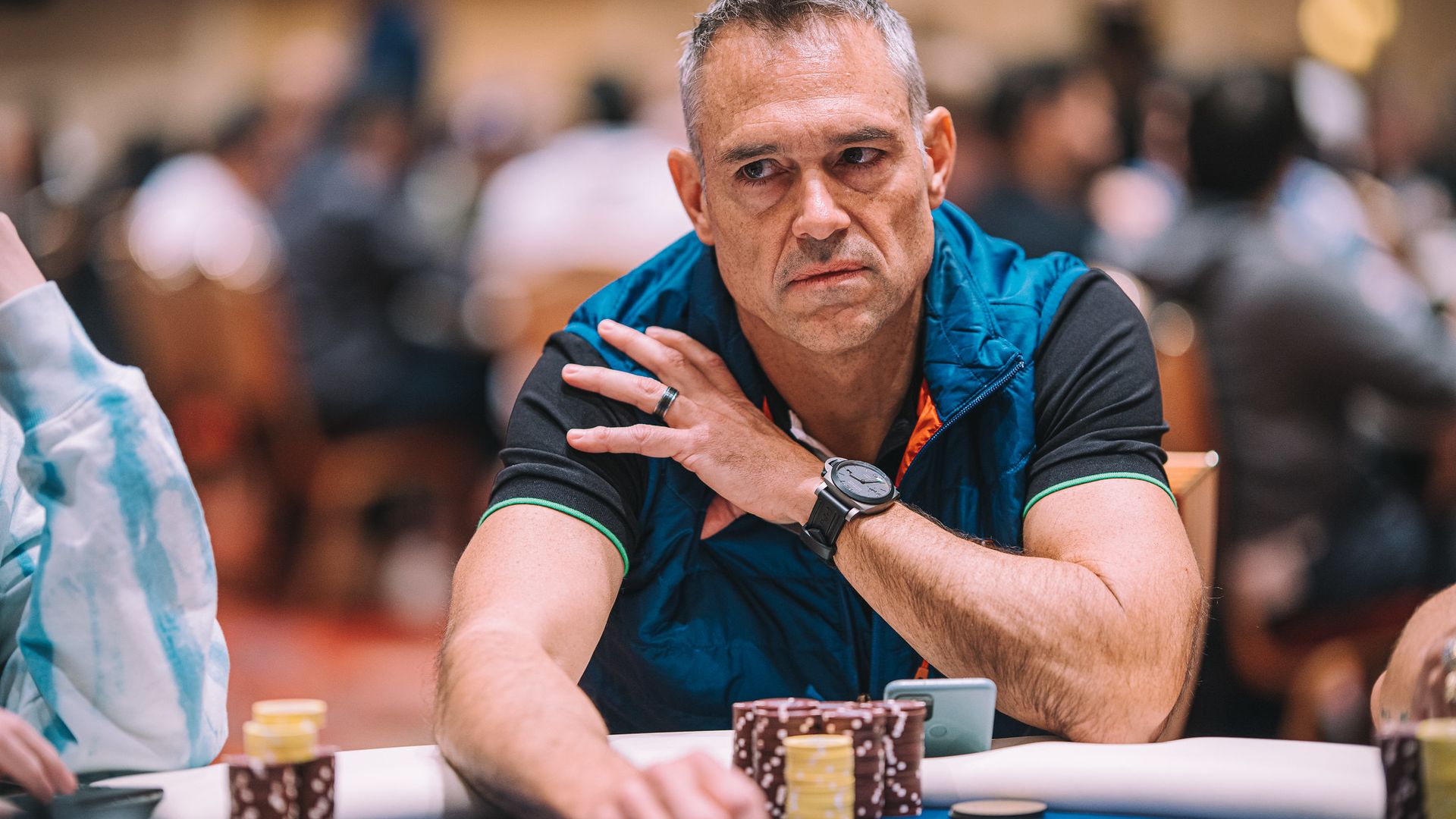
Game face. Photo: Courtesy of Tim Acker
"Professional poker player" might sound like a euphemism for someone who loses money at casinos all day, but San Diegan Tim Acker has been living that dream for the past 20 years.
The big picture: He's all in on poker, splitting his time between online games, casino tournaments and the Chula Vista card room Seven Mile, and making a living in the process.
- Acker tells Axios that he stays away from private games in San Diego, though, because they're "sketch," meaning you might get cheated or robbed.
The backstory: The 54-year-old was a math whiz in college and played a lot of poker with his frat brothers.
- He started dabbling in casino play, but would always lose.
- Then he found a book explaining the math of poker, and it suddenly clicked: It's all about odds.
After graduating in 1996, Acker had a "real job" as an engineer, but was also making money playing poker in an underground club in Denver.
- "The other guys I was playing with were almost always these ultra wealthy 'whales,'" he tells Axios.
- Whale = someone who regularly bets big and loses big, often big business owners and pro sports players, he says.
- "It was like printing money, these players were so bad," he says with a laugh.
All in: When Acker's now-wife Mette Adkisson became an ER doctor, he decided to quit his day job in 2007.
- Turns out, an ER doctor and a poker player have compatible schedules.
- They moved to Las Vegas when Adkisson was offered a job there.
State of play: Adkisson's work then brought them to San Diego, which Acker said is not so conducive to playing poker.
- California takes at least $6 out of every pot — sometimes much more in casino games — so you have to make more each hour to come out ahead.
- Private games here, in addition to being sketch, "rake really big," he says, meaning the host takes a big portion of the winnings.
He used to win a lot playing Internet poker, where he'd fit in 20 games a day.
- Then came "Black Friday," when the U.S. Department of Justice shut down online poker sites in 2011.
- Many of Acker's poker friends immediately moved to Mexico, but he shifted to live games.
Follow the money: Acker makes "in the six figures," his wife Adkisson says.
- "Some years, that's a higher six figures, never a million, we're still waiting for that," she says. "Some years, it's a lower six-figure range."
- While he sometimes made nothing when he first started, he always bought the groceries and made dinner, Adkisson says.
These days, Acker travels to Vegas, Florida, Arizona and sometimes internationally for tournaments and plays at Seven Mile.
- He likes the San Diego scene.
- "They're happy to play, they're happy to lose, they're just happy playing," he says. "You go to Vegas, and they're all kind of miserable, and they're scrutinizing you all the time, and they're trying to play perfect."
Luck of the cards: Acker's game is all based on math — what are the odds he can come out ahead on each hand.
- If the odds aren't there, he folds.
Yes, but: Sometimes it still doesn't go his way. Last summer, he played the World Series of Poker and was well ahead after the first day.
- "Then I get involved in a pot with another player, who's the second-largest stack of the table, and we built the biggest pot of the day, and we get all of our chips in," he says. "And there was one card in the deck that helped him, and with the other 45 cards in the deck, I win this massive pot."
- You can guess what happened.
- "He hits the one card that helps him, and I lose," Acker said.
But Acker said he'd do it the same next time because 96% of the time, he would win.
- It's all about the odds.