Local governments are a roadblock to California transit, report says

Add Axios as your preferred source to
see more of our stories on Google.
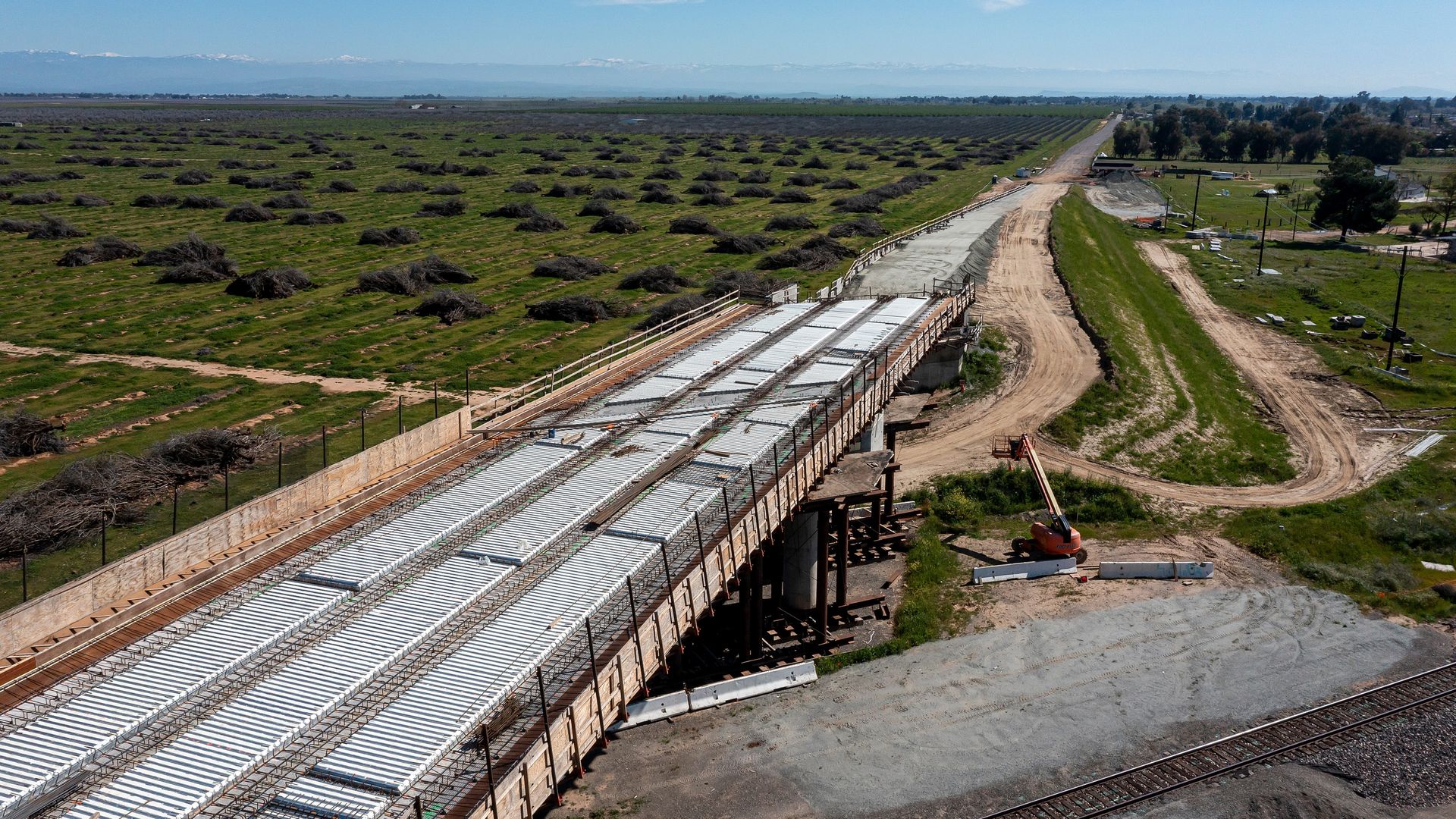
A stretch of high-speed rail in Madera County. Photo: David Paul Morris / Bloomberg via Getty Images
California governments are sometimes a major impediment to state attempts to build transit projects, according to a new report by transportation advocacy group Circulate San Diego.
Why it matters: Expanding transit systems and concentrating new housing in the dense urban areas they serve are fundamental goals of the state's plans to combat climate change.
How it works: Before transit authorities — whether local agencies like the San Diego Association of Governments or statewide entities like the California High-Speed Rail Authority — can break ground on voter-approved projects, they need approval from local governments.
- The report, "Powerless Brokers," argues that those governments can be indifferent or hostile to such projects and often use their authority to demand unrelated public benefits, delaying and increasing the costs of transit expansion.
"While transit authorities have been tasked with building transit, to a significant degree they are powerless to do so," writes Colin Parent, the report's author.
Case in point: The city of Shafter scored a variety of ancillary infrastructure benefits when it allowed state high-speed rail to expand through its city limits.
- "It provides this very expensive infrastructure for the city, earlier than when we would've been able to accomplish it by ourselves," City Manager Scott Hurlburt said in 2018 after the rail authority agreed to build local transportation projects for the city.
Local officials see their demands as a means of mitigating the effects of regional projects.
- Hurlburt said train crossings often delay emergency services and cause local congestion, which the infrastructure improvements would eliminate.
Zoom in: As a case study, Circulate examined San Diego's Mid-Coast Trolley, a $2.2 billion light rail extension from Old Town to UC San Diego completed by SANDAG in 2021 that encountered fewer hurdles than some projects in part because SANDAG has more authority than similar agencies.
- But that project's costs included $45 million for infrastructure improvements on UCSD's campus to appease the university, according to the study.
What's next: The report suggests a series of potential reforms to make it cheaper and easier for California to realize its transit ambitions.
- Transit agencies could, for instance, receive the power to grant their own permits.
- Or local governments could retain that right but be required to follow specific state standards, rather than engage in a case-by-case process that gives them leverage to make demands.
State Sen. Scott Wiener proposed a bill this year to impose deadlines for high-speed rail permit approvals, but it was opposed by dozens of utility companies, water agencies and local governments.