
IQHQ is still betting it can create a downtown San Diego life sciences hub

Add Axios as your preferred source to
see more of our stories on Google.
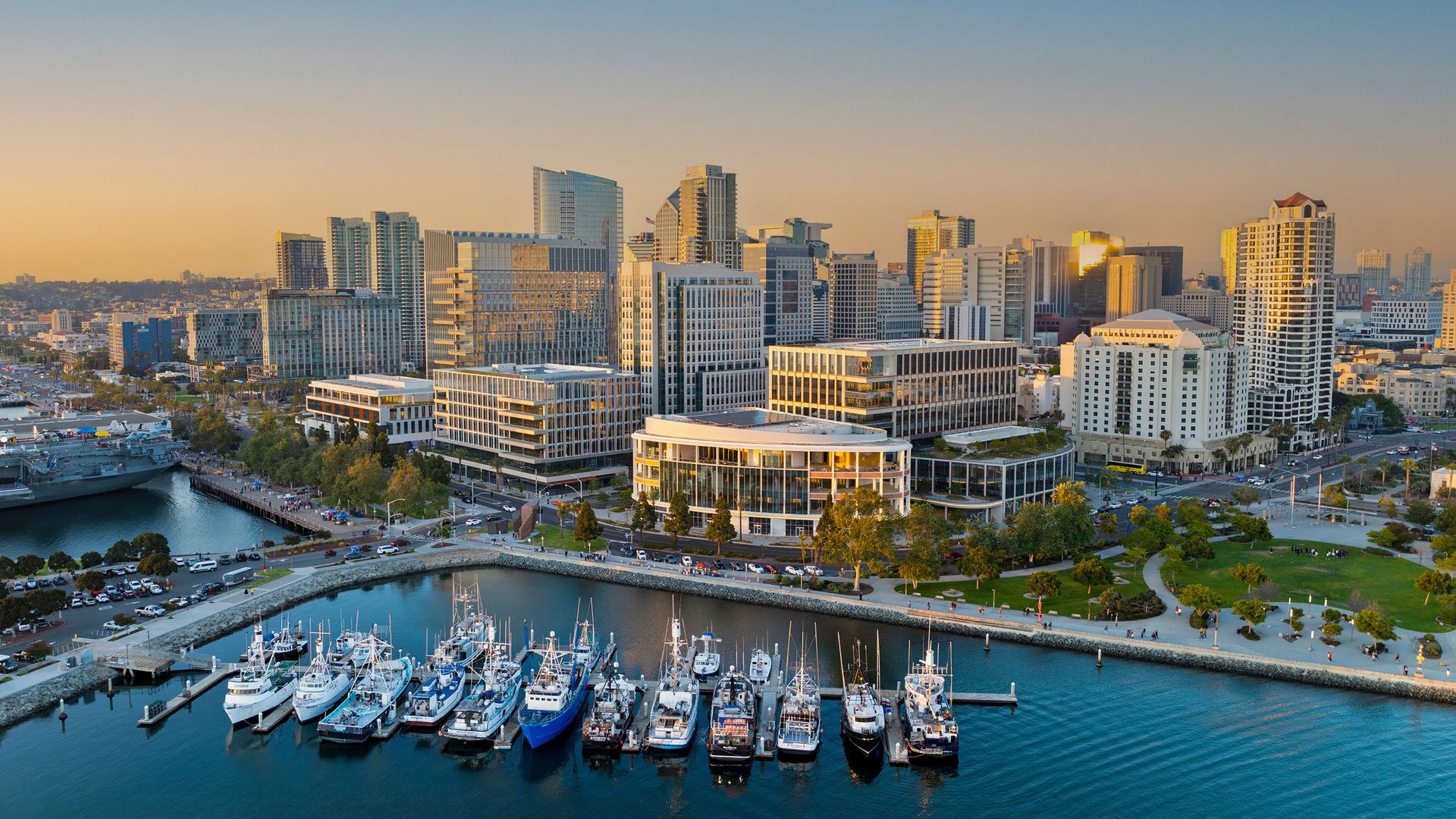
Downtown San Diego, with IQHQ's waterfront RaDD project. Photo: Courtesy IQHQ/Photo by Sudenim Visual Media
IQHQ made a big bet it could build a life sciences hub on San Diego's downtown waterfront.
Yes, but: Four years later, IQHQ still hasn't inked any research or office tenants, but executives projected optimism about the project in an interview with Axios last week.
Why it matters: The fate of IQHQ's $1.9 billion, 1.7 million-square-foot Research and Development District (RaDD) carries significant implications for one of the region's most important industries — and the future of downtown.
Driving the news: The company announced last week it raised $900 million to support real estate projects in Boston, San Francisco and San Diego, and two executives told Axios this week they're in advanced talks to land the project's first office or life sciences tenant soon.
- "We are in active dialogue with three life science users at the moment," said IQHQ co-CEO Tracy Murphy. "We also have active engagement with three office users. We're a little behind where we thought we would be at this time. … But the plan is being executed."
Catch-up quick: RaDD signed leases with high-end tenants for just over half of its 200,000 square feet of retail space last year, but the lack of interest from the life sciences industry sparked significant concern.
- Shares for the project's lender, Bank OZK, plunged in May after a Citigroup analysis downgraded the stock specifically because RaDD had "been rejected numerous times by sizable pharmaceutical companies" and had no tenants.
- "The loan is in good standing and we have a very good partnership with them, and we anticipate that to continue," said Steve Rosetta, IQHQ's other co-CEO.
What they're saying: Murphy didn't exactly say everything is going to plan, but she said securing leases with the high-end gym Equinox, a Rivian showroom, Mexican restaurant Javier's and a window treatment company make the space more attractive.
- "You need that to attract the office and life science," she said. "They're not going to come to a project where there aren't amenities. There is a critical sequence that I think people overlook when you're doing something at this scale."
Between the lines: Murphy said they still believe in the project's central premise: that it can create a downtown footprint for a life sciences industry that has thrived for decades in central county areas like Torrey Pines and Sorrento Valley.
- "If you look around the corner at the continued and expected growth of this sector, the central county will not accommodate it," she said.
- "It's our belief San Diego is in the early stages of surpassing other [life sciences markets], and so it's an around-the-corner trend, which we fully understood in the thesis when we made the investment," Murphy added.
Friction point: "It only takes one to get it going," she said. "But it's easy to criticize when you're doing something different than the 50 people behind you. Everybody wants to be the first to be second."
The other side: Commercial real estate firm CBRE estimates that there's demand for just under 1 million square feet of lab space from tenants, down from nearly 4 million square feet of demand when RaDD was under construction.
- "I think their thesis was, if we continue with this demand, we're going to be out of space," said Matt Carlson, a San Diego-based executive VP with CBRE. "But so far, the San Diego life sciences market has not said 'we need to be downtown, on the waterfront, near to the airport.'"
The bottom line: "That campus will lease," Carlson said. "It may lease as office, it may lease as life science, it may lease as high tech, it may lease as a combination. … But the market is not bearing that type of opportunity right now."
What we're watching: "In short order, we will have proof of concept beyond retail: That's life science and office," Murphy said.