Chronic absenteeism drops but still plagues local schools

Add Axios as your preferred source to
see more of our stories on Google.

Illustration: Brendan Lynch/Axios
Chronic absenteeism continues to drop in schools across San Diego County, as test scores and graduation rates don't budge much, newly released state data shows.
Why it matters: The California School Dashboard's annual performance ratings are the state's main accountability measure for school districts and charters.
- That's particularly important as students nationwide are still recovering from pandemic-era learning losses that exposed deep inequalities in public schools.
Between the lines: The data gives parents and teachers a look at how local schools are doing in academics, attendance, discipline, college preparedness and other areas.
- The dashboard also informs districts' budgets and programming to improve student outcomes.
Driving the news: About 21% of San Diego Unified students were chronically absent last school year — a nearly 6% decline from the previous year.
- That means thousands of kids missed at least 10% of the days in the school year.
- That number has been steadily dropping after a spike during the pandemic, which amplified learning losses and affected state funding.
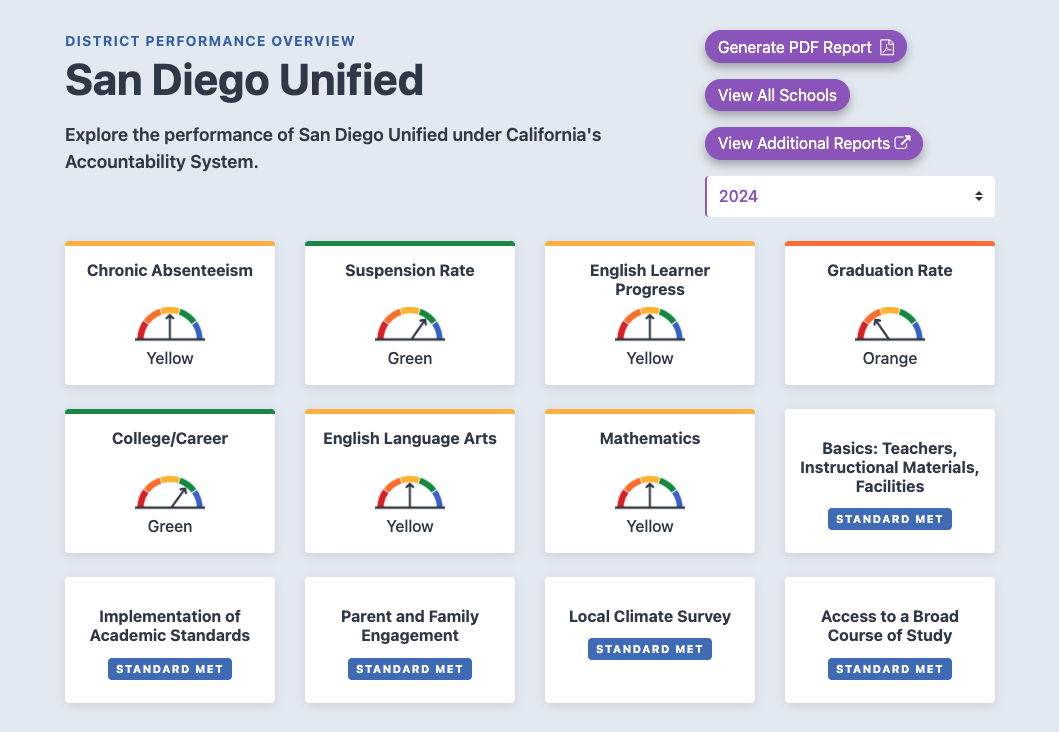
Zoom in: Across the district, English and math scores stayed about the same, and higher than statewide scores.
- About 88% of students graduated within four years, down slightly from 90% but still higher than the state average.
- San Diego Unified suspended 2.5% of students.
The big picture: The share of students who were chronically absent dropped to about 20% countywide and statewide.
- Yes, but: Local rates are still nearly twice as high as before the pandemic, as school districts fight to get kids back in classrooms.
The intrigue: Horton and Fay Elementary saw some of the highest chronic absenteeism declines as both schools have joined a countywide network focused on bringing down rates, Voice of San Diego reported.
- The data-driven strategies to make schools more engaging, improve communication with families and offer incentives to kids contributed to their progress.
Go deeper: Explore the data to track how your kids' school is performing year to year.