San Diego upward mobility among worst in nation


Add Axios as your preferred source to
see more of our stories on Google.
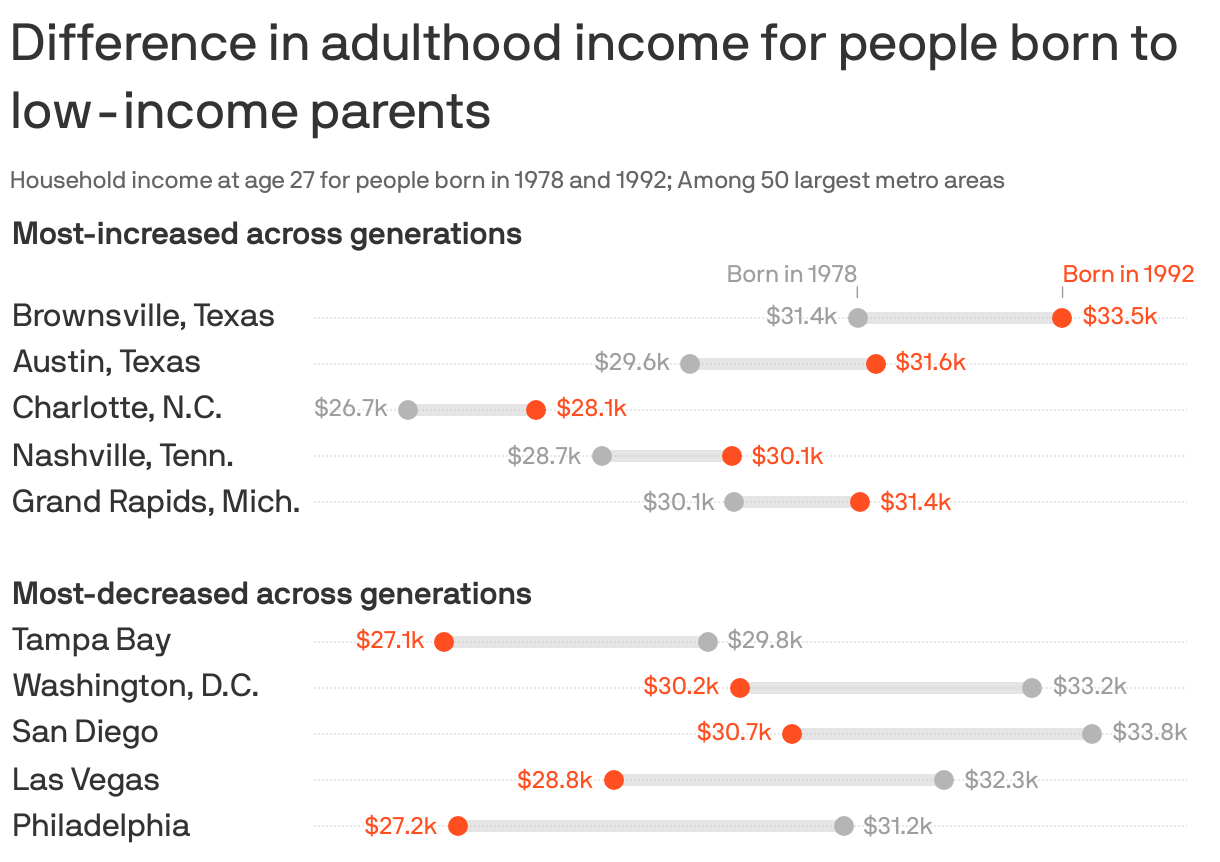
People born to low-income families in San Diego tend to be worse off than their parents, a new analysis finds.
Why it matters: Intergenerational mobility — the idea that a generation will do better than their parents, perpetually — is core to the American dream but far from assured.
Driving the news: San Diegans born to low-income families in 1992 are earning less at age 27 than others born poor in 1978 made at that age, according to an analysis by the U.S. Census Bureau and a Harvard University research group.
By the numbers: People born to low-income San Diego families in 1978 averaged $33,800 per year — adjusted for inflation — by the time they were 27.
- By 2019, when people born to low-income San Diego families in 1992 reached 27, their average earnings had dipped to $30,700 — a 9.2% decrease.
- That was the third-worst measure of intergenerational mobility among the nation's 50 largest metro areas, trailing only Philadelphia and Las Vegas.
Between the lines: By 1992, white kids born into low-income families on the coasts and in the Southwest — like in San Diego — had posted upward-mobility rates comparable to those in Appalachia and other areas that historically struggled to improve, the researchers found.
Yes, but: "Black children born in 1992 still had poorer prospects of rising up than white children in virtually every county in America, because initial Black-white disparities were so large," the researchers wrote.
Case in point: Intergenerational mobility in San Diego declined among every racial group between people born in 1978 and 1992, but some more than others.
- White children of low-income San Diego families in 1992 earned 11% less at 27 than their counterparts from 1978 — the largest decline among racial groups.
- Blacks born in '92 earned 6.8% less, Hispanics 5.8% less, Asians 4.7% less and American Indians 8.8% less.
- Children of the highest-income families in 1992 fared a bit better than those born in 1978 — driven by kids from white (1.5% higher salaries) and Asian (5.8% higher salaries) families.
Go deeper: You can explore more data about how intergenerational mobility has fared in San Diego at the Opportunity Atlas, a web tool the researchers have published.