Thousands of Pa. homes face summer without AC

Add Axios as your preferred source to
see more of our stories on Google.
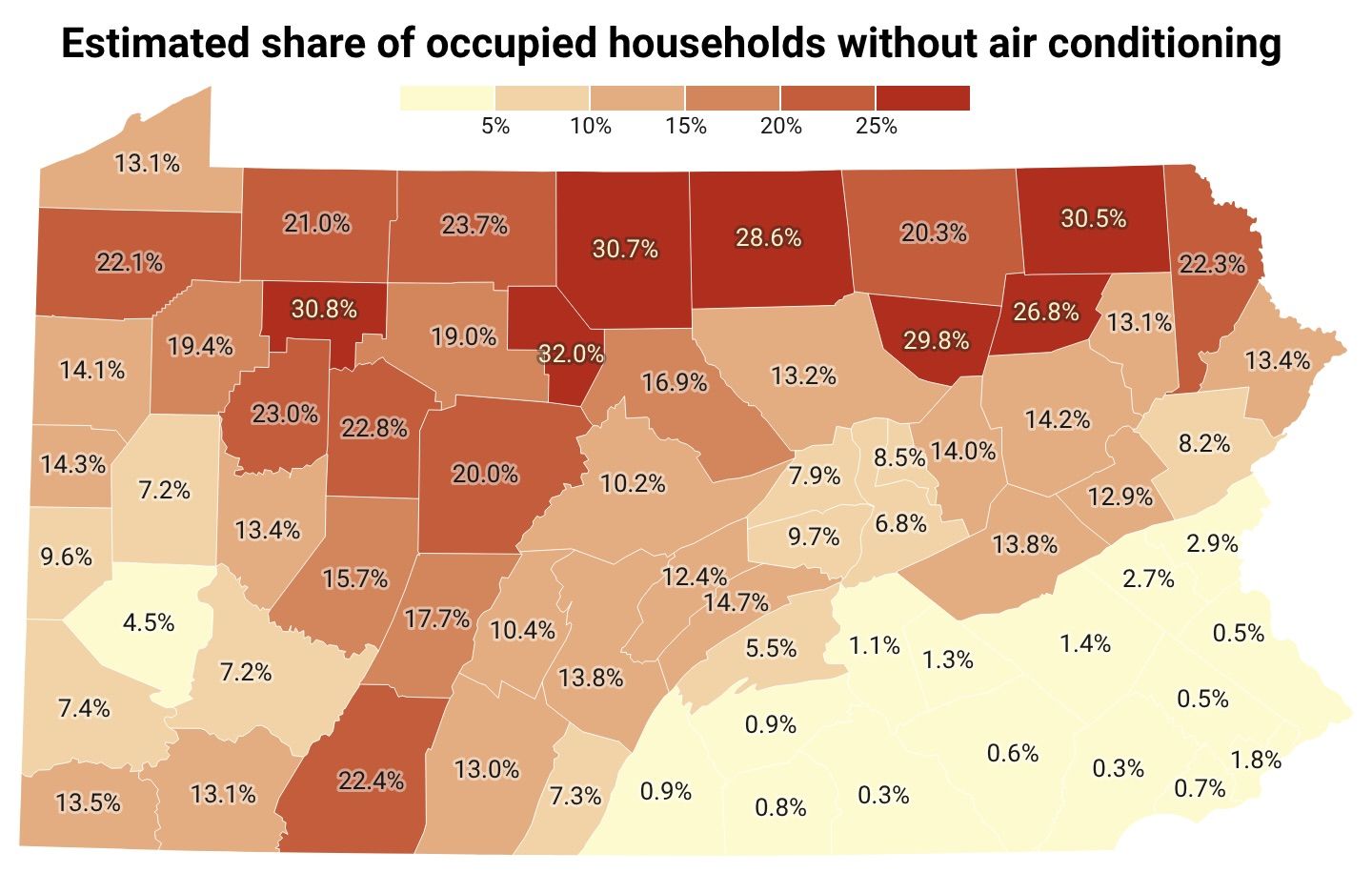
The dog days of summer are here, and an estimated 300,000 Pennsylvania households are weathering them without air conditioning, per U.S. Census figures released in May.
Why it matters: More than 94% of occupied Pennsylvania homes are equipped with some type of cooling system, but residents without access to one face greater health risks as extreme heat and poor air quality days become more frequent.
By the numbers: An estimated 5.7% of Pennsylvania households lack AC, including some 24,600 in Allegheny County.
Zoom in: Most households have some form of air conditioning throughout the Pittsburgh region, but pockets of vulnerability remain — disproportionately among lower-income residents.
- Census tract data show that parts of McKees Rocks, McKeesport and Etna stand out, with roughly 9%-12% of occupied homes lacking air conditioning.
- Residents in those communities also spend a larger share of their income on utility bills, per U.S. Department of Energy data.
Between the lines: Income and our aging housing stock help explain why some neighborhoods have lower air-conditioning rates.
- Older, poorly insulated homes can trap heat. Some residents may skip window units to avoid high electric bills.
- One recent Carnegie Mellon study revealed formerly redlined Pittsburgh neighborhoods are nearly 5 degrees hotter than the rest of the city, due to less tree cover and more dark, heat-storing surfaces like asphalt.
The big picture: Air conditioning is far less common in Pennsylvania's cooler, higher-elevation regions. In the Pennsylvania Wilds and Laurel Highlands, only 70% to 80% of households have cooling systems.
Zoom out: In Southwestern Pennsylvania, Lawrence County had the region's highest share of homes without AC (14.3%), followed by Greene (13.5%), Armstrong (13.4%) and Fayette (13.1%).
- Air conditioning is virtually universal in Philadelphia's affluent suburban counties such as Chester, Montgomery, and Bucks — where nearly 100% of occupied homes have AC.
How it works: The U.S. Census estimates AC access in each census tract by combining 2023 American Community Survey and American Housing Survey data using cross-survey modeling.
The bottom line: Use our interactive map to see how many homes in your county lack AC, then check out a few simple tips to stay cool from our friends at Axios Salt Lake City.