Allegheny County gets "F" for air quality

Add Axios as your preferred source to
see more of our stories on Google.
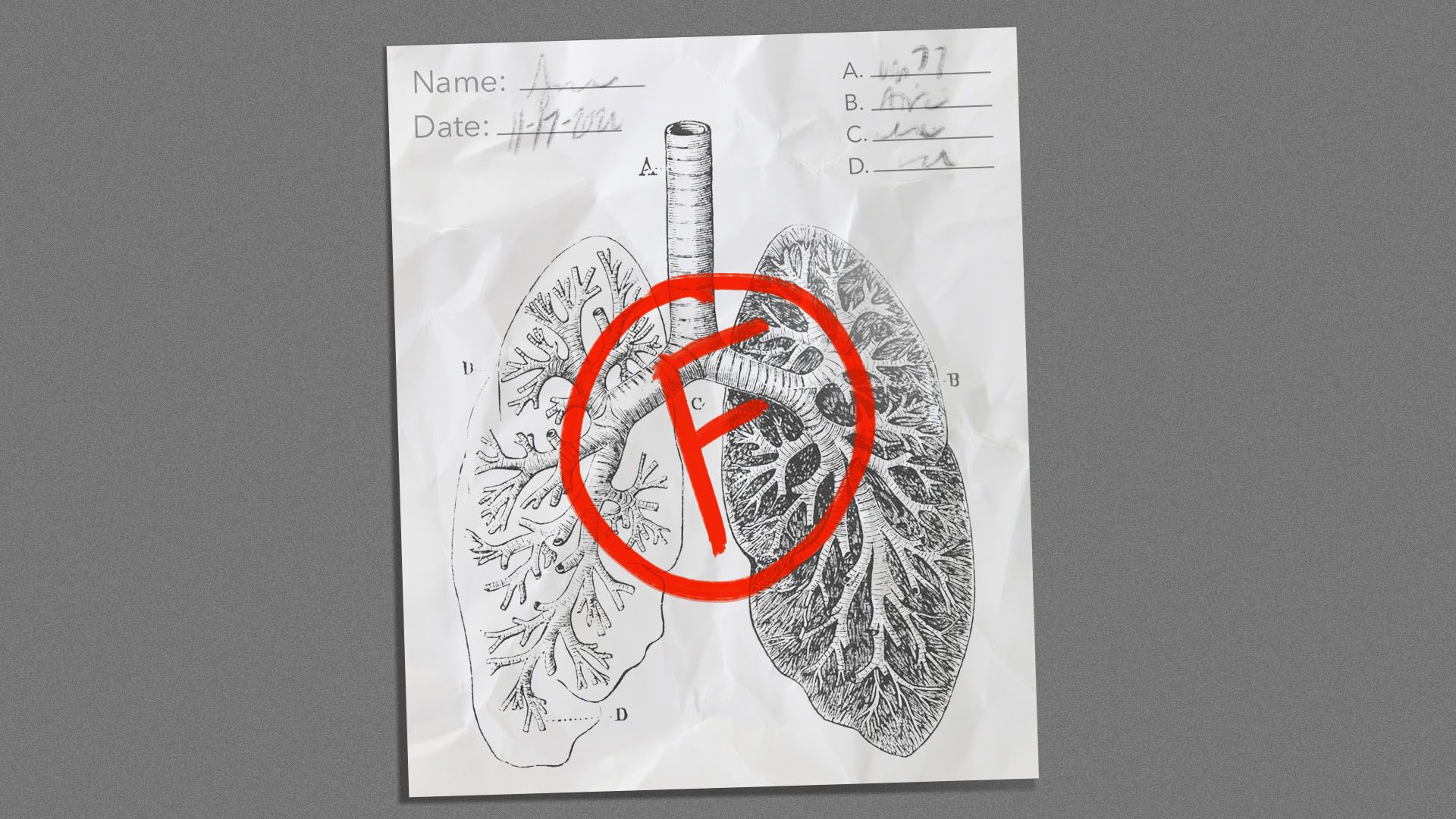
Allegheny County failed every pollution test in the American Lung Association's annual State of the Air Report yesterday.
Why it matters: The county is home to hundreds of thousands of residents who face a higher risk of pollution-related health problems.
The big picture: Roughly 44% of Americans are living in places that get failing grades for unhealthy levels of ozone or particle pollution, per the report.
How it works: Researchers use local air quality data to grade and rank locations based on high ozone days, daily particle pollution and annual particle pollution.
- Ground-level ozone, the main component of smog, forms when emissions from cars, power plants and other sources react in sunlight.
- The report notes that ozone pollution has worsened across much of the U.S., over the past two years as climate change drives extreme heat and wildfires.
- Particle pollution involves tiny airborne particles from car exhaust, wildfires, fossil fuel burning and more.
Zoom in: The Pittsburgh-Weirton-Steubenville metro area ranked No. 16 nationally for worst annual particle pollution out of 211 U.S. metros.
- It ranked No. 63 for high ozone days out of 226 metros.
Yes, but: The county's air has dramatically improved over the past two decades, per American Lung Association measures, and is vastly better than it was before the 1970 Clean Air Act.
The other side: Pittsburgh Works Together, a business-labor alliance focused on regional economic growth, criticized the ALA's annual air quality report, arguing its methodology is an oversimplification and relies on the highest readings from EPA-approved monitors.
- It has released its own air quality evaluation.
The bottom line: Check daily pollution forecasts at Airnow.gov or PurpleAir.