O'Connor outlines priorities for next year

Add Axios as your preferred source to
see more of our stories on Google.
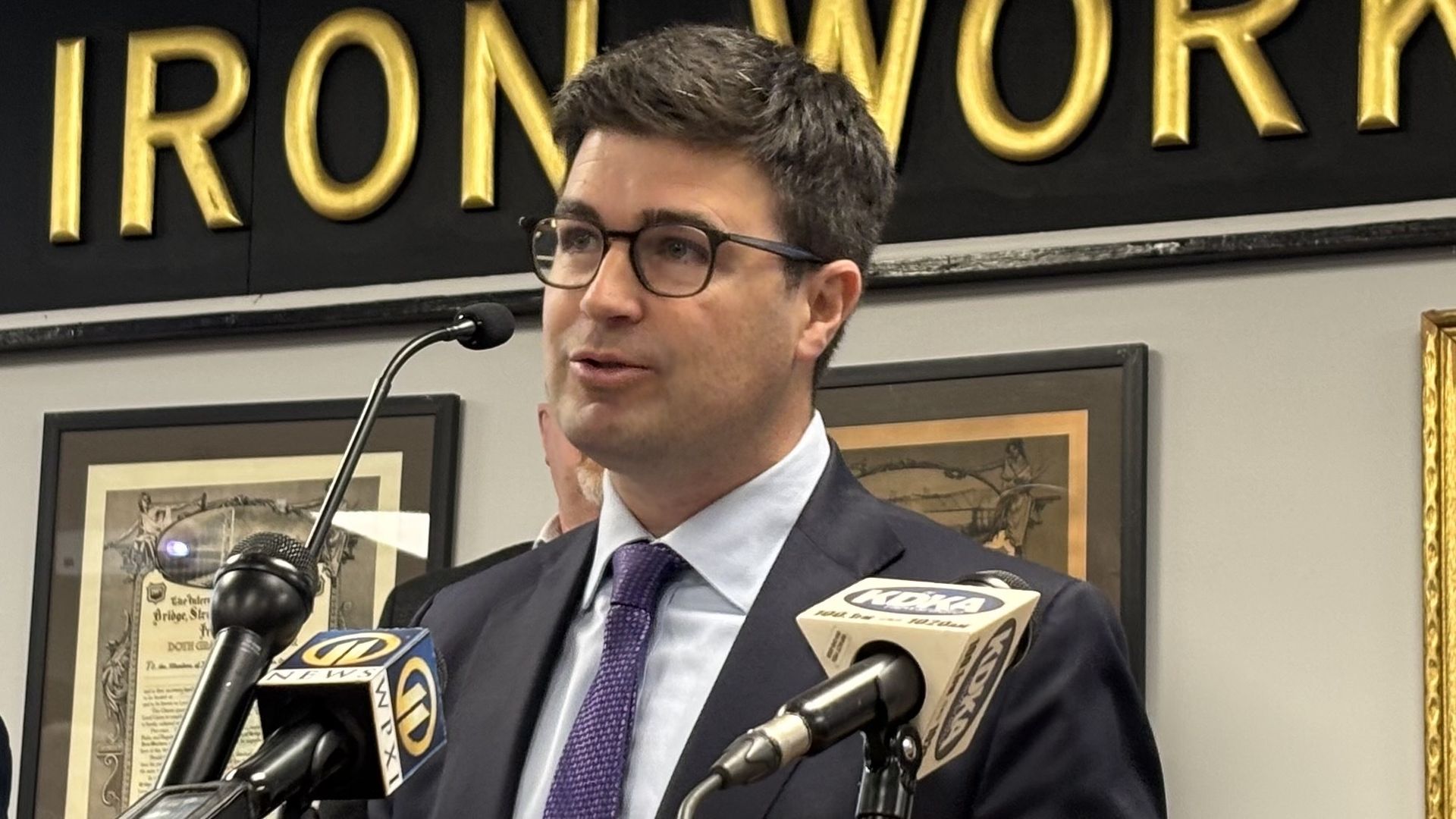
O'Connor says he will bring some new strategies to zoning, public safety and dealing with large nonprofits. Photo: Ryan Deto/Axios
Pittsburgh's likely new mayor, Corey O'Connor, will focus on the little things, he tells Axios.
Why it matters: O'Connor and Mayor Ed Gainey share many liberal priorities, but there are key differences that O'Connor says he will bring to the table, like how he will find a permanent police chief, his housing policy priorities, and how his administration interacts with the city's large nonprofits.
Driving the news: The Allegheny County controller defeated Gainey 53%-47% in Tuesday's primary. With Democrats having a 5-1 voter edge over Republicans in the city, O'Connor has a good chance of winning the general election and becoming the next Pittsburgh mayor.
State of play: As large nonprofits, UPMC and Carnegie Mellon University don't pay property taxes to municipal governments, despite occupying acres of valuable property within the city. For several years, mayors have struggled with how to get the nonprofits to contribute revenue to city coffers.
- Some, like Gainey, have sued the nonprofits, hoping the courts will force payments. Others have tried to work with them to try to secure a payment-in-lieu-of-taxes (PILOT).
- O'Connor said he wants to get a PILOT focusing on the nonprofits paying for civic goods they also need, like ambulances for hospitals and transit infrastructure for students.
- "Let's get an agreement," he said. "We need more snow plows. If we can work something with larger nonprofits, some new plow trucks fit their mission."
Zoom in: One of his biggest priorities is hiring a permanent police chief, said O'Connor. There have been five different chiefs under Gainey, and none lasted longer than 19 months under his tenure.
- O'Connor said he won't conduct a national search, calling it a waste of time. He said he will promote someone from within the ranks or is open to an outside candidate who already has experience in Pittsburgh.
Between the lines: Gainey is pursuing a citywide inclusionary zoning rule that would require large developers to build a percentage of affordable housing on their projects.
- O'Connor said he supports inclusionary zoning for certain neighborhoods, but not citywide.
- He said he wants to boost all types of housing production, and said the city should help bridge financial gaps for developers so they can take advantage of more affordable housing tax credits.
- "We will be looking at opportunities for growth. We need affordable and market-rate units."
Fun fact: O'Connor's late father, Bob O'Connor, served as Pittsburgh mayor in 2006, and, if victorious in November, Corey O'Connor would join George W. Guthrie (1906-1909) as the only other Pittsburgh mayor whose father was also mayor.
The bottom line: O'Connor said his main goal is to focus on mundane improvements that could make the city more vibrant. He said there are scores of vacant properties in Pittsburgh that should be open to alternate uses, like art galleries, community events, and for small businesses.
- "We have so much empty space that can be used."